Home/Blog/Why Capable Companies Don't Win Defence Contracts?
Defence · 30 June 2026 · Visionex Solutions
Why Capable Companies Don't Win Defence Contracts?
Most companies that lose a defence tender do not lose on price. They do not lose on capability. They lose before evaluation begins, disqualified on compliance
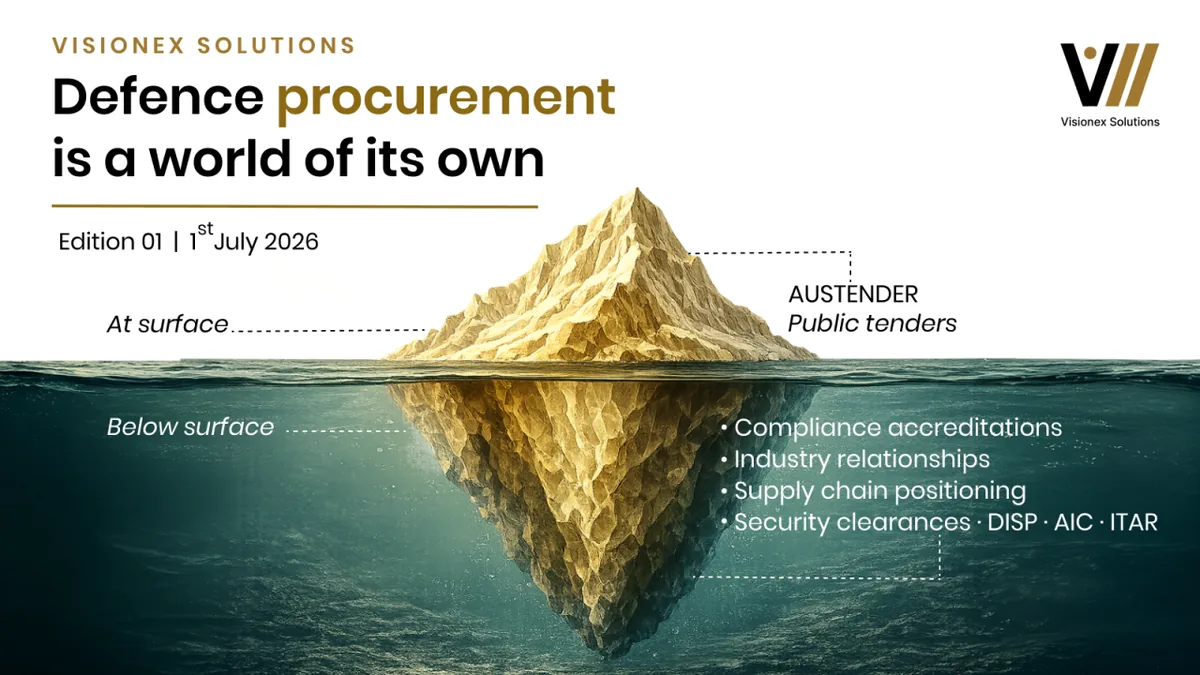
Most companies that lose a defence tender do not lose on price. They do not lose on capability. They lose before evaluation begins, disqualified on compliance conditions they did not know existed, or competing for a contract where the preferred supplier was effectively determined months before the request for tender was ever published.
That is not a flaw in the system. It is how the system is designed to work.
By the time a defence opportunity appears publicly on AusTender, the competitive landscape is already shaped. The companies best positioned to win have spent months, sometimes years, building the relationships, accreditations, and supply chain positioning that make them credible respondents. A company that starts at the moment a tender drops is not starting late. It has already missed the race.
This series exists to change that.
The market most companies are not looking at correctly
Australian defence procurement is one of the largest and most sustained purchasing programmes in the country. In December 2025, Defence Minister Richard Marles announced that the government had increased defence spending by A$70 billion over the decade, describing it as the largest increase in Australia's peacetime history. The pipeline of active acquisition and sustainment projects runs into the hundreds of billions of dollars across a decade-long horizon.
That is not a niche market. It is one of the most significant procurement exercises in Australia, running continuously, and it is growing.
The 2024 National Defence Strategy accelerated investment commitments with particular emphasis on infrastructure, logistics, and sovereign industrial base. AUKUS, the trilateral security partnership between Australia, the United Kingdom, and the United States, has added further momentum. As the Australian Strategic Policy Institute has reported, AUKUS is reshaping the development of HMAS Stirling in Western Australia to facilitate hosting of allied nuclear-powered submarines, with Darwin Harbour already validated for nuclear-powered vessel visits and active debate underway about whether full certification should follow. The infrastructure requirement that flows from that programme is significant, and it is construction work.
For construction and infrastructure companies more broadly, this represents a pipeline of genuine scale. The work is not all submarines and fighter jets. It is bases, hardened facilities, runways, fuel storage, logistics hubs, accommodation, and the supporting civil infrastructure that a modern military force requires. Companies that know how to deliver complex, compliant construction projects have directly relevant capability. Most of them are not in the market, not because they lack the skill, but because they have never fully understood the entry conditions.
Why the usual rules do not apply
A company that has successfully tendered for federal government contracts understands the Commonwealth Procurement Rules. That knowledge is real and useful. In defence procurement, it is also insufficient.
The Commonwealth Procurement Rules are the base layer, the floor every government purchase sits on. In defence, a separate and more complex framework sits above them: the Defence Procurement Policy Manual, which governs how defence-specific requirements, security obligations, and capability considerations are managed. Where the Commonwealth Procurement Rules are designed for open, competitive purchasing focused on value for money, the Defence Procurement Policy Manual reflects a system that must also account for classified requirements, restricted supplier pools, national security risk, and project lifecycles that can span a decade or more.
Depending on the nature of the work, further compliance obligations may apply. The Defence Industry Security Program (DISP) applies to contracts involving access to classified information or sensitive facilities. Australian Industry Capability (AIC) requirements specify how much of the work must be delivered by Australian industry. And for companies working with US-origin defence technology, the International Traffic in Arms Regulations (ITAR) impose a separate layer of obligation entirely. ITAR is a United States regulatory regime administered by the US Department of State, not an Australian one, but its reach is broad: it governs the export and handling of US defence articles, services, and technical data, and any Australian company in the supply chain for US-origin equipment must understand what it requires.
The critical point is that not every defence contract carries all of these requirements. Many contracts, particularly in construction, maintenance, and general services, do not require DISP membership. The obligations that apply depend on what the work actually involves. But the pattern is consistent: these compliance layers are prerequisites, not evaluation criteria. A company that does not meet them where they apply does not receive a lower score. It does not compete.
A company that discovers any of this at the RFT stage is discovering it too late.
A system built for deliberate complexity
The sophistication of Australian defence procurement is not bureaucratic accident. It is the product of decades of reform in response to real failures.
The 2003 Kinnaird Review, the 2008 Mortimer Review, and the 2015 First Principles Review each identified the same underlying problems: inadequate project management resources, inefficiencies in government approval processes, skill shortages in the acquisition workforce, and delays in bringing capability into service. The reforms that followed built the layers of structure and compliance that characterise the system today. That complexity is a feature, not a defect.
The scale of the problem it was designed to address is not abstract. When the latest structural reform was announced in December 2025, Defence Industry Minister Pat Conroy noted that 28 major projects were running a combined total of 97 years late. That figure captures, in plain terms, why procurement reform keeps returning to the same agenda.
As of 1 July 2026, this week, the institutional structure has changed again. The Capability Acquisition and Sustainment Group, which has managed defence acquisition since 2015, has been dissolved and replaced by the Defence Delivery Group (DDG). The DDG consolidates the former CASG with the Guided Weapons and Explosive Ordnance Group and the Naval Shipbuilding and Sustainment Group into a single integrated delivery organisation. The intent is clearer accountability and more streamlined programme delivery. For industry, it also means a changed set of relationships, contact points, and internal processes at precisely the moment many companies are looking to enter the market for the first time.
What this means for a company considering defence
The instinct to treat defence tendering as an extension of existing government contracting experience is understandable. It is also one of the most reliable ways to waste significant time and resources.
The companies that build sustainable defence businesses do not start at the tender. They start by understanding the system: its structure, its compliance requirements, its timeline logic, and its informal market dynamics, before an opportunity appears. They use that understanding to position correctly, build the right accreditations, and develop supply chain relationships that make them credible when a contract does open.
That is what this series is designed to help with.
Over the next ten editions, we will work through the full architecture of Australian defence procurement: who the key institutions are and how decisions are made, what the regulatory framework requires, how the capability lifecycle works, and what a company needs to have in place before it writes a single word of a tender response.
Defence procurement is not impenetrable. It is, however, a system that rewards preparation and punishes assumptions. The distinction between companies that succeed in this market and those that do not is rarely capability. It is almost always readiness.
This is Edition 01 of the Australian Defence Tender Framework series by Visionex Solutions. The series publishes every Wednesday. Series 1: Understanding the Arena runs from 1 July to 9 September 2026.
What assumption about defence procurement do you think costs companies the most? Share your view in the comments.
Between editions, follow us on LinkedIn for Australian defence industry news, facts, and market insights.
Keep reading
More from the bid team
14 October 2026 · Visionex Solutions
The Call You Should Not Make
Construction runs on relationships: a quick call to the client, a coffee with the project manager, a word on the site walk.
6 October 2026 · Visionex Solutions
How Defence Actually Evaluates
In Defence's final evaluation for the Army's new infantry fighting vehicles, then planned as a fleet of up to 450, Rheinmetall's tendered price was almost...
30 September 2026 · Visionex Solutions
The Bid You Should Not Submit
Defence's standard construction tender form asks you to declare that bidding was your own commercial decision. The question is whether you actually made one.
Have a tender on your desk?
Send it through. Within 24 hours you will have a go or no go call, a returnables check, and a clear view of where the marks are.