Home/Blog/ASDEFCON: The Rulebook Every Defence Bidder Signs Without Reading Twice
Defence · 25 August 2026 · Visionex Solutions
ASDEFCON: The Rulebook Every Defence Bidder Signs Without Reading Twice
Somewhere inside a Defence Request for Tender, a mid-sized contractor bidding for defence work for the first time can be asked to write a draft Phase Out Plan.
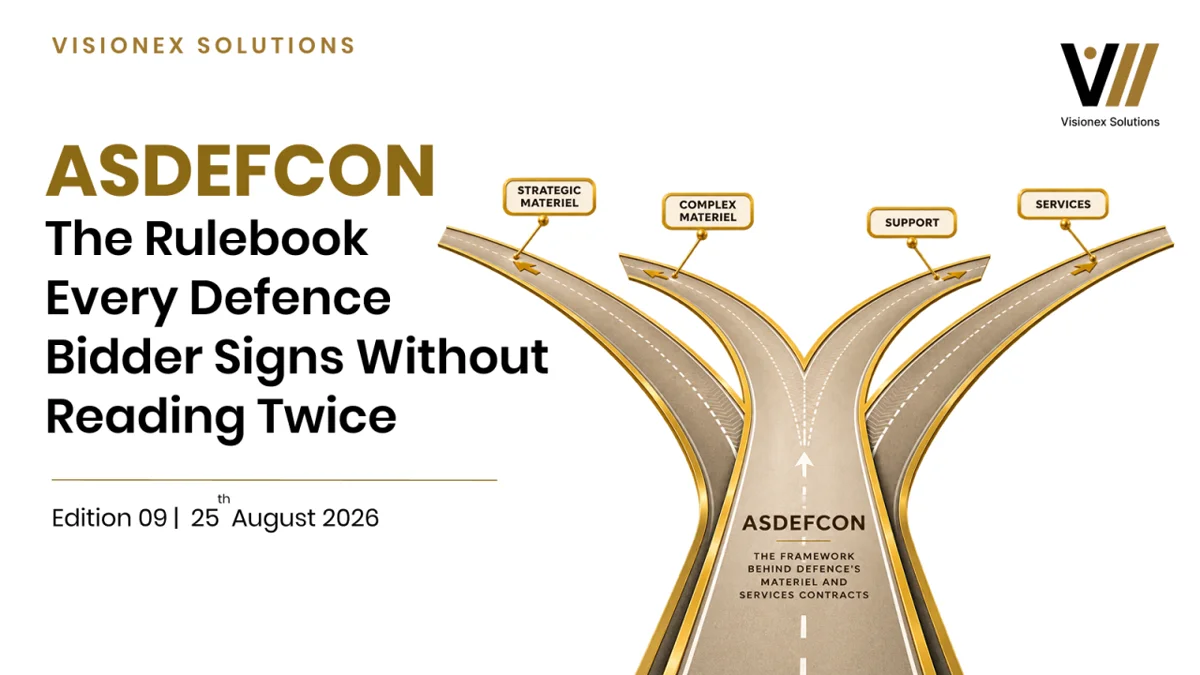
Somewhere inside a Defence Request for Tender, a mid-sized contractor bidding for defence work for the first time can be asked to write a draft Phase Out Plan, a document explaining exactly how it will exit the contract, before it has won a single dollar of the work. A US defence company bidding into Australia for the first time once described the ASDEFCON templates to a local tendering specialist as daunting, and it is easy to see why.
That is not a strange one-off. It is a symptom of something every company entering this market eventually has to reckon with. The document that shapes almost every defence tender, ASDEFCON, is not a single rulebook. It is a family of templates, each built for a different kind of work, and each carrying its own logic. Answer the wrong family's questions and no amount of good writing saves the bid.
A suite, not a single standard
ASDEFCON, the Australian Standard for Defence Contracting, is Defence's own set of proforma tendering and contracting documents, used across the acquisition of goods and services for the entire Defence enterprise. It is not optional in the way a house style guide is optional. Defence's own contracting policy instructs officials that once an ASDEFCON template exists for a type of work, that template is the one to be used, and departing from it requires proper policy sign off rather than personal preference.
The suite was first released in 2002 and has been revised continually since. A dedicated ASDEFCON and Defence Procurement Review, commissioned in 2020 and reporting in December 2021, found the templates needed to support faster, more agile procurement, and set a goal of cutting up to twelve months from acquisition timelines that can otherwise run four years or more from an identified capability gap to a signed contract. More recently, under the 2024 Defence Industry Development Strategy, Defence has begun standardising the Strategic Materiel and Complex Materiel templates around a common core of provisions, part of a deliberate effort to reduce the paperwork both sides carry. The team that manages the suite has itself just moved. Commercial Division sat inside the Capability Acquisition and Sustainment Group, which merged into the new Defence Delivery Group on 1 July 2026. Some of Defence's own contracting pages had not caught up with that change at the time of writing. The practical point for a bidder is simple. This is a living system, run by a department currently reorganising itself, and the version studied eighteen months ago may already be out of date.
Four templates, four kinds of risk
Close to twenty individual templates sit inside the suite, but four of them define the spectrum that almost every defence contractor will eventually meet.
ASDEFCON (Strategic Materiel) governs the largest, most technically demanding acquisitions: new platforms, vehicles or complex electronic systems where no off the shelf solution exists, and where extensive software development or systems of systems integration is required. These contracts carry Defence's heaviest governance and assurance requirements, because the technical risk is high and the money at stake usually runs into the billions.
ASDEFCON (Complex Materiel), most often in its Volume 2 form, sits a level down. It is built for medium risk work where the major components already exist but genuine integration effort is still required, fitting a new subsystem into an existing platform, for example. A simpler Volume 1 form covers low risk, largely off the shelf procurement further down the scale again.
ASDEFCON (Support) governs in-service support once something has already been bought: operating, engineering, maintenance, supply and training support for materiel already in the field. This is where a large share of the ongoing defence services market actually sits, long after the original acquisition contract has been signed and forgotten.
ASDEFCON (Services), and its more complex counterpart ASDEFCON (Complex Services), cover everything that is not materiel at all: consulting, ICT, garrison support, professional services. Defence scales its expectations here by value. The Services template is built for work under four million dollars, while Complex Services applies above that figure, carrying a Defence Industry Participation program that grows more extensive again once contract value passes twenty million dollars. For many of the construction-adjacent and professional services firms reading this series, this is the template family they are most likely to meet first.
Selection is a risk decision, not a formality
Defence's own Contract Template Selection and Tailoring Guide states that template selection is driven by the best fit between the template and the technical scope of the work, not by the identity of the buyer or the size of the budget attached to it. The practical reasoning that follows is straightforward. A company that assumes a bigger project always means a bigger template, or that a low value job always means a light touch contract, can be caught out in both directions. A modest support contract with a technical profile closer to Strategic Materiel can carry more governance than its dollar value suggests, and the reverse is just as true.
What this means for you
The practical task for a company preparing to enter this market is not to master every clause in the ASDEFCON suite before writing a word. It is to correctly identify, before a single line of the response is drafted, which of the four templates actually governs the opportunity in front of you, checked against Defence's own tailoring guide rather than habit or assumption. Getting this right shapes everything downstream, including how much governance and reporting the contract demands, what industry capability commitments apply, and how much of the bid budget belongs in technical assurance rather than commercial negotiation.
The companies that struggle with ASDEFCON are rarely the ones that write weak tender responses. They are the ones that answer the right questions inside the wrong template, a mistake made months before a single word of the response is drafted, and one that no amount of good writing can undo afterwards.
This is Edition 09 of the Australian Defence Tender Framework series by Visionex Solutions. The series publishes every Wednesday. Series 1: Understanding the Arena runs from 1 July to 9 September 2026.
Between editions, follow us on LinkedIn for Australian defence industry news, facts, and market insights. We have also opened The Bid Room, a free community for Australian companies working through defence tendering for the first time.
Next edition: sovereignty, local industry, and the ITAR problem, and what Australian Industry Capability requirements actually commit a builder to deliver.
Keep reading
More from the bid team
6 October 2026 · Visionex Solutions
How Defence Actually Evaluates
In Defence's final evaluation for the Army's new infantry fighting vehicles, then planned as a fleet of up to 450, Rheinmetall's tendered price was almost...
30 September 2026 · Visionex Solutions
The Bid You Should Not Submit
Defence's standard construction tender form asks you to declare that bidding was your own commercial decision. The question is whether you actually made one.
22 September 2026 · Visionex Solutions
The Gate Before the Tender
EOI, RFI, RFP and RFT. Four instruments, one procurement method, and a limit the buyer has to publish before you spend a dollar.
Have a tender on your desk?
Send it through. Within 24 hours you will have a go or no go call, a returnables check, and a clear view of where the marks are.