Home/Blog/The Word That Cost a Fortune: How Contract Language Is Quietly Deciding Who Carries the Risk
Deep Dives · 16 July 2026 · Hashan Senarathna
The Word That Cost a Fortune: How Contract Language Is Quietly Deciding Who Carries the Risk
The Intelligence Deep Dive 08 | Issue 016 | 2026 — a Hashan Senarathna deep dive.
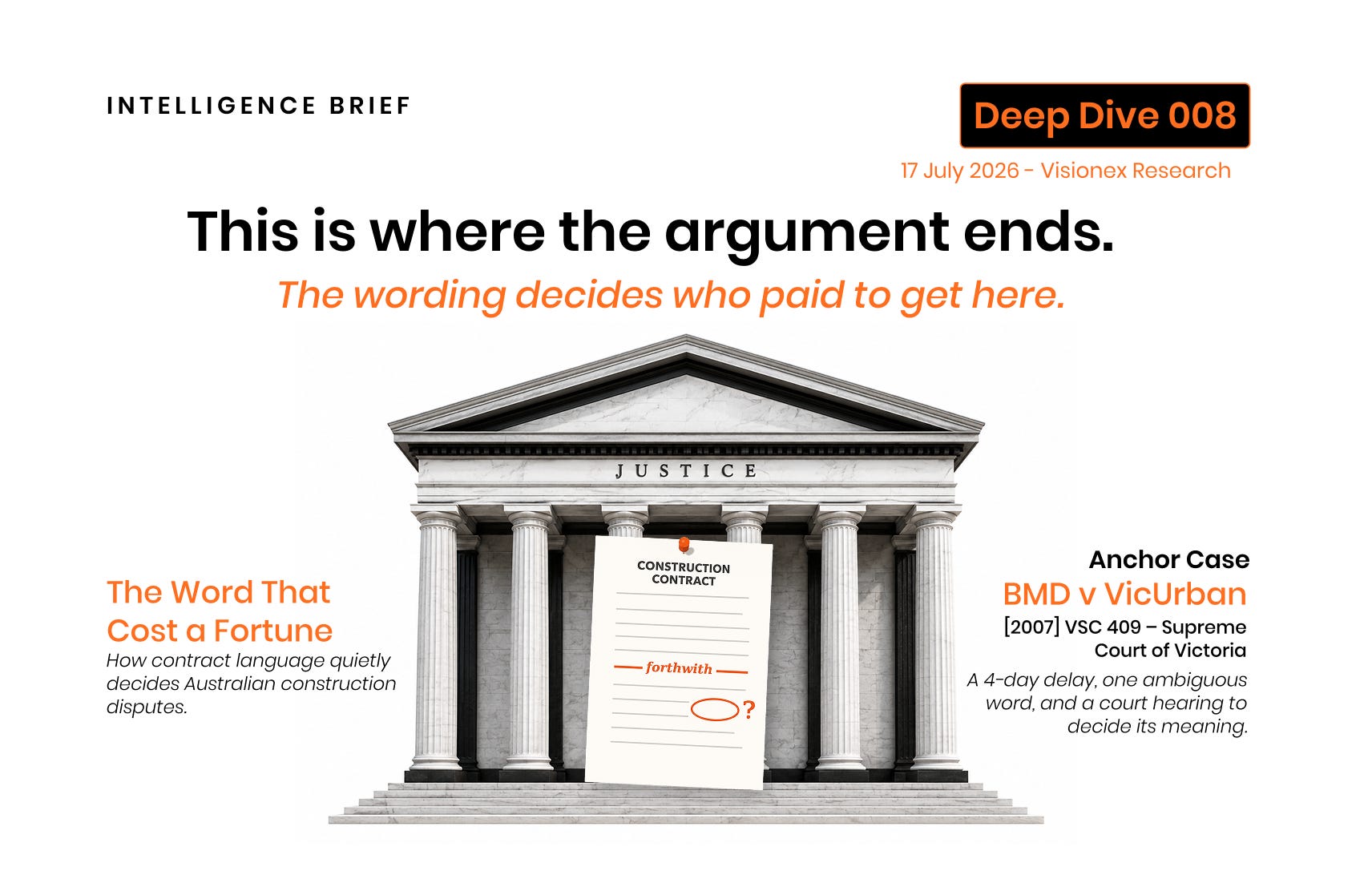
In 2007, a Victorian court spent real time and real money arguing about the meaning of one word.
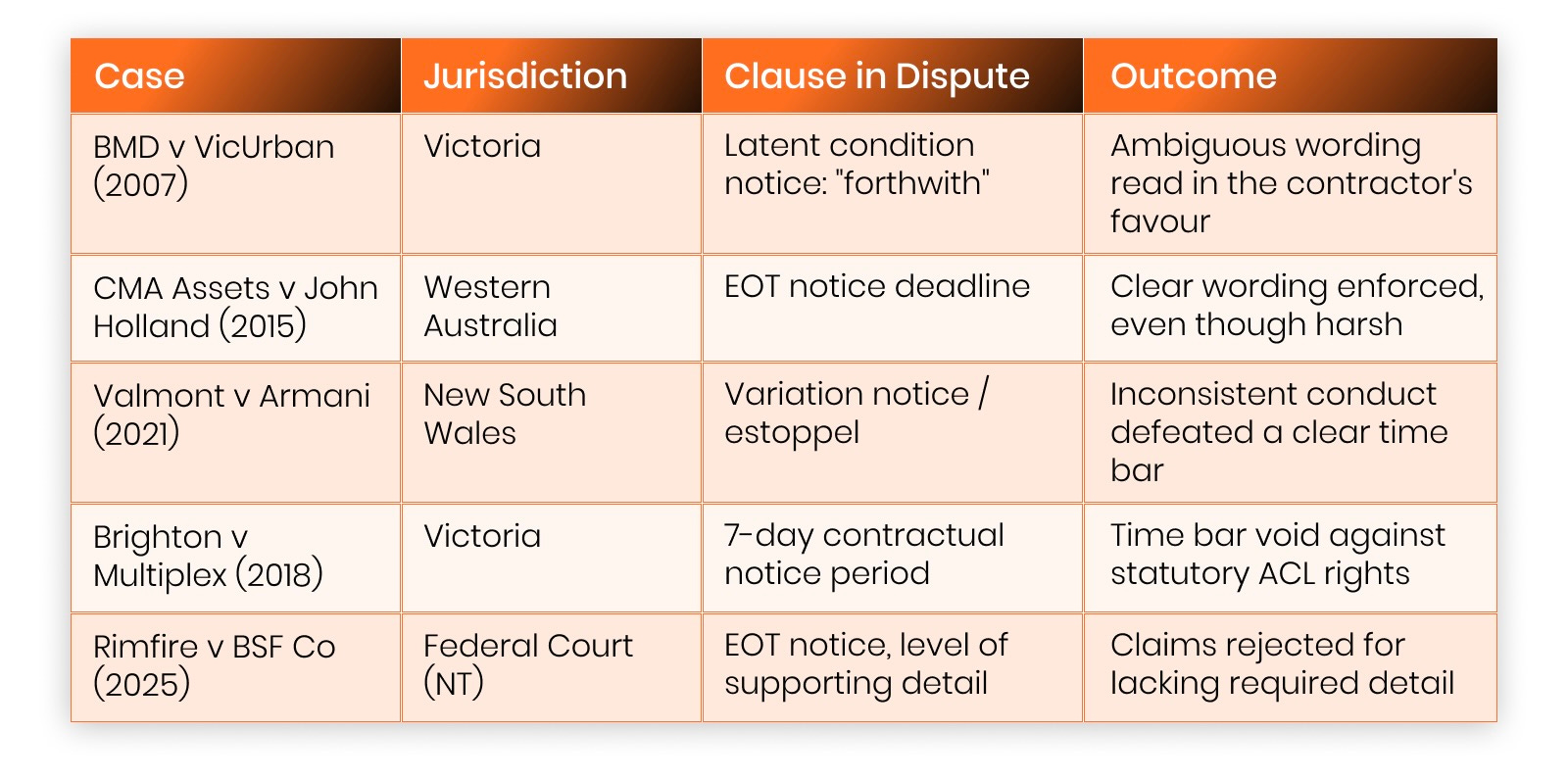
The word was “forthwith.” A contractor called BMD Major Projects was excavating a former quarry for VicUrban when it found the quarry floor sat lower than the tender documents had shown, a genuine latent condition. BMD notified VicUrban four days after discovering the problem. The contract said notice had to be given forthwith. VicUrban argued that meant immediately, and that four days was too slow. BMD argued forthwith could only sensibly mean as soon as reasonably practicable in the circumstances. The court agreed with BMD, holding that a stricter reading would simply force contractors to obsess over paperwork deadlines instead of getting on with the actual problem on site (BMD Major Projects Pty Ltd v Victorian Urban Development Authority [2007] VSC 409; upheld on appeal [2009] VSCA 221).
Nobody in that dispute was dishonest. Nobody was trying to rort the system. Two competent parties had simply signed a document that did not say, clearly enough, what it meant. And that single ambiguity became the entire dispute.
This is the story Pillar 3 opens with, because it is the story that keeps repeating across Australian construction, in different states, under different contracts, at different scales. The industry loses money not primarily because people behave badly, but because the documents governing the relationship are not written with enough precision to survive contact with a real, messy, evolving project.
This brief has already traced the structural pressure sitting underneath the industry: a pipeline the delivery system cannot fully absorb, a cost base that will not reset before 2028, a housing recovery that fractures state by state, and a delivery ceiling closing in on labour and contractor bandwidth. The pillars that follow identify which firms come out the other side of that pressure stronger, and what they do differently. Last time, this brief showed a rise-and-fall clause fail in court because it hadn’t been drafted to survive a genuine cost shock. That was one failure mode. This chapter opens Pillar 3, Contract Risk Pricing, by showing it is one of many.
1. The problem is bigger, and closer to home, than most contractors assume
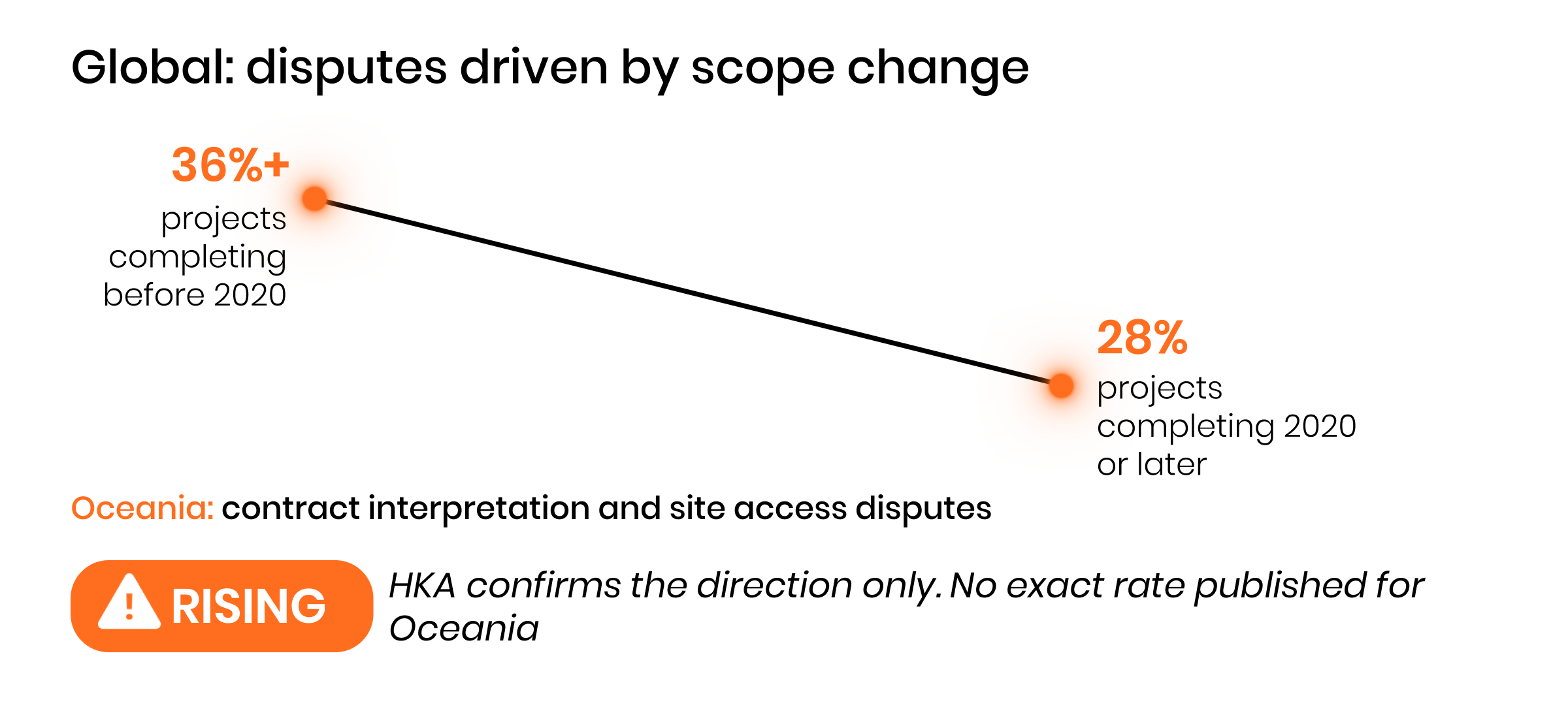
HKA, one of the world’s largest construction dispute consultancies, tracks the underlying causes of claims and disputes across more than 2,200 projects worldwide, worth a combined US$2.43 trillion. Its Eighth Annual CRUX Insight Report, released in November 2025, is genuinely good news on the surface. Sums in dispute across the global dataset now average 33.4 per cent of contract budgets, and most of the individual causes that drive disputes, scope change chief among them, have been trending down for years. On projects completing in 2020 or later, scope change affected just over 28 per cent of projects, down from more than 36 per cent on projects completing before 2020.
But one region bucked that positive trend. HKA’s own analysis singled out Oceania as the region where disagreements over site access and contract interpretation actually increased, even as the rest of the world improved. In other words, while the global industry is getting better at avoiding disputes over what a contract means, Australia and its neighbours are moving in the wrong direction.
That single finding is the reason this chapter exists. It is not a story about fraud, and it is not a story about incompetence. It is a story about the words themselves, and about an industry that has not yet worked out how to write them well enough.
The Australian Constructors Association (ACA), the peak body representing the country’s largest builders, has been making a related argument from a different angle. Its 2023 report, All Risk, No Reward, found that building sector profit margins had fallen from around 3 per cent to below 1 per cent, and that liquidity across the sector had collapsed from 15 per cent to below 5 per cent. Most strikingly, the ACA found that more than half of the country’s large builders were now carrying current liabilities in excess of current assets, which is the technical definition of insolvency. In a separate 2022 ACA survey, almost 90 per cent of contractors agreed that inappropriate risk allocation was one of the main drivers pushing construction costs higher, a finding the ACA has continued to press in its more recent advocacy.
None of that is caused by contract wording alone. But wording is the mechanism through which risk allocation actually gets enforced. A contract can say, in principle, that risk sits with whoever is best placed to manage it. Whether that principle survives contact with reality depends entirely on how precisely the clause is drafted, and Australian courts keep finding that the precision is not there.
2. Why the ambiguity keeps showing up
It would be easy to assume this is a problem of laziness, that firms simply grab a standard-form contract off the shelf and sign it without reading it closely. The evidence says the opposite. A landmark University of Melbourne Law School study of the Australian construction industry found that 84 per cent of standard-form contracts get amended before they are signed. Far from ignoring the fine print, industry participants are actively rewriting it.
The problem is what they choose to rewrite, and what they leave alone. The same study found that extension-of-time (EOT) clauses, the provisions that decide how much extra time a contractor gets when something delays the job, are the single most heavily amended clause type, changed in 76 per cent of contracts reviewed. And yet EOT disputes remain among the most common and expensive disputes in the industry. The clause everybody agrees is important, and everybody is willing to rewrite, is still the clause causing the most trouble.
Standards Australia effectively admitted as much this year. In June 2025, it released AS4000:2025, the first major overhaul of one of the country’s most widely used construction contracts in 28 years. Among the changes: archaic words like “forthwith” and “thereon”, the very kind of language that sat at the centre of the BMD dispute, were removed and replaced with plainer modern English. When the body responsible for one of the industry’s benchmark contracts spends nearly three decades using a word, then rewrites it out entirely, that is a quiet but unambiguous admission that the word was a problem the whole time.
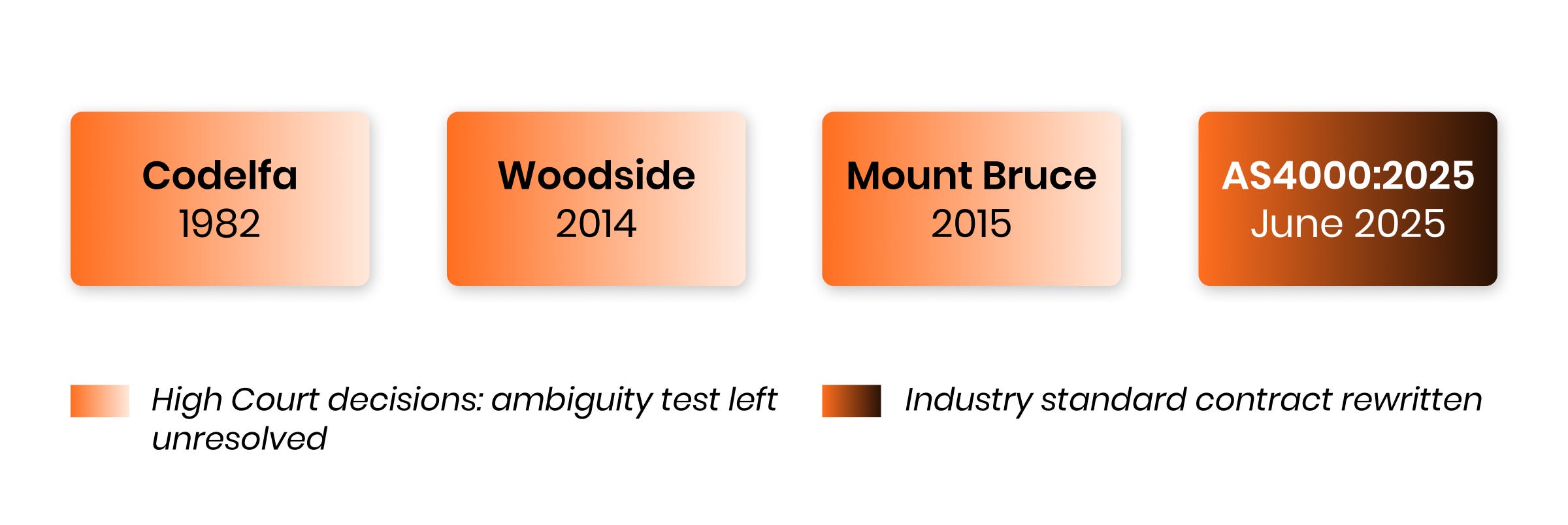
There is also a genuinely surprising legal wrinkle sitting underneath all of this, one most contractors have never heard of. Australian courts themselves cannot agree on the basic test for identifying when a contract clause is ambiguous in the first place. The High Court’s 1982 decision in Codelfa Construction v State Rail Authority of NSW established that courts can only look outside the written words, at emails, conduct, and surrounding circumstances, once ambiguity has already been found. Its 2014 decision in Electricity Generation Corporation v Woodside Energy seemed to soften that rule without saying so directly, and its 2015 decision in Mount Bruce Mining v Wright Prospecting had the chance to settle the confusion once and for all and deliberately chose not to. Legal commentators still describe this as unresolved. If judges cannot agree on the test for ambiguity, it should not be surprising that commercial parties keep drafting into it by accident.
3. What ambiguity actually costs, in real disputes
The BMD case is not an isolated curiosity. Four other Australian cases, spread across different states and different years, show the same pattern playing out with real money attached.
In Western Australia, CMA Assets was subcontracted by John Holland to demolish part of a wharf at Finucane Island (CMA Assets Pty Ltd v John Holland Pty Ltd [No 6] [2015] WASC 217). Delays occurred, some of them squarely John Holland’s fault, but CMA missed the strict notice deadlines its subcontract required for claiming an EOT. The court’s finding was blunt: the clause was clear and unambiguous, so it would be enforced, even though the outcome was harsh. This is the flip side of the BMD lesson. Ambiguous language can cost a principal the argument. Clear language, even harsh language, will be enforced against a contractor exactly as written. Either way, the words decide the outcome.
In Sydney, Valmont Interiors was fitting out a new Emporio Armani store at the airport when Armani asked it, informally, to supply joinery a third-party supplier could no longer deliver in time (Valmont Interiors Pty Ltd v Giorgio Armani Australia Pty Ltd (No 2)[2021] NSWCA 93). Valmont did the work without lodging the formal variation notice its contract required. When Armani later refused to pay, the Court of Appeal found that Armani’s own inconsistent conduct, approving other variations informally in the past, then denying this one existed, had not been communicated clearly enough to remove Valmont’s reasonable assumption that it would be paid. The written clause was perfectly clear. What was ambiguous was the conduct surrounding it, and that ambiguity was enough to defeat a time bar that, on paper, should have worked.
In Melbourne, Brighton Australia was a plastering subcontractor on Multiplex’s NAB Docklands project (Brighton Australia Pty Ltd v Multiplex Constructions Pty Ltd [2018] VSC 246). When Brighton later argued it had been misled about the construction program during tender, Multiplex tried to rely on a seven-day contractual notice period to shut the claim down entirely. The Supreme Court of Victoria held that a time bar this short could not override the six-year limitation period the Australian Consumer Law (ACL) guarantees for misleading conduct claims, because doing so would be contrary to public policy. A clause that looked airtight on the page was not airtight in practice, because it collided with a statutory right the drafters hadn’t accounted for.
And in 2025, the Federal Court dealt with almost the identical issue in an entirely different sector. In Rimfire Energy Pty Ltd v BSF Co Pty Ltd (No 2) [2025] FCA 384, two energy project developers, BSF Co and HCPS Co, had contracted to supply electricity to Rimfire Energy from a solar farm and a gas-fired power station respectively, both in the Northern Territory. Both submitted EOT claims worth a combined 865 days across the life of both projects. The court rejected the claims outright, not because the delays weren’t real, but because the notices failed to include the level of supporting detail the contracts specifically required. Even in a power purchase agreement, a different commercial world entirely, the same underlying failure shows up: a notice clause exists, someone assumes good faith and general awareness will be enough, and the words in the contract disagree.
Four different jurisdictions, four different sectors, one recurring shape. It is never that the contract said nothing about the issue. It is that what it said wasn’t precise enough, or wasn’t followed precisely enough, to survive a dispute.
4. The gap sitting inside project teams
Court cases show what happens when ambiguity finally reaches a judge. A less visible but arguably more important body of research asks a different question: why does the ambiguity survive all the way to the point of dispute in the first place, instead of being caught earlier?
A peer-reviewed study published in the American Society of Civil Engineers’ Journal of Legal Affairs and Dispute Resolution in Engineering and Construction interviewed construction professionals across Australia and found a measurable gap between the legal knowledge project teams actually have and the legal knowledge their contracts demand of them. The gap was most concentrated in exactly the two areas this chapter keeps returning to: change management and time management, the variation clauses and EOT clauses that also happen to be the most heavily amended and most heavily litigated provisions in the industry.
Put plainly, the people signing off on variations and assessing delay claims on-site are often not the people equipped to spot when a clause’s wording is doing something legally different from what everyone assumes it does. That is not a criticism of those individuals. Reading a construction program and reading a notice clause for its precise legal effect are two entirely different skills, and most project teams are resourced for the first, not the second.
This matters commercially because it explains why the problem persists even as awareness of it grows. Firms know EOT clauses are contentious. They amend them 76 per cent of the time, as the Melbourne study showed. But amending a clause and correctly closing its ambiguity gaps are not the same exercise, and the second one requires a kind of legal literacy that construction management, as a discipline, has not traditionally built into its training.
5. What is starting to change
The first practical response to this problem is not new. It is simply better legal review, earlier, more consistently. But a genuinely new tool is emerging alongside it: software that reads a contract before it is signed and flags the clauses most likely to cause a dispute later.
Early academic results are promising, with a caveat worth taking seriously. A 2025 study using natural language processing (NLP) models trained specifically on construction contract templates achieved around 89 per cent accuracy identifying risk and responsibility clauses. That sounds decisive, but it is worth comparing against a separate benchmark released the same year, which tested nineteen general-purpose AI language models against a standard legal contract dataset and found the best of them scored closer to 64 to 68 per cent on the same kind of task. The gap between those two numbers is the gap between a tool built specifically for construction contracts and a general chatbot asked to do the same job. It is not yet a solved problem, and the two studies are not directly comparable exercises, but the direction of travel is clear. Purpose-built contract review tools are getting genuinely useful, faster than most firms have noticed.
For now, the realistic use case is not replacing legal review but making it earlier and cheaper to trigger. A tool that can flag, before signing, that an EOT clause uses undefined causation language, or that a notice provision has a time bar without a corresponding fallback for genuine hardship, gives a commercial team the chance to ask a lawyer a specific, targeted question rather than hoping nothing goes wrong three years into the project.
Capital View
For the firms funding, insuring or acquiring exposure to construction projects, contract ambiguity is a form of margin transfer that never appears on a balance sheet until it is too late to price.
When a clause is genuinely unclear, risk does not disappear, it simply sits unpriced until a dispute forces someone to absorb it. The BMD case cost VicUrban an argument it thought it had already won. The CMA Assets case cost a subcontractor a legitimate claim it had every factual right to. In both cases, the money moved not because of a negotiated allocation of risk, but because of a court’s reading of a sentence. That is a genuinely different category of risk from the ones capital typically underwrites, and it is one that does not show up in a feasibility model, a cost plan, or a credit assessment.
The arbitrage available here is straightforward and currently underused. Firms that build genuine contract review capability, whether through senior legal resource, structured internal review processes, or the emerging clause-scanning tools discussed above, are effectively buying certainty other firms are leaving to chance. In an industry where margins have compressed as far as the ACA’s own data shows, the cost of that certainty is small next to the cost of a single dispute that runs the distance.
This chapter opens Pillar 3, Contract Risk Pricing. The next chapter in the pillar, DD13, turns from how contracts are written to how they are insured, with a look at the insurance crisis quietly pulling capacity out of Australian construction.
[Coming in Deep Dive 13: The insurance crisis pulling capacity out of Australian construction. Publishing September 2026.]
See you next week.
Note: This article is general market commentary and does not constitute financial, legal or investment advice. All monetary figures are in Australian dollars (AUD).
Keep reading
More from the bid team
14 October 2026 · Visionex Solutions
The Call You Should Not Make
Construction runs on relationships: a quick call to the client, a coffee with the project manager, a word on the site walk.
6 October 2026 · Visionex Solutions
How Defence Actually Evaluates
In Defence's final evaluation for the Army's new infantry fighting vehicles, then planned as a fleet of up to 450, Rheinmetall's tendered price was almost...
30 September 2026 · Visionex Solutions
The Bid You Should Not Submit
Defence's standard construction tender form asks you to declare that bidding was your own commercial decision. The question is whether you actually made one.
Have a tender on your desk?
Send it through. Within 24 hours you will have a go or no go call, a returnables check, and a clear view of where the marks are.