Home/Blog/The Subcontractor Squeeze: Where the Insolvency Cascade Actually Starts
Deep Dives · 4 June 2026 · Hashan Senarathna
The Subcontractor Squeeze: Where the Insolvency Cascade Actually Starts
The Intelligence Deep Dive 05 | Issue 010 | 2026 — a Hashan Senarathna deep dive.
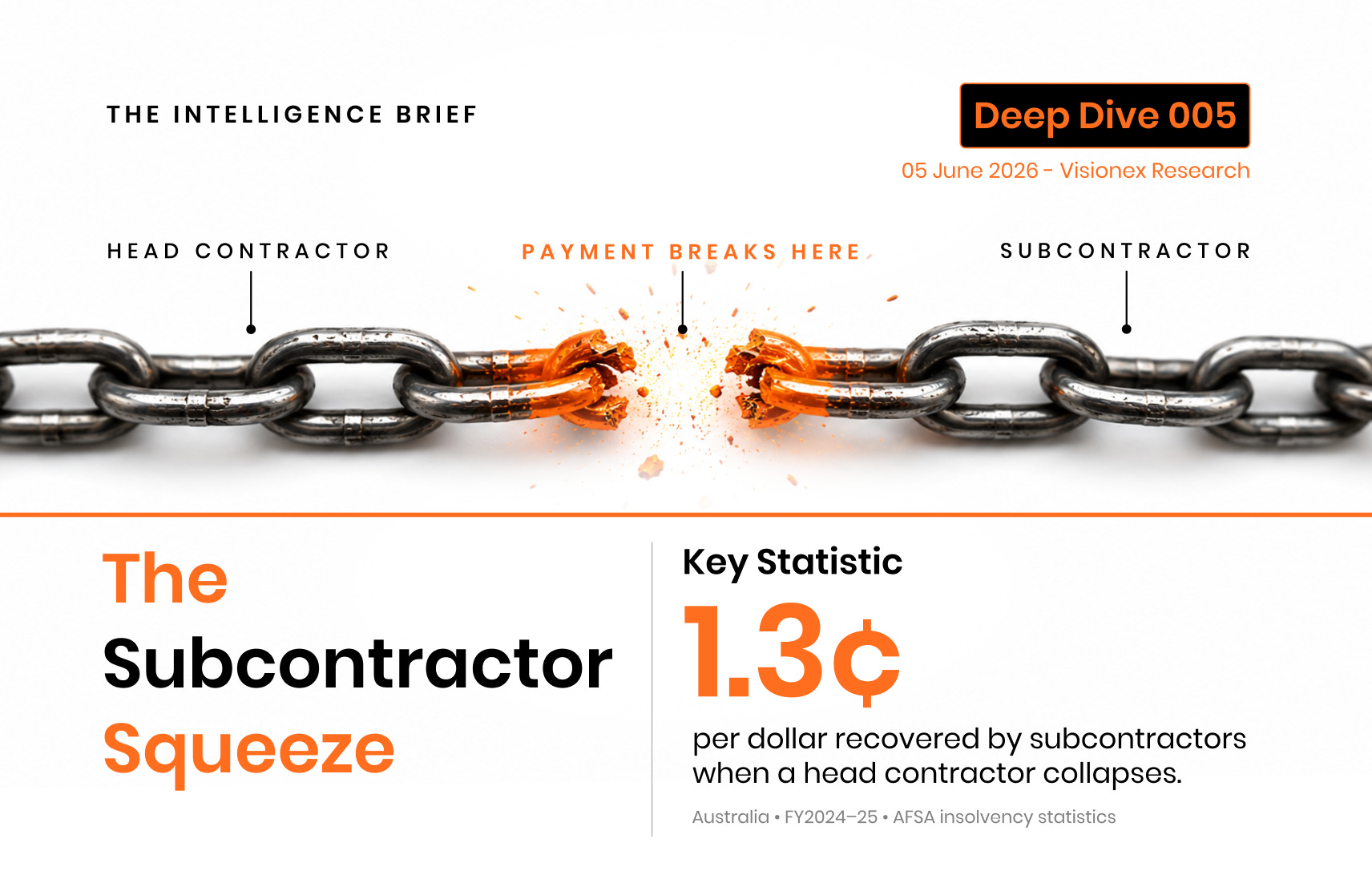
When a head contractor collapses in Australia, the subcontractors who built the project recover an average of 1.3 cents for every dollar they are owed. Not 13 cents. 1.3 cents. That number is the subject of this chapter.
Over the past two months, the Deep Dive series has set out the structural pressure on Australian construction: a $350 billion pipeline the system cannot fully deliver, a cost base that won’t reset before 2028, a housing federation fracturing along state lines, and a delivery ceiling approaching across labour, contractors, and procurement bandwidth.
That diagnosis is complete. The question this series has not yet answered is the commercially decisive one: under that pressure, which firms come out of 2027 materially stronger, and what specifically do they do differently?
The remaining Deep Dives in this series answer that question. This chapter profiles Financial Discipline, beginning with the part of the insolvency story the industry systematically misreads.
1. The Number Nobody Talks About
Every major construction collapse of the past four years has a name. Probuild. Porter Davis. Clough. Roberts Co. The names matter because the scale of those failures is real. Probuild carried approximately $5 billion in projects when it entered voluntary administration in February 2022. Porter Davis left 1,700 homes without a builder when it went into liquidation in March 2023. Roberts Co’s Victorian arm collapsed in March 2025, abandoning eight major projects including Australia’s largest Amazon warehouse.
These are the stories the industry tells itself about insolvency. They are not the insolvency story.
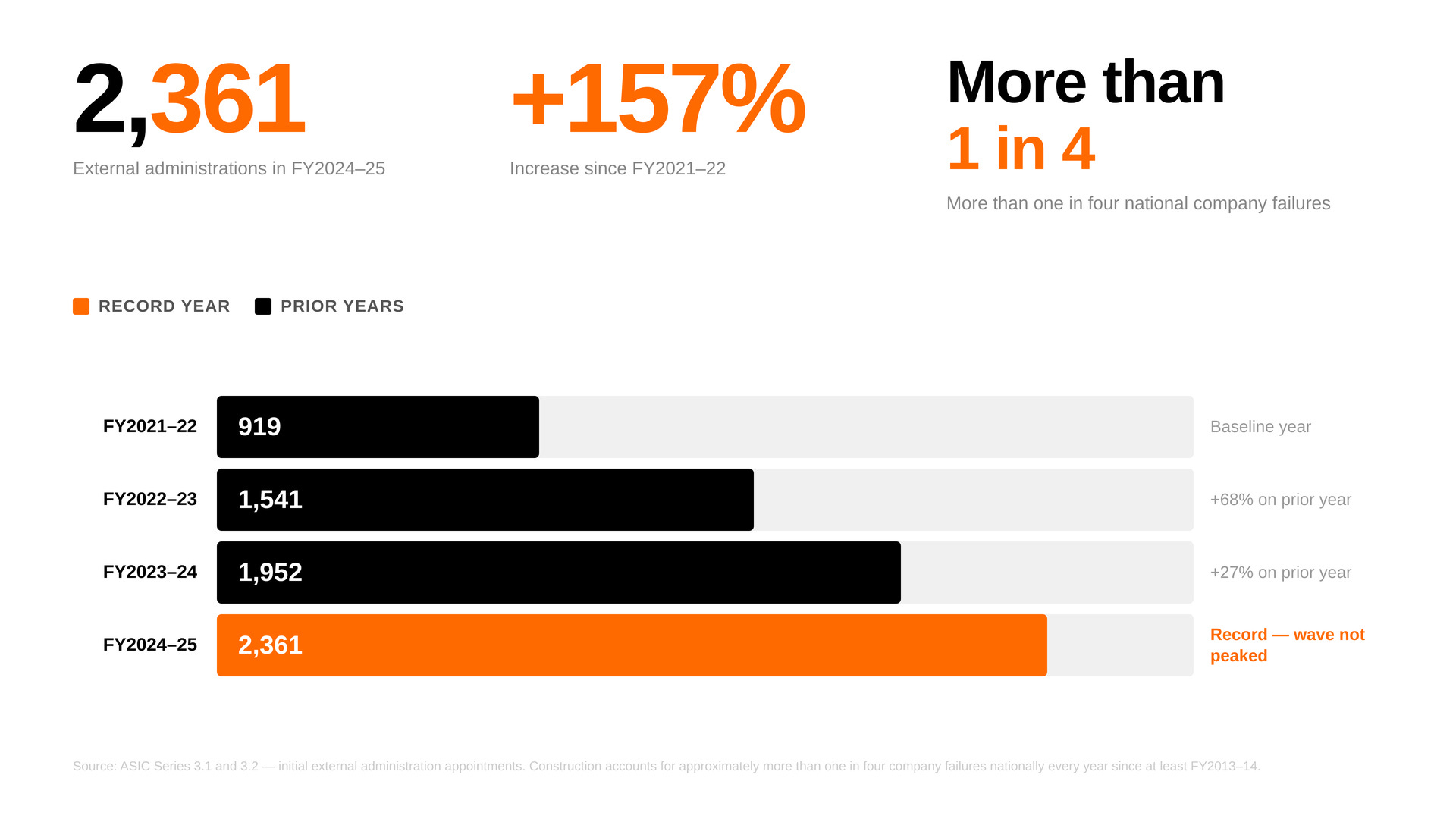
The real story is in the formal failure data. External administration is the legal process by which a business hands control to an insolvency practitioner because it can no longer pay its debts. Each case, in plain terms, is a business that has failed. Australian Securities and Investments Commission (ASIC) tracks every one of them through the ASIC external administration data. In FY2021-22, construction recorded 919 initial external administration appointments. The following year: 1,541. Then 1,952. Then 2,361 in FY2024-25, according to ASIC Series 3.1 and 3.2 data. The sector has more than doubled its failure rate in three years, has recorded the highest insolvency count of any Australian industry every year since at least FY2013-14, and now accounts for approximately more than one in four company failures nationally.
The overwhelming majority of those failures are not Probuild. They are the electrician who wired the apartments three suburbs over. The plumber who had 14 staff. The concreting crew that had been operating for eleven years. Small businesses make up 98.5% of the Australian construction sector, according to the Victorian Building Authority’s February 2026 insolvency research. The collapse wave is concentrated precisely there, in the firms too small to make the news, too numerous to track individually, and too interconnected to fail without consequence.
The fixed-price contract mechanism that drove the named collapses, contracts priced in 2021 and 2022 that could not absorb the 35% cost reset that followed, sits behind this wave too. Deep Dive 02 covered that ground. The point here is narrower. When a small subcontractor fails, it rarely makes headlines. But it always makes a ripple.
2. How the Payment Chain Works and Where It Breaks
Understanding why subcontractors fail at the rate they do starts with understanding how money moves through a construction project. It does not move evenly, and it does not move quickly.
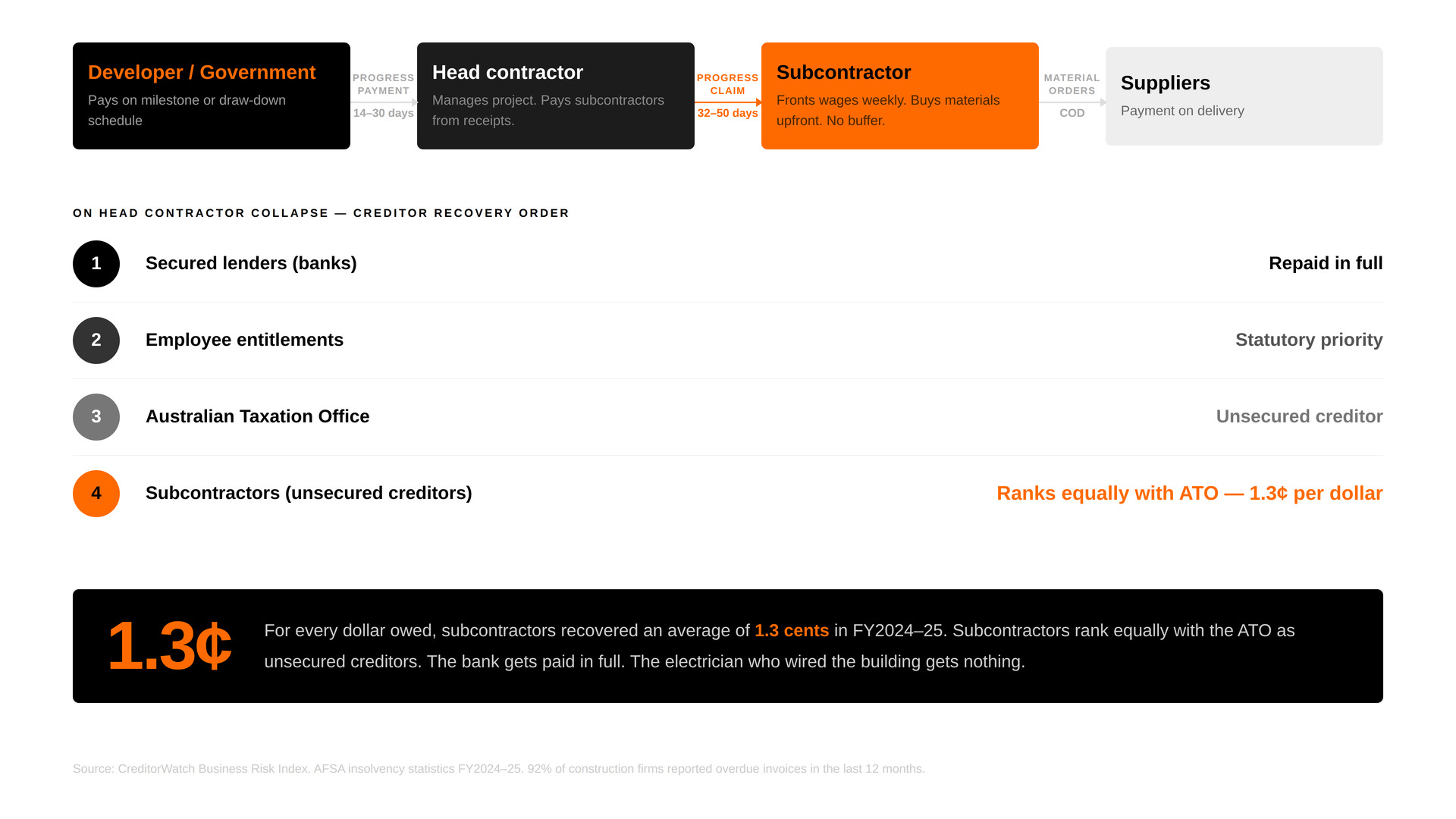
The chain runs in one direction: the developer or government client pays the head contractor, who pays the subcontractors, who pay their material suppliers. Each link waits to be paid before it can pay the next. Subcontractors front their own costs daily. Wages go out every week. Materials are purchased before they are installed. Payment arrives, on average, 32 to 50 days after the work is complete, according to CreditorWatch’s Business Risk Index data. For a small firm with no credit facility, that gap is the entire operating environment. There is no buffer. There is only the next invoice and the hope that it clears before payroll.
The current data confirms that gap is widening. CreditorWatch recorded that business-to-business (B2B) trade payment defaults jumped 68.1% in the year to August 2024, one of the strongest predictors of insolvency in their dataset. 92% of construction firms have had overdue invoices in the last 12 months, according to CreditorWatch’s Business Sentiment Survey. A separate CreditorWatch Business Risk Index report found that approximately 11% of small construction businesses had payments more than 60 days overdue. One payment default, just one, raises the probability of closure within 12 months to 28%. Four or more defaults and that probability reaches 74%.
This is the environment in which the cascade starts. Not with a collapse at the top of the chain. With a payment that is late by six weeks at the bottom of it.
Roberts Co’s Victorian collapse in March 2025 is the clearest recent illustration of how the cascade runs, and of something the standard narrative misses: it runs in both directions. The firm’s losses exceeded $60 million across eight abandoned projects. One unpaid subcontractor described the experience to the Australian Financial Review:
“We’d been chasing them for two weeks. They were so regular and all of a sudden they’ve stopped.”
Two days after hearing rumours, they were telling staff to pull equipment off site. Subcontractor failures had contributed to the head contractor’s collapse, which then triggered more subcontractor failures. The chain broke in the middle and the fracture spread in both directions simultaneously.
When a head contractor does collapse, the position of subcontractors inside the insolvency hierarchy is the most important commercial fact in this article. Subcontractors become unsecured creditors. They rank behind the banks, behind the Australian Taxation Office (ATO), and behind employee entitlements. In FY2024-25, unsecured creditors in finalised estates received an average of 1.3 cents for every dollar they were owed, according to Australian Financial Security Authority (AFSA) insolvency statistics. Not 13 cents. 1.3 cents.
Porter Davis makes this arithmetic concrete. The firm collapsed with $557 million in total debt. $481.6 million of that was owed to unsecured creditors, the subcontractors, the suppliers, the small businesses that had done the work. Commonwealth Bank’s $32.9 million secured debt was expected to be repaid in full. The subcontractor dividend, according to the administrator’s report, was likely zero.
The bank that lent money gets paid. The electrician who wired the building gets nothing. That is not an injustice in the abstract. It is the operating risk that every subcontractor in Australia is currently carrying.
3. The Law That Is Supposed to Help
Australia has a legal framework specifically designed to protect subcontractors from exactly this scenario. Every state has a Security of Payment Act that gives subcontractors a fast adjudication pathway to claim unpaid money without going to court. Instead of a litigation process that takes years and costs more than the debt is worth, the Acts create a rapid adjudication system where an independent referee determines the dispute in weeks. It remains among the more effective statutory protections available to trade contractors operating in the Australian construction market.
The problem is that the Acts are not the same in each state. They share a name and a purpose. The rules are meaningfully different.
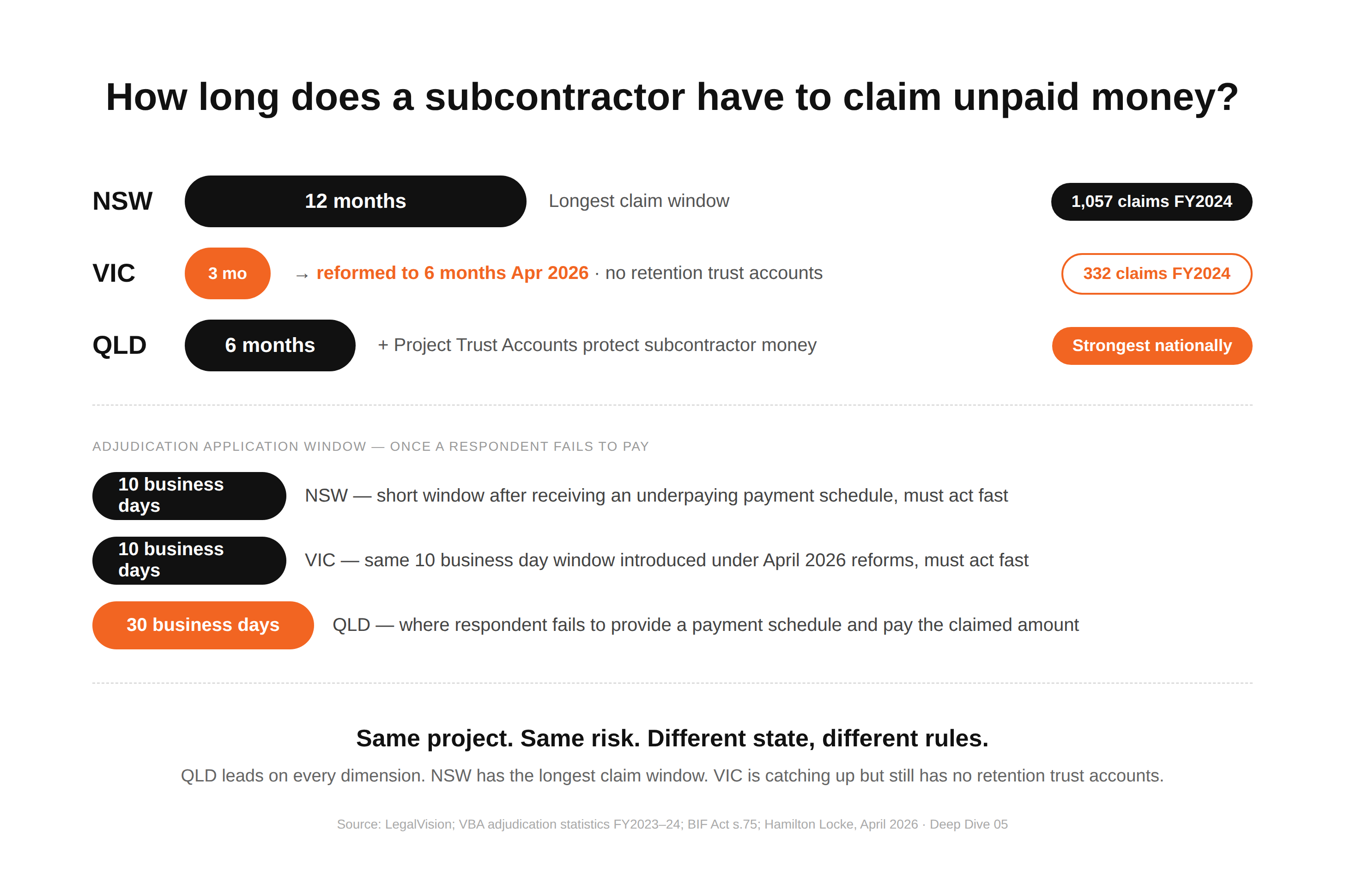
New South Wales has the most actively used system, with the longest claim window of any major state. NSW’s Building and Construction Industry Security of Payment Act 1999 gives subcontractors 12 months to make a payment claim. 2024 amendments strengthened protections further. The result is visible in the activity data: 1,057 adjudication applications were lodged in FY2024, the most of any state and nearly three times Victoria’s volume.
Victoria’s system has historically been the weakest of the three major states. Victoria’s Building and Construction Industry Security of Payment Act 2002 gave subcontractors only three months to make a claim. Miss that window and the right is lost entirely. Only 332 adjudication applications were lodged in FY2024. The gap between NSW and Victoria, 1,057 applications versus 332, is a rough measure of how many subcontractors in Victoria were leaving money on the table simply because they did not act in time or did not know the deadline existed.
Victoria’s position has changed significantly since April 2026. The Building Legislation Amendment (Fairer Payments on Jobsites and Other Matters) Act 2025 introduced a 20-business-day statutory payment cap for the first time, and allows subcontractors to claim delay costs, unapproved variations and latent conditions previously excluded. Victoria’s reforms are substantial. The claim window now matches Queensland at 6 months, and the 20-business-day payment cap aligns Victoria with QLD and with NSW’s subcontractor payment terms (NSW operates 15 business days for head contracts, 20 for subcontracts). The remaining gaps are specific: NSW still has a longer claim window at 12 months, and Victoria has no Project Trust Accounts, the structural protection that makes Queensland’s framework the strongest in the country for subcontractors.
Queensland combines its Building Industry Fairness (Security of Payment) Act 2017 with a 6-month claim window and, critically, with Project Trust Accounts. Adjudication applications in Queensland can be lodged within 30 business days where a respondent has failed to provide a payment schedule and pay the claimed amount. The combination gives Queensland subcontractors both a legal pathway to claim unpaid money and a structural mechanism that protects the money before a dispute ever arises.
In New South Wales, a claimant has 10 business days to lodge an adjudication application after receiving a payment schedule that underpays the claimed amount. Victoria's April 2026 reforms introduced the same 10 business day window for adjudication applications, making prompt action equally critical for Victorian subcontractors under the amended Act. In Queensland, the equivalent window is 30 business days, but applies specifically where a respondent has failed to provide a payment schedule and pay the claimed amount in full. These are different trigger scenarios and are not a direct comparison of generosity between the two states. In New South Wales, a claimant has 10 business days to lodge an adjudication application after receiving a payment schedule that underpays the claimed amount.
In Queensland, the equivalent window is 30 business days, but applies specifically where a respondent has failed to provide a payment schedule and pay the claimed amount in full. These are different trigger scenarios and are not a direct comparison of generosity between the two states.
The practical consequence is stark. A subcontractor doing identical work, for the same head contractor, on the same type of project, receives dramatically different legal protection depending entirely on which side of a state border the building sits. Most subcontractors do not know this. Many who do know it do not use the laws in time. Understanding which laws apply to which project, and acting on them before the deadline expires, is itself a mark of financial discipline. The firms that survive treat legal entitlement as an active commercial tool, not a theoretical protection.
4. Queensland’s Locked Box
The standard insolvency problem for subcontractors is not complicated. A developer pays a head contractor $5 million for work completed. That money enters the head contractor’s general operating account. The head contractor uses it to pay their own payroll, service equipment loans, cover office costs, and manage other creditors. By the time the subcontractors are due to be paid, the money may already be gone. When the head contractor collapses, the subcontractors are left as unsecured creditors in a queue that, as the Porter Davis case established, typically returns nothing.
Queensland’s Project Trust Account framework answers this problem directly. Under the Building Industry Fairness (Security of Payment) Act 2017, money paid by the developer must be held in a legally separate, purpose-specific account that exists solely to pay subcontractors. The head contractor cannot draw on it for their own operations. It is held in trust for the people doing the work below them.
There are two types. The Project Trust Account holds progress payments from the principal. The Retention Trust Account holds the retention money that head contractors typically withhold from subcontractor payments, usually 5 to 10% of each progress claim, as a quality guarantee against defects. Both are held separately. Both are protected on insolvency.
The Probuild collapse in 2022 illustrated the difference. Queensland subcontractors had access to a payment redirection notice under the BIF Act, a statutory tool not available in Victoria or NSW, though trust account requirements were not yet fully operative at that scale. No equivalent mechanism existed for subcontractors in Victoria or New South Wales. Same collapse. Different legal tools available, determined entirely by which state the project was in.
The Queensland framework has expanded materially since that collapse. The threshold for mandatory Project Trust Accounts currently applies to contracts over $10 million. The Queensland Government announced plans to expand coverage to $3 million, but the further rollout was placed on hold indefinitely by government proclamation on 31 January 2025. No revised timetable has been confirmed, as noted by the Queensland Building and Construction Commission. Had that expansion proceeded, it would have significantly increased the proportion of Queensland construction activity covered. Under the current threshold, a subcontractor on a $12 million commercial project in Brisbane has statutory protection that the same subcontractor on the same job in Melbourne does not.
The compliance requirements are not light. Head contractors must maintain separate accounts at approved financial institutions, provide monthly reconciliation statements to every subcontractor, and submit to Queensland Building and Construction Commission (QBCC) audits. Non-compliance carries automatic fines before the regulator opens an investigation file.
This is where the series argument begins to take shape. The administrative discipline required to run a Project Trust Account correctly is precisely the financial discipline that separates the firms that will come out of this cycle stronger from the ones that will not. Separate accounts. Monthly reconciliations. Accurate records of what is owed to whom. These are not bureaucratic requirements. They are the operating habits of a financially coherent business.
5. The $18 Billion Nobody Sees
There is a second category of subcontractor money at risk that sits almost entirely outside the public conversation about construction insolvency. It is not progress payments. It is retention.
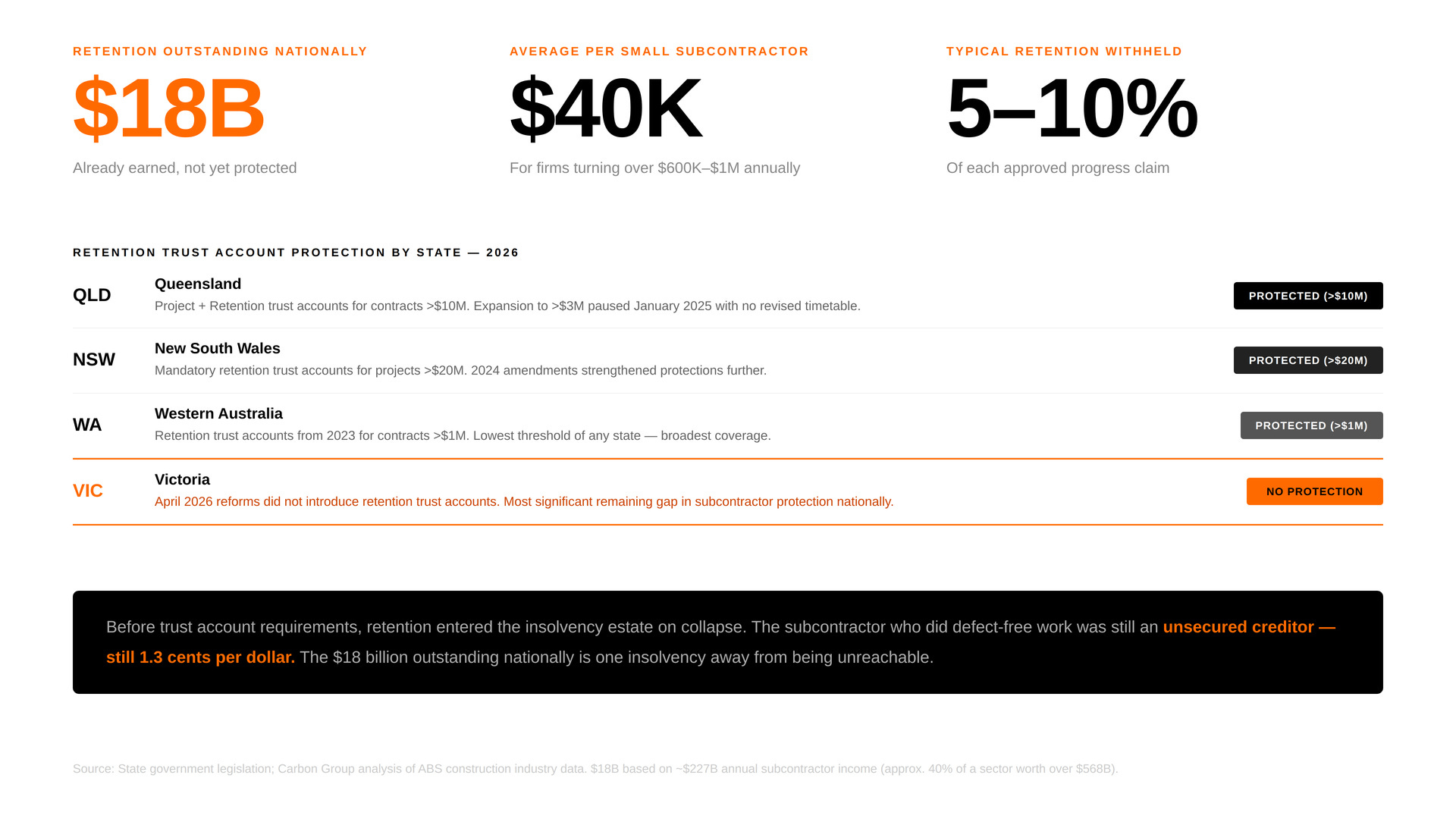
At any given moment, an estimated $18 billion in retention money is outstanding across the Australian construction industry. It has already been earned. It does not yet belong to the people who earned it.
Retention works as follows. When a subcontractor submits a progress claim, the head contractor typically withholds between 5 and 10% of the approved value as a security against defects. That withheld amount, the retention, accumulates across the life of the project. Half is usually released at practical completion. The other half is released at the end of the defect liability period, which typically runs three to twelve months after handover.
The scale of this exposure is documented by Carbon Group’s analysis of Australian Bureau of Statistics (ABS) construction industry data. Based on the estimated $227 billion annual income flowing through subcontractors (approximately 40% of a construction sector worth over $568 billion), retention outstanding at any point in time is estimated at approximately $18 billion. The average per subcontractor is approximately $40,000, for firms turning over between $600,000 and $1 million annually. That is not a rounding error in a cash flow model. For most small subcontractors, it is the difference between staying solvent and not.
Before trust account requirements were introduced, retention sat in the head contractor’s general account alongside every other dollar in the business. On insolvency, it became part of the estate. The subcontractor who had performed defect-free work, met every milestone, and was owed their release payment was still an unsecured creditor. Still 1.3 cents per dollar.
The state-by-state picture for retention protection mirrors the Security of Payment story. NSW requires retention trust accounts for projects over $20 million. Queensland captures retention within the Project Trust framework for projects currently over $10 million (the expanded $3 million threshold remains on hold). Western Australia introduced retention trust accounts for eligible contracts over $1 million in 2023. Victoria has no mandatory retention trust account, despite the April 2026 reforms. It remains the most significant remaining gap in subcontractor financial protection nationally.
A subcontractor owed $200,000 in retention across three disputed projects cannot sustain further work even if their core business is profitable. The work was done. The money was earned. Retention is the payment chain’s slow bleed. Not the sudden collapse, but the quiet drain that leaves firms too weak to absorb the next shock when it arrives.
6. Phoenix Activity: The Hidden Multiplier
There is a practice that sits behind the insolvency data and makes the cascade significantly worse. It does not appear in the ASIC headline numbers in a way that makes it easy to see. It is called phoenix activity, and construction is the industry it most reliably calls home.
Phoenix activity works like this. A company director runs up debts, including to subcontractors, the ATO, and suppliers. Rather than trading through the difficulty, they place the company into liquidation. The debts are extinguished. The director then establishes a new company, often with a similar name, in the same trade, operating from the same premises, sometimes using the same equipment and staff. The new company owes nothing. The subcontractors who did work for the old one are left with claims against an entity that has no assets to pay them.
Construction is the most affected industry because its operating structure enables the behaviour. Low barriers to entry. Fragmented contracting relationships. Cash-intensive operations. Limited licensing requirements in some states. A subcontractor dealing with a phoenix operator may not know it until the company they invoiced no longer exists.
The scale of the problem is documented. The ATO’s Phoenix Compliance Programme raised more than $3.12 billion in liabilities from phoenix audits and reviews to December 2025, completing more than 547 audits and receiving 1,843 referrals of suspected illegal activity. The programme is not a niche enforcement exercise. It is one of the ATO’s largest compliance priorities, and construction sits at the centre of it.
The structural response is Director Identification Numbers, introduced under the Treasury Laws Amendment (Registries Modernisation and Other Measures) Act 2020. Director IDs link individuals to their history of company directorships, making it materially harder to disappear from one failed entity and reappear at the head of another. ASIC’s 2026 enforcement priorities, announced in November 2025, specifically target illegal phoenixing. The era of consequence-free phoenixing is narrowing. It has not ended.
The practical implication for any firm signing a subcontract today is straightforward. Checking a company’s credit history is no longer sufficient due diligence. Checking the director’s history is now a meaningful risk management step. A director with prior liquidations, ATO defaults, or disqualification orders is a signal, not a coincidence. The firms that do this before signing are making a financial discipline decision. The firms that do not are carrying a risk they have not priced.
7. What the Surviving Firms Do Differently
The insolvency wave, the payment chain, the state law variations, the retention exposure, the phoenix risk. These are not separate problems. They are the same operating environment, experienced differently depending on how a firm is run. The firms that come out of this cycle stronger share a set of observable behaviours. They are not complicated. They are consistently absent in the firms that fail.
They treat subcontractor financial health as a business decision, not an afterthought. Before signing a subcontract, they check not just whether the firm can do the work, but whether it is financially stable enough that its failure will not become their problem. Tools such as the Personal Property Securities Register (PPSR), the iCIRT counterparty rating system, and CreditorWatch trade reference checks exist for exactly this purpose. The firms that use them systematically are making a selection that protects them from the cascade. Deep Dive 11, publishing 28 August, covers these tools in depth as a predictive framework for reading counterparty failure six months before it happens.
They understand which state’s laws apply to which project and use them actively. The firms operating across NSW, Victoria and Queensland have someone whose job it is to know all three frameworks, to lodge claims before windows expire, and to use adjudication as a commercial tool rather than a last resort.
They watch their own ATO position as a live indicator, not a year-end surprise. CreditorWatch data shows that 33.6% of businesses with ATO tax debt defaults exceeding $100,000 that are more than 90 days overdue either became insolvent or voluntarily closed within the following year. One in three. Deep Dive 06, publishing 19 June, covers the daily cash architecture that makes this kind of visibility possible.
They run their cash with the discipline that trust account compliance requires, whether or not their projects are in Queensland.
And they do not use superannuation as a cash float. From 1 July 2026, now less than a month away, Payday Super requires employers to remit contributions within seven business days of each payday, replacing the quarterly model under which many businesses quietly held super as working capital. Treasury has acknowledged that this will expose cash flow structures relying on that buffer, with research suggesting more than one in five small and medium enterprises could struggle. The firms that were never relying on it are already positioned. The ones that were are about to find out.
8. Capital View: What This Means for Developers and Lenders
The Reserve Bank of Australia (RBA) Financial Stability Review of April 2025 identified construction insolvencies as a risk to the financial system through the direct channel of loan losses for banks and non-bank lenders. The RBA is watching this sector for exactly the reasons developers and project lenders should be. The concern is not abstract.
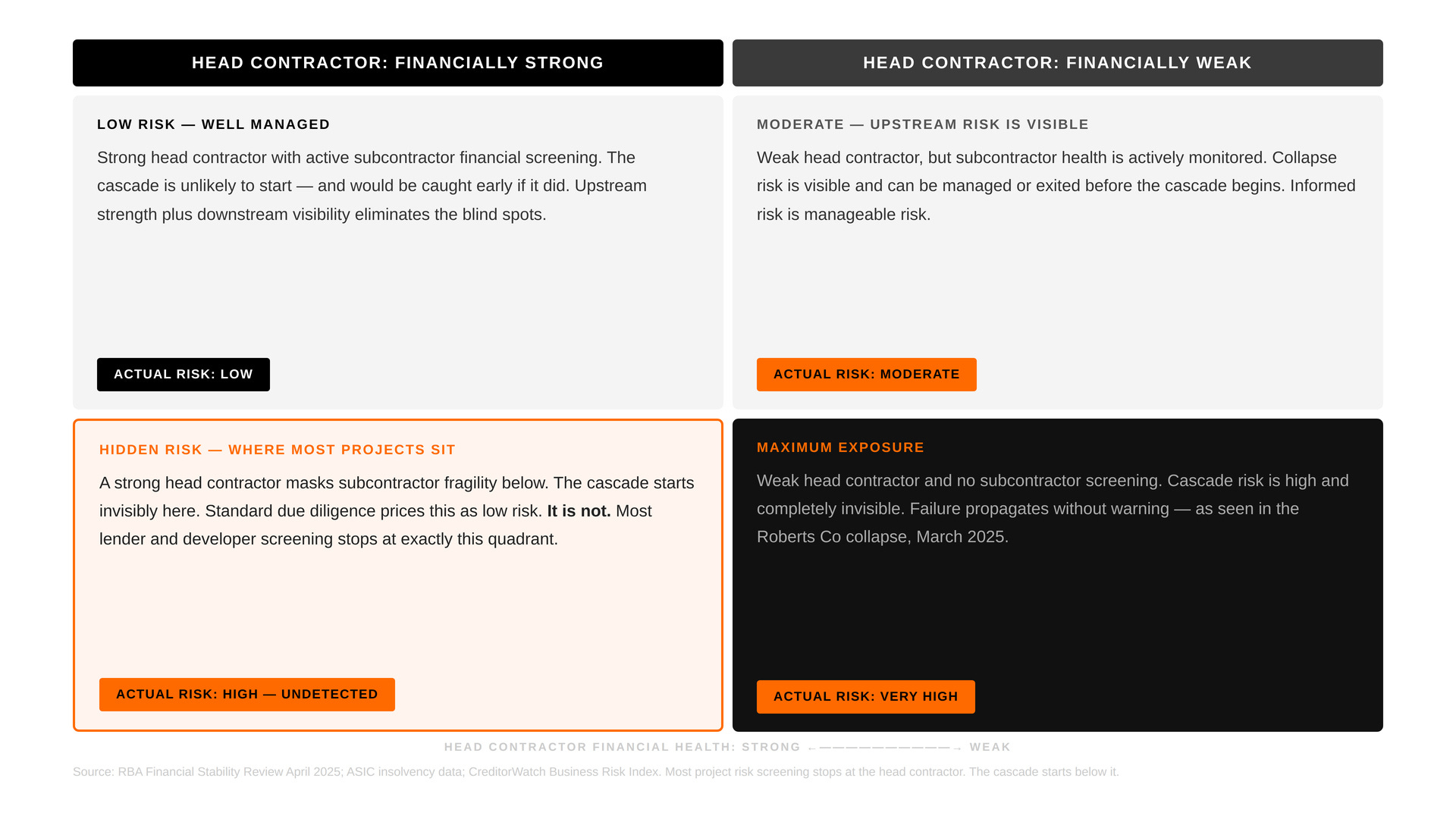
Most project lending and development feasibility assessments screen for head contractor reputation and balance sheet. Very few screen systematically for subcontractor financial health. Addressing that gap is the commercial purpose of this chapter.
The retention exposure makes this concrete. An estimated $18 billion in already-earned subcontractor money sits outside trust account protection at any given time. When a head contractor fails, that money enters the insolvency estate. Subcontractors become unsecured creditors. The project stalls. The developer absorbs the cost of novation, programme revision, and contractor replacement. None of this appears in the original feasibility.
The subcontractor risk premium, the additional cost that should be embedded in any tender price to account for the probability that subcontractors fail mid-project, is currently underpriced in Australian construction. It is not invisible. It is in the CreditorWatch data, in the ASIC insolvency series, in the ATO enforcement figures. It has simply not been systematically incorporated into how projects are priced, funded, or contracted.
For developers and project lenders, the question to ask is not only whether the head contractor is financially sound. It is whether the head contractor’s subcontractor base is financially sound, and whether the head contractor has the systems to know the answer to that question in real time. A head contractor who has embedded subcontractor financial screening into their procurement process is not just a more responsible commercial partner. They are a materially lower counterparty risk.
The Honest Cascade
The insolvency wave in Australian construction is not a story about the firms that made the news. Probuild, Porter Davis, Roberts Co. These failures are real and their consequences are material. But they are the visible fraction of a much larger structural problem.
The real wave is 2,361 initial external administration appointments in FY2024-25, according to ASIC Series 3.1 and 3.2 data. It is construction accounting for 27% of all company failures nationally. It is 98.5% of the sector made up of small businesses with no reserves, no credit facility, and no meaningful legal recourse when the chain above them breaks. It is subcontractors recovering 1.3 cents per dollar from the estates of the firms they built. It is $18 billion in earned retention sitting in accounts that are one insolvency away from being unreachable.
The cascade does not start at the top. It starts at the bottom, and it often travels in both directions at once.
The firms coming out of this cycle stronger are not the ones that got lucky with their project mix. They are the ones that treated financial discipline as an operating standard rather than a compliance obligation. They screened counterparties before signing. They understood which state’s laws gave them what rights. They watched their ATO position weekly, not quarterly. They never used the super buffer because they never needed to.
Those habits are the first pillar. They do not guarantee survival in every market condition. But their absence almost guarantees exposure when the chain above breaks, and in the current environment, that exposure is not a tail risk. It is the operating baseline.
The next chapter goes inside the firms running these habits well. Not the protection layer covered here, but the operating layer: how surviving builders manage cash at the daily level, and why the difference between monthly and daily financial visibility is the difference that matters most in a market this unforgiving.
[Coming in Deep Dive 06: Daily Margin, Not Monthly: The Cash Architecture Surviving Builders Run. Publishing 19 June 2026.]
See you next week.
Note: This article is general market commentary and does not constitute financial, legal or investment advice.
Keep reading
More from the bid team
14 October 2026 · Visionex Solutions
The Call You Should Not Make
Construction runs on relationships: a quick call to the client, a coffee with the project manager, a word on the site walk.
6 October 2026 · Visionex Solutions
How Defence Actually Evaluates
In Defence's final evaluation for the Army's new infantry fighting vehicles, then planned as a fleet of up to 450, Rheinmetall's tendered price was almost...
30 September 2026 · Visionex Solutions
The Bid You Should Not Submit
Defence's standard construction tender form asks you to declare that bidding was your own commercial decision. The question is whether you actually made one.
Have a tender on your desk?
Send it through. Within 24 hours you will have a go or no go call, a returnables check, and a clear view of where the marks are.