Home/Blog/The Players Who Decide Before the Tender Exists
Defence · 7 July 2026 · Visionex Solutions
The Players Who Decide Before the Tender Exists
Ask a construction firm who they're tendering to on a defence project, and most will point to the name on the request for tender. That's the wrong answer, or
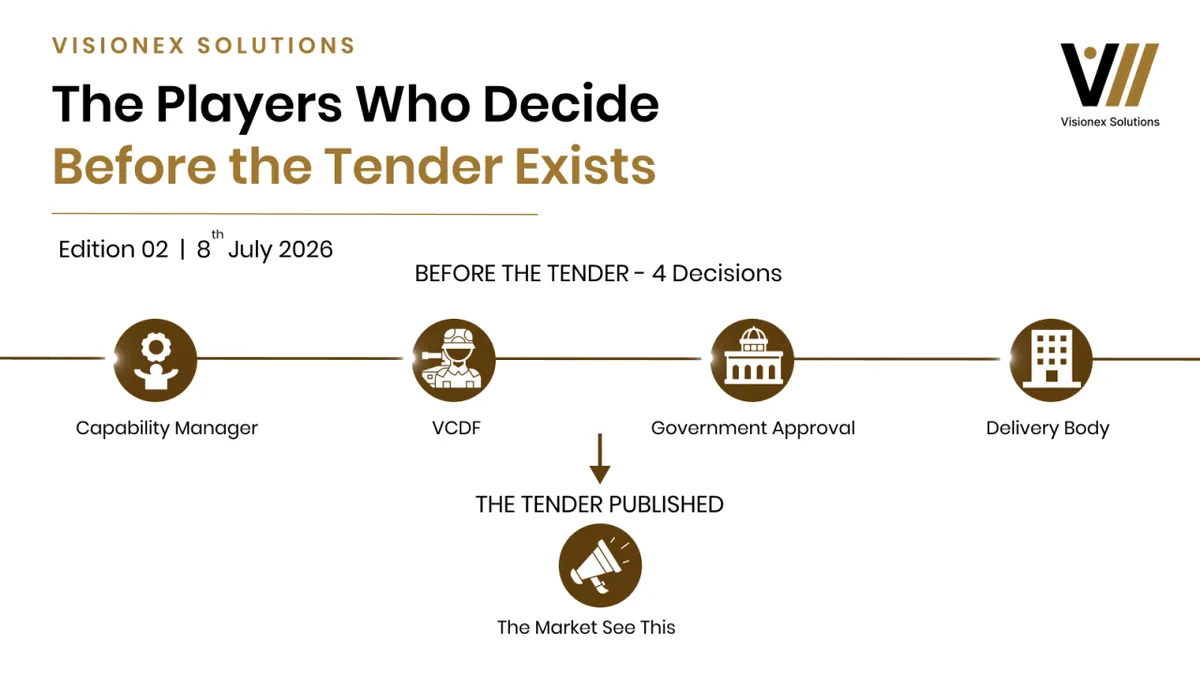
Ask a construction firm who they're tendering to on a defence project, and most will point to the name on the request for tender. That's the wrong answer, or at least an incomplete one. By the time a tender is published, at least three separate parts of the Defence system have already decided that the project exists, what it's allowed to cost, and who's allowed to run it. The name on the document is usually the last of the four to get involved, not the first.
Understanding that sequence, not just the final signature, is what actually tells you whether an opportunity is real, and who you should be building a relationship with well before anything goes to market.
It starts inside a Service, not on AusTender
Every defence requirement begins as a gap between what the Australian Defence Force can currently do and what government has decided it needs to be able to do. That judgement doesn't originate with a procurement team. It comes from the Chiefs of Navy, Army, and Air Force - formally called Capability Managers - who identify the gap and remain accountable for the capability once it's fielded.
The practical implication is timing. The earliest, least formal conversations about a future project happen inside a Service, long before a tender exists. A firm that starts paying attention when AusTender publishes an opportunity isn't starting on time. It's arriving at the last stage of a process that's been running for months, sometimes years.
Prioritisation now sits in one place, not three
As Edition 01 covered, Defence's delivery structure changed on 1 July 2026 with the creation of the Defence Delivery Group. A related but separate change happened alongside it, and it matters more for understanding where power actually sits: capability development, previously run independently by each Service, has been centralised under the Vice Chief of the Defence Force (VCDF) Group, covering every domain from land to space. Minister for Defence Industry Pat Conroy set out the resulting division of labour in his remarks to the Defence and Industry Conference: VCDF decides what capability Defence needs, while the National Armaments Director is responsible for getting it delivered.
For industry, that's a genuine structural shift. Three separate, competing sets of Service priorities have become one centralised agenda. Fewer, larger conversations about what's coming next have replaced a more fragmented picture, and knowing who now actually sets that agenda matters more than knowing who used to.
Before any proposal reaches government, it also passes through Defence's Investment Committee, which sits under VCDF governance and has carried standing representation from the Department of Finance and the Department of the Prime Minister and Cabinet since the committee's earliest years. In practice, that means Finance's influence on a project begins well before the formal two-pass approval most bidders focus on, not after it.
The money gate hasn't moved, but who sits at it is worth naming
Government approval still runs through the familiar two-pass system: First Pass to confirm the concept, Second Pass to lock in cost, scope, and schedule. Higher-risk projects go to the National Security Committee of Cabinet. Lower-risk ones can be cleared through what the Australian National Audit Office documents as Two Minister Approval, sign-off by the Minister for Finance and the Minister for Defence directly, currently Katy Gallagher and Richard Marles.
The commercial takeaway is straightforward. A project that hasn't reached Second Pass has no locked budget and no fixed scope. It's worth watching. It is not yet worth resourcing a bid for.
For equipment and platform work, the Defence Delivery Group, covered in Edition 01, is now the relevant delivery body. But construction and engineering firms are chasing a different kind of opportunity, and it sits outside that whole chain. Defence estate work - bases, ranges, and facilities - runs through the Security and Estate Group, with its own procurement pathway, the Estate Works Program, entirely independent of DDG's pipeline.
There's a live, dated reason to care about this now. Government has flagged around $5 billion over the forward estimates and $15 billion over the decade in projects it intends to explore for alternative financing arrangements, explicitly including the Defence estate. For firms with construction or private-financing capability, that's a genuine, near-term opening, not a hypothetical one.
A gap worth knowing about, stated plainly
One development deserves a clear mention rather than silence. In March 2026, Parliament's Joint Committee of Public Accounts and Audit cancelled the Major Projects Report, an eighteen-year-old, independently audited disclosure on how Defence's biggest acquisitions were tracking. Its replacement will report largely behind closed doors.
This isn't a criticism of the broader reform - the schedule and cost problems it responds to were real. But it does mean the new delivery structure will hold more budget autonomy at the same moment public visibility into acquisition performance has narrowed. For firms building a long-term defence pipeline, that's context worth factoring into how much you rely on public reporting versus your own relationships inside the system.
What this means for you
Before resourcing a bid, ask three questions. Which Capability Manager originated this requirement? Has it passed Second Pass? And does it actually run through the Defence Delivery Group, or through the Security and Estate Group? Those three answers tell you more about whether an opportunity is real than anything in the tender document itself.
In practice, that means the businesses building lasting defence relationships are having conversations at the Capability Manager and Investment Committee stage, long before a project has cleared government approval, not waiting for a tender to confirm it exists.
The structure is not designed to be a mystery. It's designed around accountability, and accountability means power sits in specific, identifiable places at each stage. Knowing which of those places controls your opportunity, and reaching it before the tender exists, is what separates a business that's positioned to win from one that's simply hoping to be noticed.
This is Edition 02 of the Australian Defence Tender Framework series by Visionex Solutions. The series publishes every Wednesday. Series 1: Understanding the Arena runs from 1 July to 9 September 2026.
Which of these four players did you assume held the least power? Share your view in the comments.
Between editions, follow us on LinkedIn for Australian defence industry news, facts, and market insights.
Keep reading
More from the bid team
14 October 2026 · Visionex Solutions
The Call You Should Not Make
Construction runs on relationships: a quick call to the client, a coffee with the project manager, a word on the site walk.
6 October 2026 · Visionex Solutions
How Defence Actually Evaluates
In Defence's final evaluation for the Army's new infantry fighting vehicles, then planned as a fleet of up to 450, Rheinmetall's tendered price was almost...
30 September 2026 · Visionex Solutions
The Bid You Should Not Submit
Defence's standard construction tender form asks you to declare that bidding was your own commercial decision. The question is whether you actually made one.
Have a tender on your desk?
Send it through. Within 24 hours you will have a go or no go call, a returnables check, and a clear view of where the marks are.