Home/Blog/The Plan Defence Marks Twice
Defence · 17 November 2026 · Visionex Solutions
The Plan Defence Marks Twice
On a Defence Head Contract tender, one schedule can carry as much weight as your entire track record.
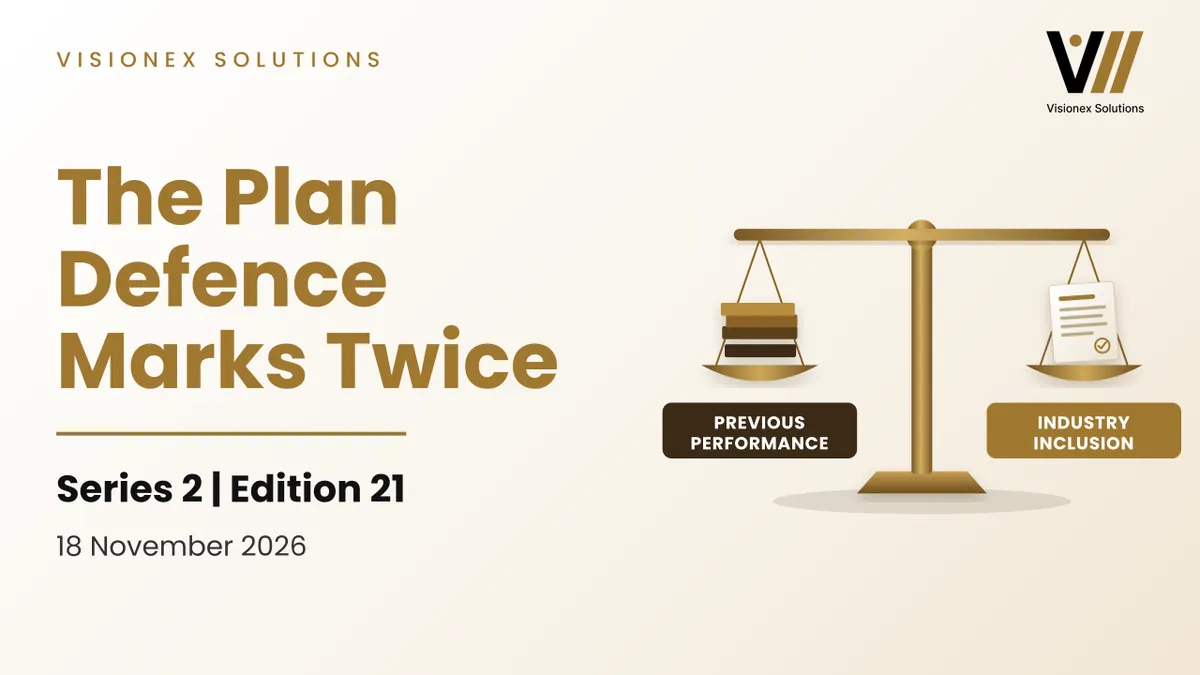
On a Defence Head Contract tender, one schedule can carry as much weight as your entire track record. It is not the program, and it is not your project history. It is the industry inclusion and skills schedule, home of the Local Industry Capability Plan.
Under Defence's CFI Tender Evaluation and Probity Protocol (November 2026), that schedule carries a standard weighting of 20 per cent on Head Contract tenders. Where previous performance is assessed, it carries 20 per cent too.
Yet it is easy to treat the local industry plan as paperwork: written last, from last year's wording.
Edition 20 covered the gates that remove a tender before scoring starts. This edition looks at a scored section that is easy to underrate, and at what happens to it after the contract is signed.
Where the marks sit
On the Head Contract tender documents (December 2025), local industry sits in evaluation criterion 4(a)(v), "industry inclusion and skills". The criterion asks whether the tenderer will ensure local industry "is given full, fair and reasonable opportunity to participate in the delivery of the Works."
The protocol gives that whole criterion one standard weighting of 20 per cent on Head Contract and Medium Works tenders. On the Head Contract, that single score covers three things: Indigenous participation, local industry participation and the Australian Skills Guarantee.
Two cautions apply. First, this is a standard, not a fixed rule. The Delegate can approve project-specific weightings before release, so the figure printed in clause 4(a) is the one that counts. Second, templates differ. On the Estate Works Program Medium Works template, local industry is assessed within the weighted "workload and proposed resources" criterion, so it sits beside your people and capacity rather than standing alone.
The practical point is the same in both. Local industry is marked, but never on its own. It shares a score with other content, so on our reading a thin answer weakens the whole criterion.
What the evaluator is actually reading
The questions are published in advance. Section 2 of Tender Schedule E on the Head Contract asks the tenderer to:
• define what it means by "local" industry
• explain how it considered the limits of local capacity
• give an annual forecast for local industry for each financial year of the works
• state the percentage of contract value it will subcontract locally and nationally
• describe how local SMEs will hear about packages, and how the obligation passes to subcontractors
• name the person responsible for implementing and reporting on the plan
Nearly every prompt asks for a number, a mechanism or a name. The named Local Industry Capability Manager also appears in the Schedule B key people table, with a CV of up to three pages.
Consider two answers to the same question (illustrative example only). The first says the company "is committed to engaging local subcontractors wherever possible". The second defines local as within a stated distance of the base, lists the trade packages it expects to let locally with an estimated value for each, and explains which packages it expects to source interstate and why.
Only the second answers what the schedule asks. On our reading of the schedule, the first leaves the evaluator very little to score.
The plan follows you onto site
Here is the part many teams miss. Under clause 26.2(c) of the Head Contract tender conditions, the successful tenderer's final plan must be "based on the draft Local Industry Capability Plan" it lodged. Under clause 18.3 of the Conditions of Contract, the contractor must comply with the plan and report on it at least every six months. The monthly report must confirm compliance with local industry requirements, and project plans must be reviewed at least on each anniversary of award.
Put simply, every forecast in the draft becomes a benchmark the contractor reports against for the whole job. An optimistic number written to impress an evaluator does not disappear at award.
What the auditors found
The Australian National Audit Office tested this in Maximising Australian Industry Participation through Defence Contracting (May 2025). Its conclusion was blunt: Defence "has not maximised Australian industry participation through the administration of its contracts."
One example examined was a $19.33 million electrical works contract at RAAF Base Learmonth. The tendered plan forecast $5.2 million of local spend, with local defined as within 50 kilometres. At completion, local spend was $1.4 million, a 73 per cent fall.
The contract required an amended plan within 14 days of such a shift. According to the ANAO, none was submitted or requested. Defence explained that most of the scope was specialised and local skilled labour was short.
That explanation matters. The lesson is less about one contractor than about the gap between a tendered number and what the local market can supply.
The audit also found the reverse is possible. On a contract at RAAF Base Tindal, supplier reporting showed 77 per cent local subcontractor participation against a 70 per cent target.
Where suppliers did report against their industry commitments, the ANAO found only 12 of 59 relevant measures were reported against. Defence agreed to all nine recommendations. On our reading, closer scrutiny of delivery against tendered plans is the likely direction.
Before your next tender
1. Read clause 4(a) first. Find the criterion local industry sits in and its weighting.
2. Define local deliberately. The definition shapes every forecast that follows.
3. Build the forecast from real packages. Use your estimate, not a target percentage.
4. Test local capacity. If the region cannot supply a trade, say so and explain the alternative.
5. Treat the named manager as a key person. On Head Contract and Medium Works tenders, their CV is part of the tender.
6. Price the reporting. Six-monthly reporting and plan reviews take time.
A promise with a price
Policy requires a plan on construction work from $7.5 million, but the capital works templates ask for a draft on every Head Contract and Medium Works tender. So most builders on those templates will write one.
The firms that gain from it treat the plan as an estimate of their own supply chain, not a statement of goodwill. That gives evaluators something real to score, and it reduces the risk of an awkward variance report later.
The better question for a bid team is not "how good can we make this sound?" It is "which of these numbers would we be comfortable reporting against for the life of the contract?"
Next week, Edition 22 looks at how Defence structures and tests price.
This is Edition 21 of the Australian Defence Tender Framework series by Visionex Solutions. The series publishes every Wednesday. Series 2: Inside the Tender runs from 16 September to 2 December 2026.
How does your team build its local industry forecast: from real subcontract packages, or from a target percentage?
Between editions, follow us on LinkedIn for Australian defence industry news, facts, and market insights.
Keep reading
More from the bid team
10 November 2026 · Visionex Solutions
Before the First Score
Bid teams spend their best hours on the parts of a tender that earn marks. The first decision Defence makes about a tender awards none.
3 November 2026 · Visionex Solutions
What Counts as Proof
There is one part of your track record that Defence will not take your word for.
27 October 2026 · Visionex Solutions
The Schedule Is the Question
Two Defence estate tenders can ask a contractor for the same draft Work Health and Safety Plan. On one, the plan earns marks.
Have a tender on your desk?
Send it through. Within 24 hours you will have a go or no go call, a returnables check, and a clear view of where the marks are.