Home/Blog/The Clearance Queue Has Moved, and It Is Now Sitting on Your Side of the Desk.
Defence · 12 August 2026 · Visionex Solutions
The Clearance Queue Has Moved, and It Is Now Sitting on Your Side of the Desk.
Security clearances, the timeline nearly every firm budgets incorrectly, and the finding that the slowest part of the process is the part industry controls.
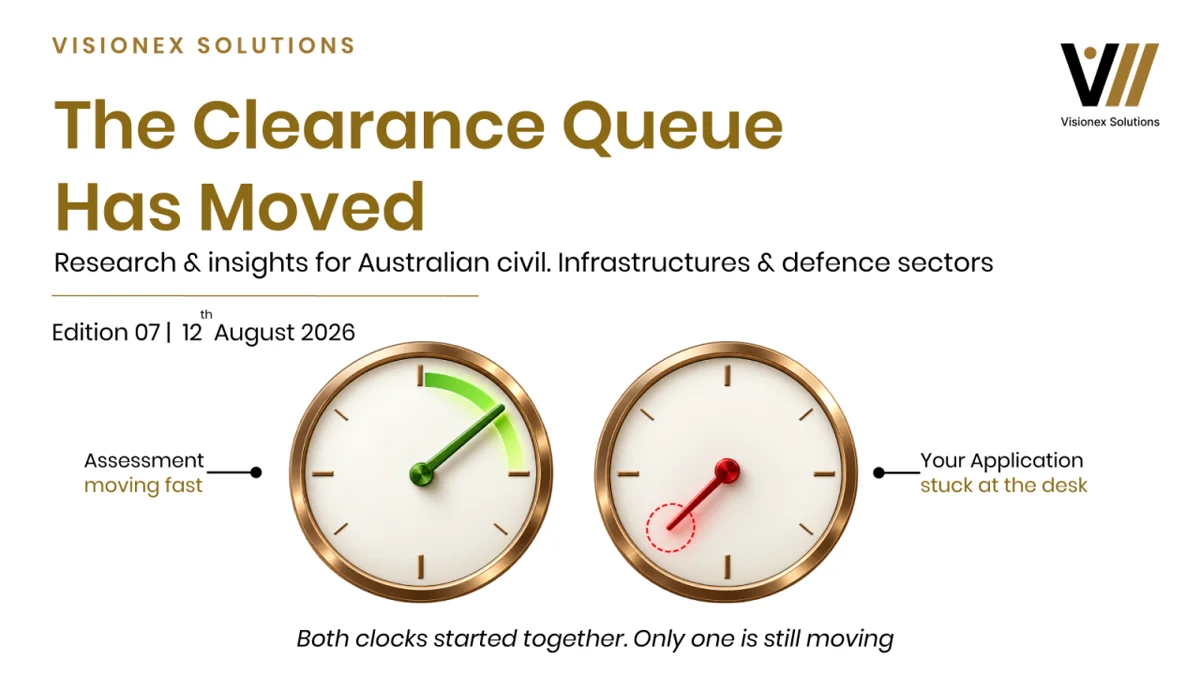
Security clearances, the timeline nearly every firm budgets incorrectly, and the uncomfortable finding that the slowest part of the process is the part industry controls.
Two numbers sit in the same performance table of the Australian Government Security Vetting Agency’s 2024-25 Annual Update, and read together they overturn what most of the construction market believes about security clearances.
The first is 49. That is the median processing time, in business days, for a Negative Vetting Level 1 clearance in 2024-25, against a target of 70. The year before it was 72 days. The agency did not merely meet its benchmark, it came in 21 business days under it and improved sharply on its own prior performance.
The second is 59.6 per cent. That is the share of applications submitted by the clearance subject and verified as complete within 30 business days, against a target of 85 per cent. It is the agency’s weakest timeliness result, and it went backwards from 66 per cent the year before.
One of those numbers measures government. The other measures us. Only one is improving.
The clock does not start when you decide you need a clearance
This is a technical detail with real money attached, and it is where tender programs quietly go wrong.
AGSVA’s published benchmarks, Baseline 20 business days, Negative Vetting Level 1 70 days and Level 2 100 days, are not counted from the day a firm works out it needs cleared staff. The Service Level Charter is precise on this point: those targets commence only once AGSVA has verified that a complete application has been received from the clearance subject.
Everything before that moment is unmeasured, and that is exactly where elapsed time hides. The applicant has 20 business days to lodge once the application is issued. Before that, the firm has to arrange sponsorship, because no individual can apply for their own clearance.
So the honest reading of 49 days is this. It describes the government’s half of the job. It tells you how quickly the assessment runs once you have done your part properly. It says nothing whatsoever about how long your part takes.
Where the time actually goes
Two figures put a number on the industry-side cost.
The shared submission measure, 59.6 per cent against a target of 85, means roughly four in every ten applications fail to clear the front gate inside the allotted month. That is not a vetting delay. It is paperwork sitting on somebody’s desk.
Then there are requests for information. AGSVA sent 76 per cent more of them in 2024-25 than the year before, including 35,155 at Negative Vetting Level 1 alone.
An RFI looks unremarkable on paper. The vetting team needs a date confirmed, a referee chased, a gap in a residential history explained. Commercially it is dead time. Picture a site supervisor nominated for a clearance in March, then sent to a remote project in April. The RFI lands, nobody with authority to answer it is near a laptop, and four weeks evaporate on a question that would have taken ten minutes to resolve. Multiply that across a team of six and a delivery program starts to slip for reasons that have nothing to do with national security.
The direction of travel is unambiguous. Vetting has become faster at assessing. Industry has not become better at supplying. To be fair to the agency, the broader picture is improving on both sides: the share of routine cases finished inside KPI timeframes rose from 58.6 per cent to 74.3 per cent, still marginally short of the 75 per cent target.
The queue behind you is lengthening
Current performance was produced under a rising load, and that matters for anyone planning beyond this financial year.
Total clearance demand grew 17.2 per cent in 2024-25, an additional 15,335 cases, reaching 104,405 requests against 83,727 completions. AGSVA was managing 424,914 active clearances at 30 June 2025. The agency attributes the growth to rising demand in an increasingly complex threat environment, and it recorded operating expenditure of $148.19 million against a $120.28 million budget, driven by clearance demand and external vetting costs.
The commercial inference, and we flag this as reasoning rather than published forecast, is that today’s fast medians reflect last year’s workload. Firms scheduling cleared roles for 2027 should treat the current figures as a good year, not a guarantee.
The second clock almost nobody costs
Cleared people are one requirement. Somewhere lawful to do the work is another, and it runs on an entirely separate schedule.
Under PSPF Policy 16, facilities used to hold or discuss classified material must be certified to an appropriate security zone, and that certification is time limited, so facilities can require recertification. At the highest business impact levels, including Top Secret, ASIO-T4 is the nominated certification authority.
For a construction or engineering business this should be the most familiar risk in this edition, because it is simply a works package: design, fit-out, hardware, inspection, sign-off. It does not run in parallel with personnel vetting unless somebody deliberately sequences it that way, and it appears in no AGSVA median. A firm can hold every clearance it needs and still be unable to start.
Read the new fee schedule as a market signal
From 1 July 2026, AGSVA’s schedule, excluding GST, sets Baseline at $810.91, Negative Vetting Level 1 at $1,724.55, Negative Vetting Level 2 at $3,445.45 and Positive Vetting at $16,003.64.
Comparing the current and previous published schedules on a common basis, Baseline has moved by roughly one per cent while Negative Vetting Level 1 is up about 40 per cent and Level 2 about 52 per cent. Those percentages are our calculation from the two schedules, not published figures.
Baseline barely shifted. Negative vetting absorbed nearly the whole increase. Alongside that, the Charter asks sponsoring entities to give careful consideration to the number and level of clearances they genuinely need. Priced together, the message is legible enough: clear people at the level the work actually requires, and no higher. Over-specifying a clearance now costs a multiple, and takes considerably longer.
The practical takeaway
The instinct is to treat clearances as something done to you, a government bottleneck to be endured and blamed. The 2024-25 evidence does not support that. Assessment is faster than its own targets and getting faster. The measure that failed hardest is the one shared with industry, and it failed worse this year than last.
Which means the binding constraint is not government speed. It is administrative capability: whether a firm can arrange sponsorship, brief its people properly, assemble a complete application first time, and turn an RFI around in days instead of weeks. That is not a security capability. It is a back-office one, and it sits entirely inside a contractor’s control.
So change the planning question. Not “how long will the government take”, but “how fast can we get a complete file across the line, and who owns that job on Monday morning”. The firms that can answer the second question are already compressing a timeline their competitors still describe as fixed.
This is Edition 07 of the Australian Defence Tender Framework series by Visionex Solutions. The series publishes every Wednesday. Series 1: Understanding the Arena runs from 1 July to 9 September 2026.
Had you assumed the clearance delay sat with government rather than with your own application process? Share your view in the comments.
Between editions, follow us on LinkedIn for Australian defence industry news, facts, and market insights.
We have also opened The Bid Room, a free community for Australian companies working through defence tendering for the first time. It is a place to ask questions between editions, compare notes with other builders and suppliers navigating the same system, and get a steer on your specific situation rather than waiting a week for the next edition. Come and say hello.
Next edition: why a capable firm can be locked out of work it could easily deliver, before the tender is even written.
Keep reading
More from the bid team
30 September 2026 · Visionex Solutions
The Bid You Should Not Submit
Defence's standard construction tender form asks you to declare that bidding was your own commercial decision. The question is whether you actually made one.
22 September 2026 · Visionex Solutions
The Gate Before the Tender
EOI, RFI, RFP and RFT. Four instruments, one procurement method, and a limit the buyer has to publish before you spend a dollar.
15 September 2026 · Visionex Solutions
The Pack You Downloaded Is Not the Pack You Are Signing
Inside the Tender begins where Series 1 left off. Defence has chosen a contracting template, and it has just landed in your inbox.
Have a tender on your desk?
Send it through. Within 24 hours you will have a go or no go call, a returnables check, and a clear view of where the marks are.