Home/Blog/The $1,000 Wage Floor: Why Almost No Construction Contract Can Actually Pay for It
Industry News · 9 July 2026 · Hashan Senarathna
The $1,000 Wage Floor: Why Almost No Construction Contract Can Actually Pay for It
This Week's Read 07 | Issue 015 | 2026 — a Hashan Senarathna deep dive.
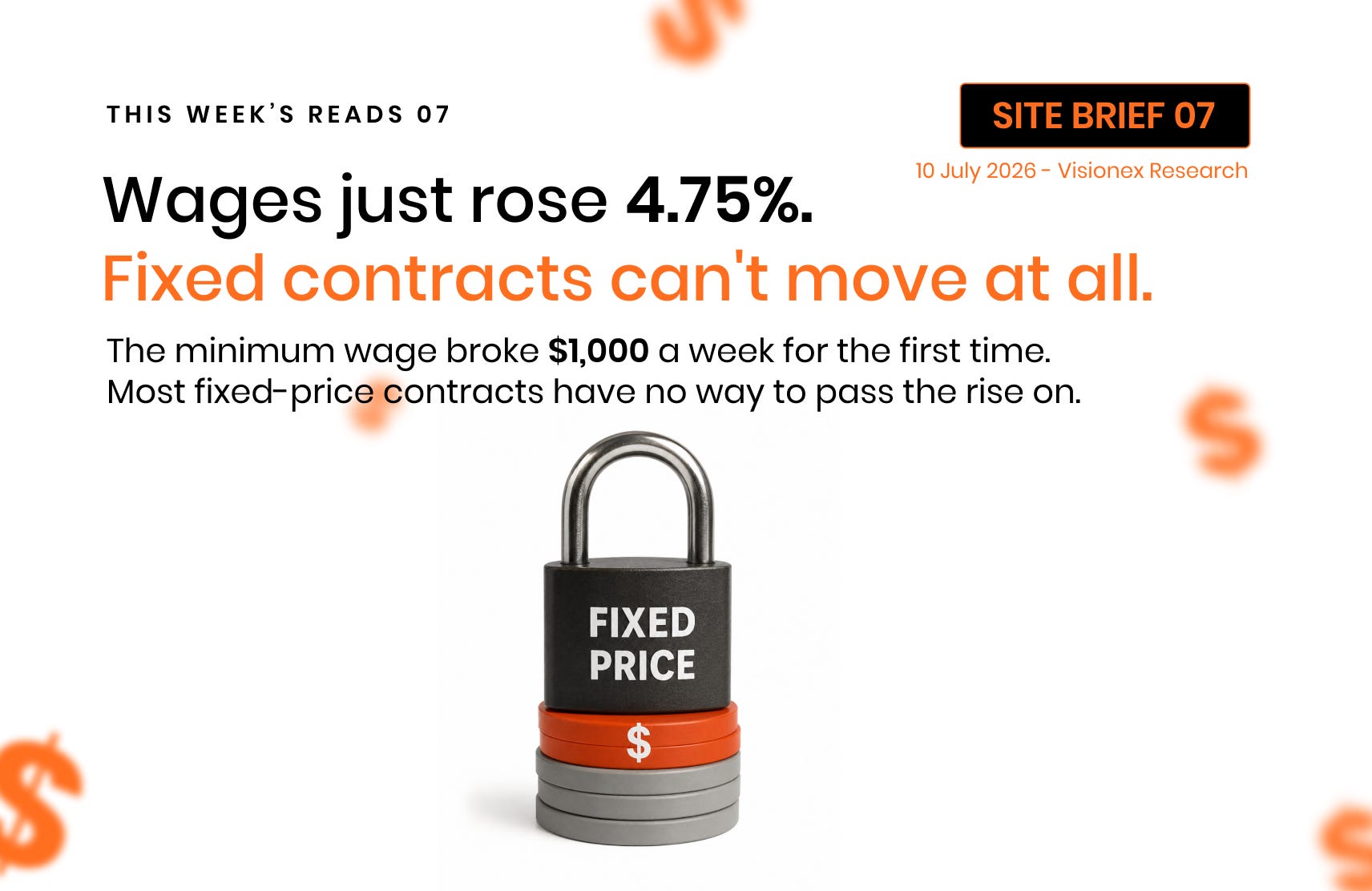
Every pay level in the construction award rose by the same 4.75% on 1 July. The fixed-price contract sitting on most desks was never built to move.
Every construction wage story this month tells the same version of events: the lowest paid got the biggest rise, and the cost of a labourer just jumped harder than the cost of a tradesperson. It is a tidy story. It is also not what happened inside the award that actually governs Australian construction, and what it’s hiding matters more than the headline.
On 1 July, the Fair Work Commission pushed the National Minimum Wage (NMW) past $1,000 a week for the first time in the country’s history, lifting modern award wages 4.75%. A separate reform, phasing out the lowest pay classifications across the award system, has been widely reported as pushing construction’s bottom rung up by even more. We checked that claim against Fair Work’s own pay guide for the award construction actually runs on. It doesn’t hold.
That correction matters less than what it exposes. A wage rise that lands evenly still has to be paid by someone, and most of the industry is currently working under contracts that were never built to let that cost move anywhere.
1. The number, and the one that came before it
Fair Work’s Annual Wage Review 2026 lifted the National Minimum Wage from $948.00 to $1,004.90 a week, or $24.95 to $26.44 an hour, effective the first full pay period on or after 1 July 2026. Modern award minimum rates rose by the same flat 4.75% across the board, including the Building and Construction General On-site Award - a smaller jump than the NMW’s own rise, which reflects the boosted C13 rate covered below. For an estimator, that is now the floor every subcontractor rate has to be checked against, not a one-off news item to skim past.
2. The claim that doesn’t survive the pay guide
Alongside the general rise, the Commission began phasing out a classification called C13, the lowest ongoing rate in the award safety net, moving the floor toward the next rate up. Workers actually paid at C13 get an extra 1.2% this year, taking their rise to 5.95%. That change is real, and it’s why this has been framed as construction’s lowest earners getting the bigger lift.
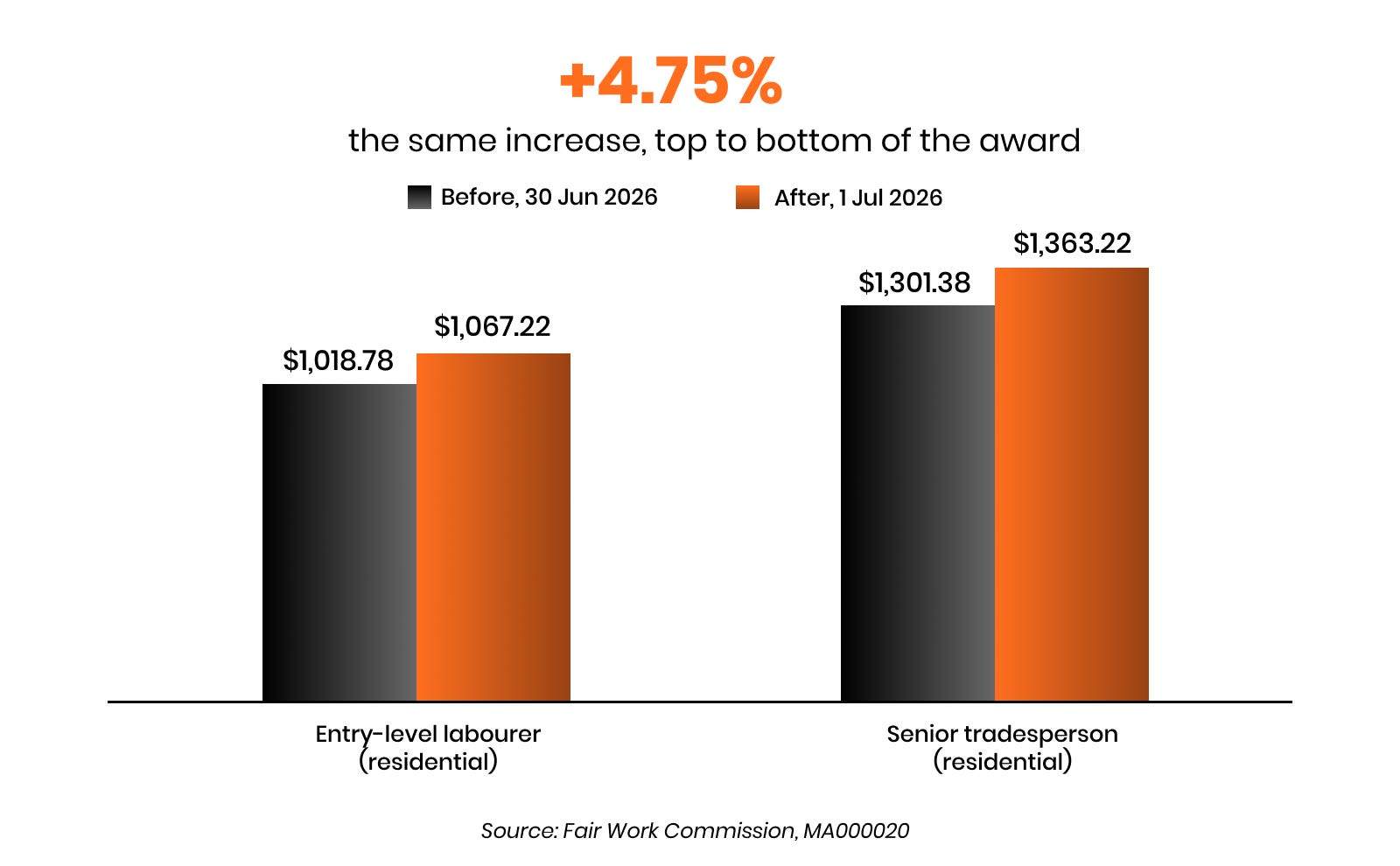
C13 is not a label used inside the Building and Construction Award itself. It is a benchmark the wider award system is measured against. Construction has its own ladder, and we checked it directly: an entry-level residential labourer’s rate rose from roughly $1,018.78 to $1,067.22 a week. A senior tradesperson’s rose from roughly $1,301.38 to $1,363.22. Same 4.75%, top to bottom.
Nobody inside this award got the extra bump.
3. Why an equal rise costs more, not less
A flat percentage rise behaves differently to a bottom-loaded one. If the lowest rates had moved further than the top, a business running mostly qualified trades would have felt a softer blended increase than the headline suggested. Because every level moved together, a payroll weighted toward experienced, higher-paid workers absorbs the full 4.75% in dollar terms.
Take a builder who signed a fixed-price residential contract in May, pricing labour against the award rate as it stood then. That gap between the old rate and the new one is now theirs, not their client’s, because most Australian building contracts are lump-sum: the price is set before work starts and does not move even if costs do. A rise and fall clause can be written in to let it move, but the majority of private-sector construction contracts don’t include one, and even the standard national commercial contract, AS4000, has no built-in mechanism. It has to be added deliberately, or it simply isn’t there.
4. Victoria has had this problem for a decade and hasn’t fixed it
Victoria shows how bad the gap can get. Under the Domestic Building Contracts Act 1995, a residential contract cannot include a cost escalation clause unless the price exceeds $500,000, and even then, the clause needs a notice form approved by the Director of Consumer Affairs Victoria. Consumer Affairs Victoria’s own current guidance for builders confirms that form has never been approved. In practice, no Victorian residential builder, at any contract value, has a working legal path to pass this rise on right now. The same guidance tells builders to price wage rises in upfront instead.
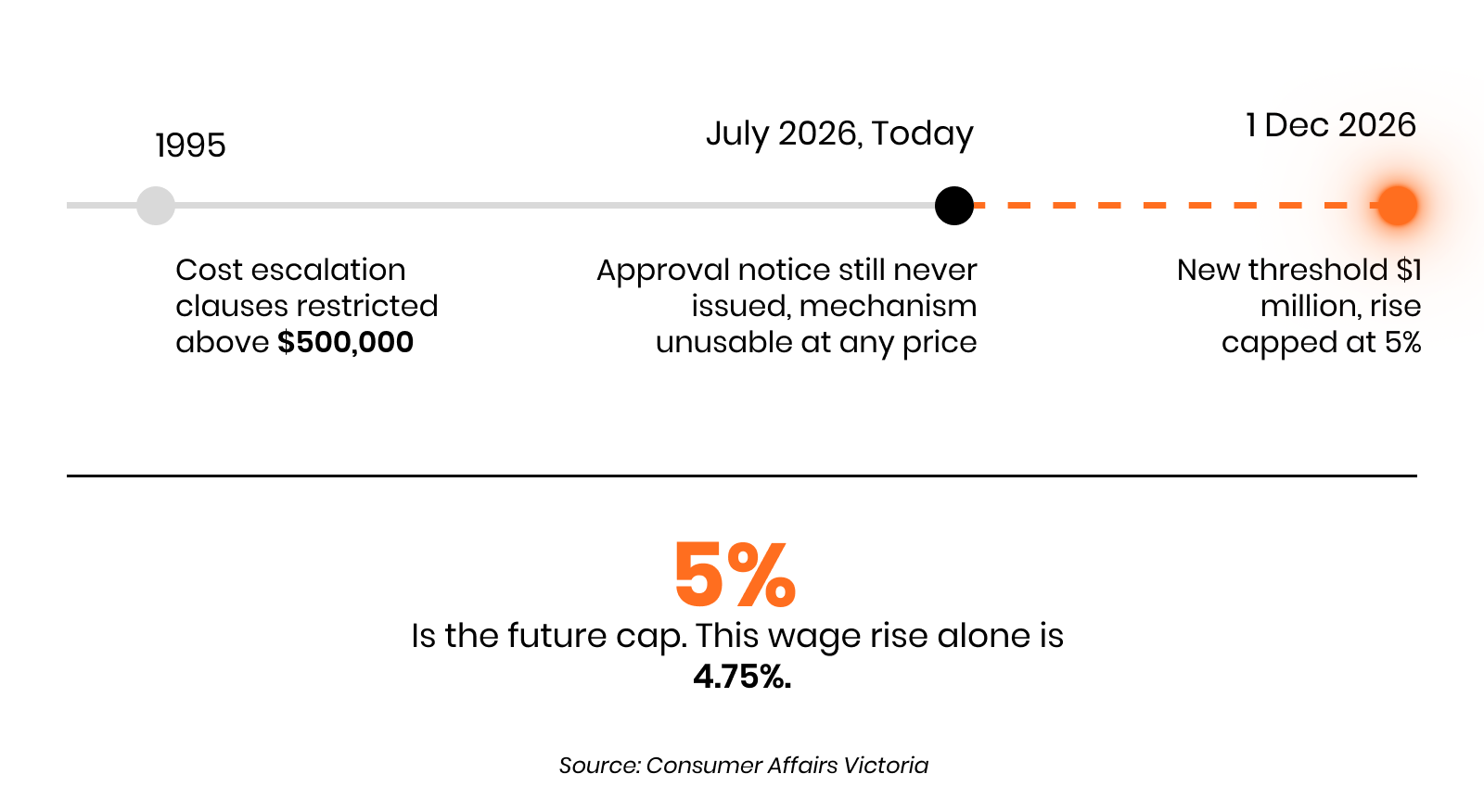
A fix is coming. A reform passed in September 2025 will raise the threshold to $1 million and cap escalation at 5%, but it doesn’t commence until 1 December 2026 at the earliest, and only for contracts signed after that date.
It’s worth sitting with the maths: a 5% cap barely covers this one wage rise alone, before a single material cost is added.
5. A clause in the contract is not the same as a working one
Queensland doesn’t ban these clauses, but a 2023 District Court decision shows how easily they fail anyway. In Perera v Bold Properties, a builder tried to add roughly 8% to a $645,370 fixed-price contract for rising material and labour costs. The court voided the clause: it was too vague about how any increase would be calculated, the mandatory warning didn’t comply with Queensland’s building law, and it was ruled an unfair contract term under consumer law. The builder kept the original price and paid the homeowners’ legal costs.
That result generalises well past one state. Having a clause is not the same as having one that survives a dispute.
The wage rise didn’t choose winners inside the award. The contract did. Two builders can face the identical 4.75% increase and land in completely different positions, one because a tender priced it in last month, the other because a contract signed in May has no mechanism to move at all.
The number making headlines is the same for everyone. What happens to it next depends entirely on paperwork most businesses signed without reading for exactly this scenario. That is the part worth checking this week, before the next rate rise makes the gap bigger.
What does this look like from where you’re standing?
If you’ve signed fixed-price work in the last few months, have you checked whether it actually has a working way to move if costs do? Leave a comment below.
Our next Deep Dive turns to the $1.2 million problem hiding in contract language itself, and why contract wording sits behind the large majority of construction disputes.
See you next week !
This article is general market commentary and does not constitute financial advice.
Keep reading
More from the bid team
14 October 2026 · Visionex Solutions
The Call You Should Not Make
Construction runs on relationships: a quick call to the client, a coffee with the project manager, a word on the site walk.
6 October 2026 · Visionex Solutions
How Defence Actually Evaluates
In Defence's final evaluation for the Army's new infantry fighting vehicles, then planned as a fleet of up to 450, Rheinmetall's tendered price was almost...
30 September 2026 · Visionex Solutions
The Bid You Should Not Submit
Defence's standard construction tender form asks you to declare that bidding was your own commercial decision. The question is whether you actually made one.
Have a tender on your desk?
Send it through. Within 24 hours you will have a go or no go call, a returnables check, and a clear view of where the marks are.