Home/Blog/Series 1 Recap: The Map You Now Have
Defence · 9 September 2026 · Visionex Solutions
Series 1 Recap: The Map You Now Have
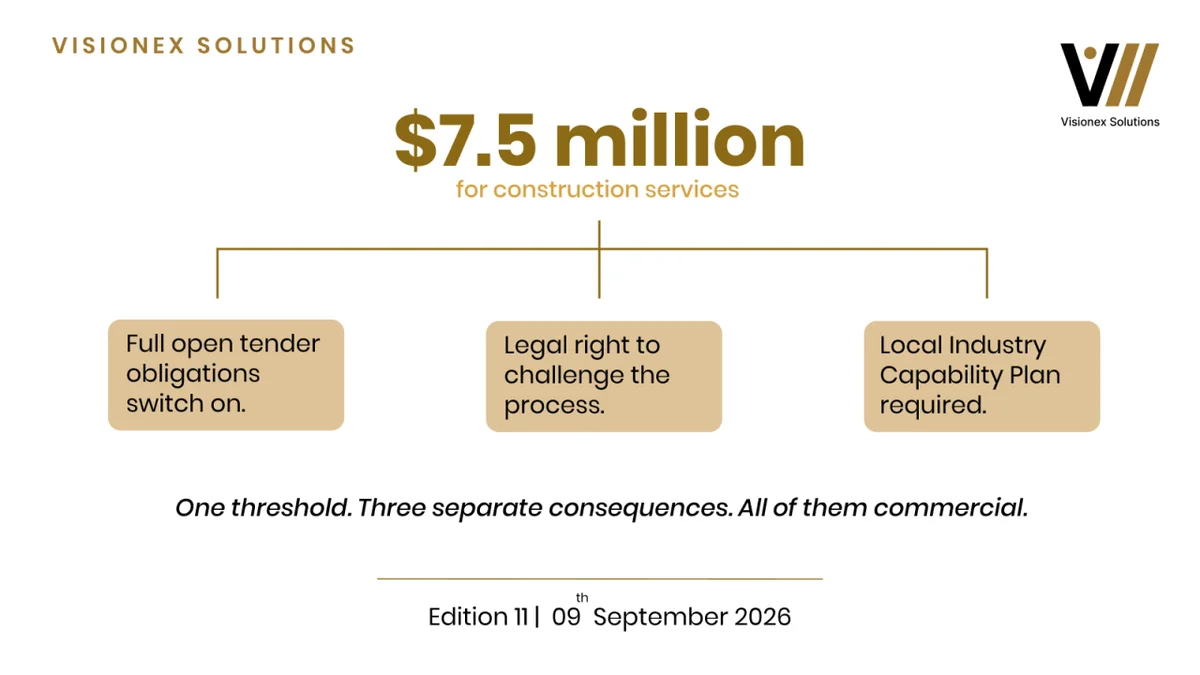
One number has turned up in three separate editions of this series, in three unrelated contexts.
One number has turned up in three separate editions of this series, in three unrelated contexts.
$7.5 million. In Edition 03 it switched on the full open tender obligations of Commonwealth Procurement Rules Division 2, and made a construction procurement a covered procurement under the Government Procurement (Judicial Review) Act 2018, with legal rights attached. In Edition 10 it returned as the threshold at which construction services require a Local Industry Capability Plan.
One figure, three commercial consequences. Nothing in this arena is arbitrary, and almost nothing is where a capable builder would expect to find it. Ten editions in, what this series leaves you with is not a summary. It is a correction, repeated often enough to be the pattern.
The market you were told about is not the market you would be entering
Most commentary on Australian defence procurement describes the equipment world: ships, vehicles, weapons, sorted by Acquisition Category and debated in ACAT ratings.
Edition 05 showed why that world is largely irrelevant here. Defence runs three procurement systems, not one with big and small versions. Equipment and materiel. Services. And construction and infrastructure, where most readers sit, administered through the Security and Estate Group and its Estate Works Program on entirely separate machinery.
That separation is why general defence industry advice misfires for builders. Edition 10 made the sharpest version of the point: the $4 million AIC threshold quoted in nearly every explainer is the wrong number for a construction firm. Your instrument is the Local Industry Capability Plan, and it starts at $7.5 million. Before accepting any figure as applying to you, ask which of the three systems it was written for.
The gates you were afraid of are narrower than you think
Two beliefs keep capable firms out of this market, and Series 1 dismantled both.
The first is clearance. Edition 06 put a number on it. Of 58,310 Defence contracts on foot between July 2018 and November 2020, only 11.8 per cent were held by firms that had joined the Defence Industry Security Program since it opened up in April 2019. Longer-standing members sit on top of that, but not enough to close the gate. DISP gates real things, chiefly classified information and assets. It does not gate the market.
The second is panels. Edition 08 found that assumption failing three ways at once. The Defence Infrastructure Panel does not cover construction or design work, apart from a narrow aircraft pavements exception. The panel that does cover construction starts at $200 million. And the programme that suits a mid-sized contractor has no panel at all. Many firms have been queuing at a door that was never their entrance.
The gates that actually bite are the ones nobody warns you about
Edition 07 produced the most uncomfortable finding in the series. The Australian Government Security Vetting Agency cleared Negative Vetting Level 1 applications in a median of 49 business days against a target of 70. Over the same period, only 59.6 per cent of applications were submitted and verified as complete within 30 business days against a target of 85, and that result went backwards. The government half is improving. The industry half is not. The benchmarks do not start counting until a complete application is verified, so every day your own side loses is invisible in the statistics and entirely your cost.
The pattern repeats. Thresholds trigger obligations quietly: $4 million for WHS accreditation on directly funded Commonwealth building work, $30 million where a Gateway assurance review can apply, the Public Works Committee Act on top of both. Edition 09 showed that answering the wrong ASDEFCON variant means no amount of good writing rescues the bid. Edition 10 showed a contractor promise $5.2 million in local spend and deliver $1.4 million, the shortfall visible from the first progress report and unremarked all the way to completion. Nothing failed. Nothing was set up to look.
And the ground is moving underneath all of it
Editions 02 and 04 covered the change that took effect on 1 July 2026. Capability development is centralised under the Vice Chief of the Defence Force, while delivery sits with the National Armaments Director and the new Defence Delivery Group. Defence's governing principle is that whoever is accountable for a project controls its funding, which tells you who to talk to and when. Timing works the same way. The 2026 Integrated Investment Program allocates around $425 billion through to 2035-36, but that is intent, not an order book. Before second pass, a project has direction and no committed funding.
What this means for you
Take one real project, the kind you would want if it appeared next month, and answer four questions in order. Which of the three systems is it in, and which thresholds therefore apply to you? Is the money committed or merely intended? Which obligations does its value trigger, and do you hold them today rather than at tender close? And can you evidence the commitments you would make, not just write them?
Most firms find their real gap in the third or fourth question. Both are fixable. Neither is fixable in the four weeks a tender is open.
What Series 2 does
Series 1 was about the arena. Series 2 is about the contest inside it, and it starts next Wednesday.
Twelve editions, same day, same length. We open the tender pack and work through what each document actually does, then move to how evaluation really works, what the rules of contact permit and forbid, and how a bid is run in the weeks between release and close. Along the way: the requirements that quietly sink capable bidders, what a Local Industry Capability Plan has to prove rather than promise, how Defence structures and tests price, and what your rights are after you submit.
If Series 1 told you whether to be in this market, Series 2 tells you how to compete in it. Stay subscribed and it arrives on its own.
What do you most want covered? Tell us in the comments and it will shape how these editions are written.
This is Edition 11 of the Australian Defence Tender Framework series by Visionex Solutions, and the close of Series 1. The series publishes every Wednesday. Series 1: Understanding the Arena ran from 1 July to 9 September 2026.
Between editions, follow us on LinkedIn for Australian defence industry news, facts, and market insights.
We have also opened The Bid Room, a free community for Australian companies working through defence tendering for the first time. It is a place to ask questions between editions, compare notes with other builders and suppliers navigating the same system, and get a steer on your specific situation rather than waiting a week for the next edition. If you have finished Series 1 with a question about your own position, that is the place to bring it. Come and say hello.
Next edition: Series 2 begins, with what is actually inside a defence tender pack and why most first-time bidders read the wrong document first.
Keep reading
More from the bid team
15 September 2026 · Visionex Solutions
The Pack You Downloaded Is Not the Pack You Are Signing
Inside the Tender begins where Series 1 left off. Defence has chosen a contracting template, and it has just landed in your inbox.
2 September 2026 · Visionex Solutions
The $5.2 Million Promise Nobody Checked
In September 2022 a contractor began an electrical works contract at RAAF Learmonth, later valued at $19.33 million. Its tender promised $5.2 million local.
25 August 2026 · Visionex Solutions
ASDEFCON: The Rulebook Every Defence Bidder Signs Without Reading Twice
Somewhere inside a Defence Request for Tender, a mid-sized contractor bidding for defence work for the first time can be asked to write a draft Phase Out Plan.
The Bid Room
Learn this stuff live with other contractors
The Bid Room is our Skool community for Australian contractors who tender. Live sessions, scoring walkthroughs and templates you can use on your next submission.
Have a tender on your desk?
Send it through. Within 24 hours you will have a go or no go call, a returnables check, and a clear view of where the marks are.