Home/Blog/Payday super won’t break construction businesses. It will reveal which ones were already broken
Industry News · 11 June 2026 · Hashan Senarathna
Payday super won’t break construction businesses. It will reveal which ones were already broken
This Week's Read 05 | Issue 011 | 2026 — a Hashan Senarathna deep dive.
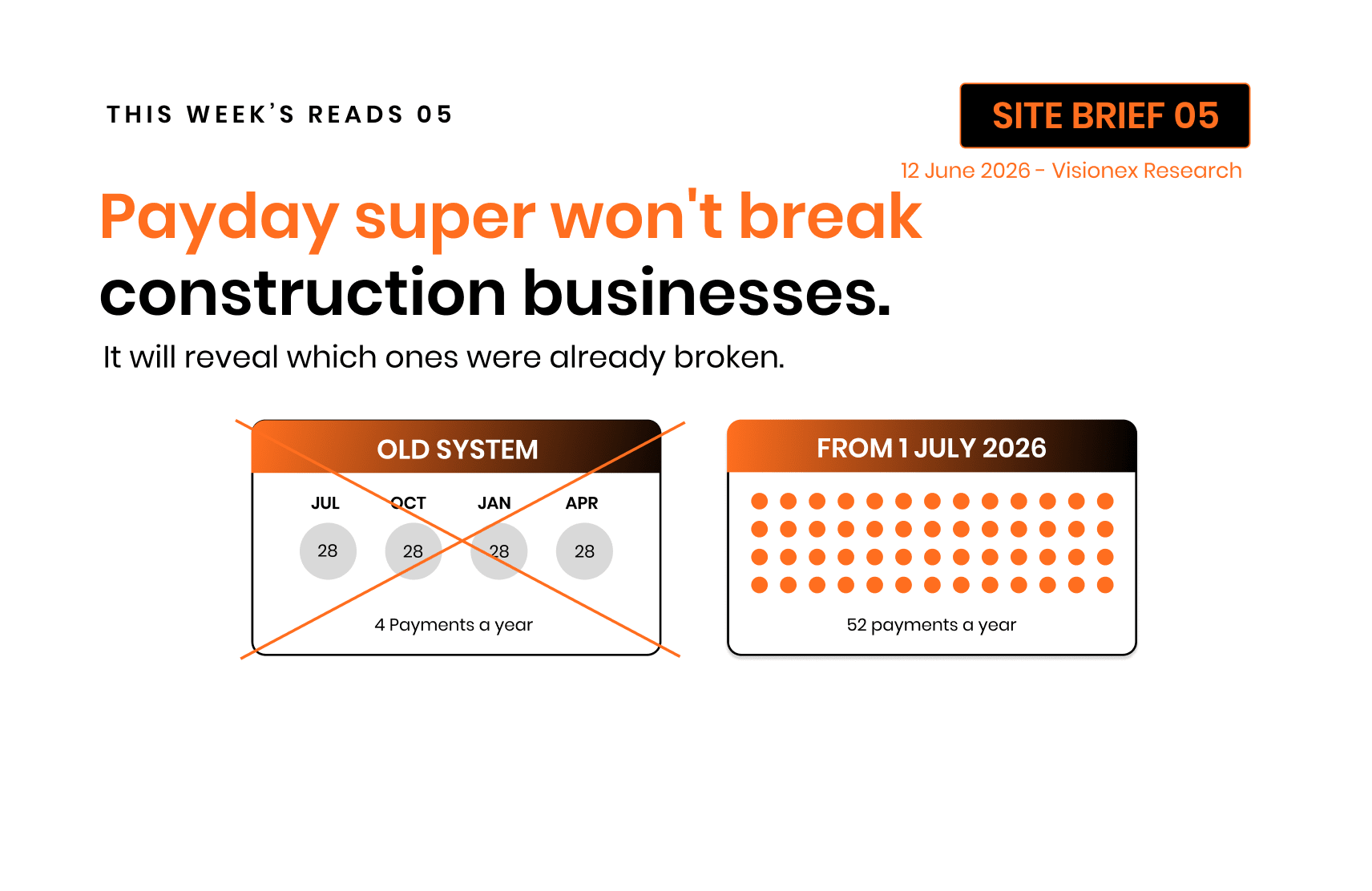
The businesses that will feel payday super are not the ones that lost track of it. They are the ones that had come, over time, to depend on a three-month timing gap that was never meant to serve that purpose. From 1 July 2026, it is gone.
For more than three decades, the quarterly superannuation system gave Australian employers permission to hold up to three months of super obligations before settling them. For a sector built on thin margins and slow payment cycles, that gap became something it was never designed to be: working capital. From 1 July 2026, it is gone.
Payday super will not create that problem. It will reveal it.
1. What is actually changing ?
The mechanism is simple. From 1 July 2026, every employer must ensure superannuation reaches an employee’s fund within seven business days of payday, not 28 days after the end of a quarter. The rate stays at 12 %. The systems and the obligation are otherwise familiar. What changes is timing, and timing is the whole story.
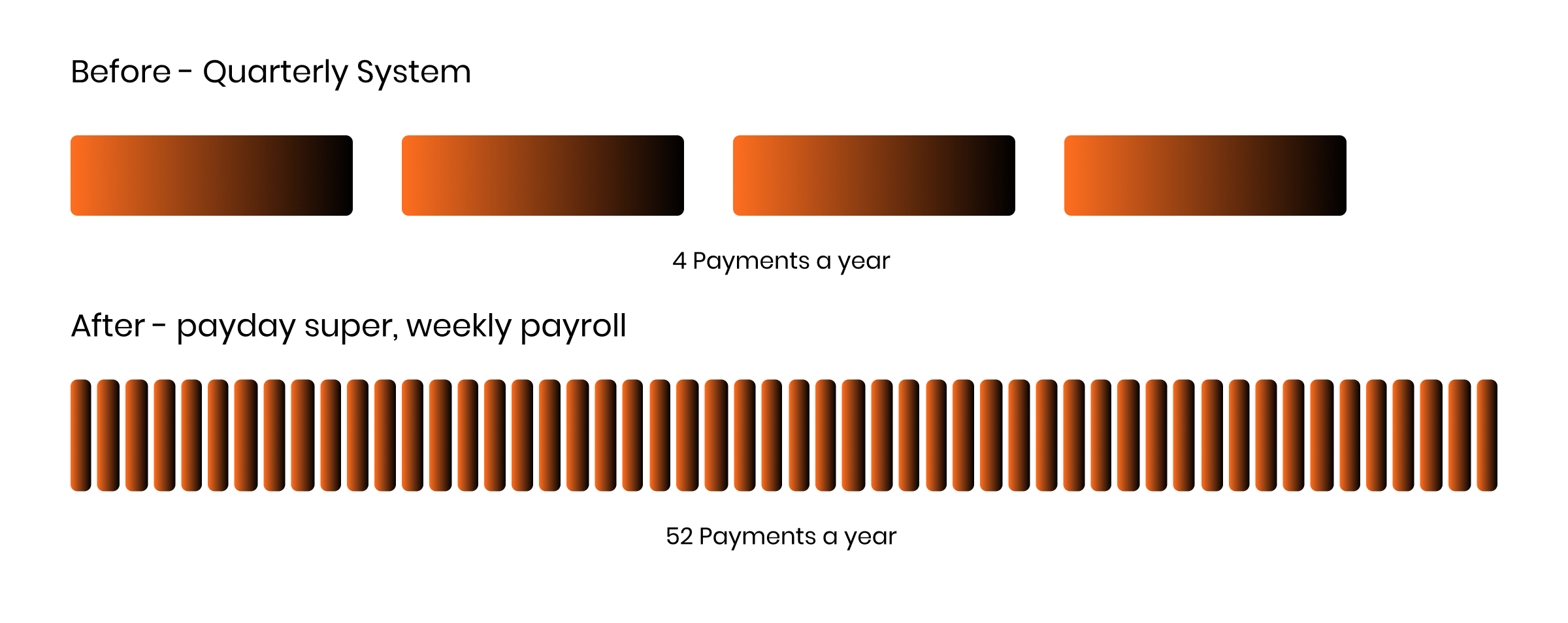
For a business paying fortnightly, super submissions move from four a year to 26. For weekly payroll, common across trades, they move from four to 52. The Australian Taxation Office (ATO) will see each one in close to real time through Single Touch Payroll, matched against fund records. A missed payment now surfaces in days, not months.
This is the part most operators have not fully absorbed. The quarterly gap was never just an administrative convenience. For some businesses it was the float that kept the lights on between a slow-paying head contractor and the next invoice. Remove the float, and the underlying cash position becomes visible immediately.
2. Why this lands hardest on construction ?
Construction is the most exposed industry in the country to this change, and the data is not close.
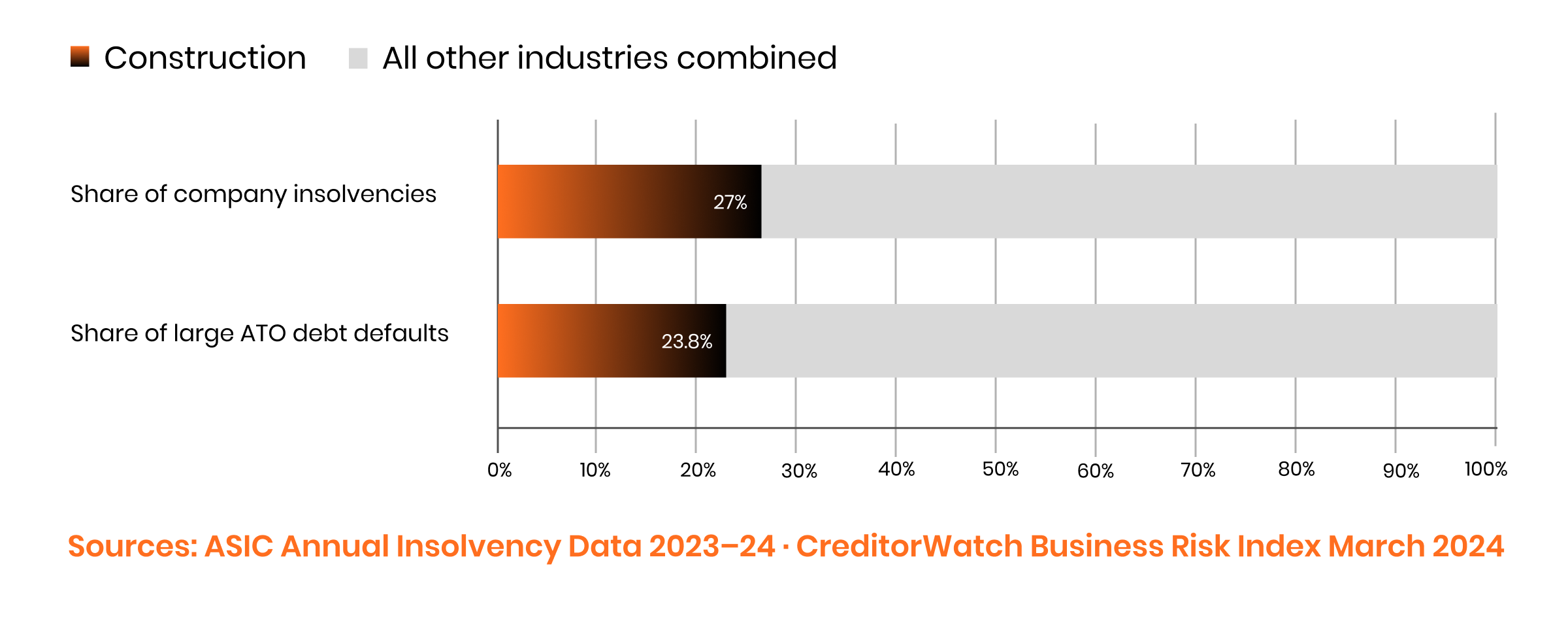
The sector records around 27% of all company insolvencies nationally, the highest of any industry, every year for more than a decade. It also dominates tax stress. Of all ATO tax debt defaults over $100,000 tracked by CreditorWatch, construction accounts for 23.8%, the largest share of any sector. Roughly 70% of those records are from construction services firms, mostly small subcontractors.
That concentration is not random. It is structural. Construction subcontractors front wages and materials daily, then wait an average of 32 to 50 days to be paid. With more than 98% of the sector’s 462,939 businesses employing fewer than 20 people, most operators have no finance team and no credit buffer. The quarterly super hold was, for many, the only thing standing between a tight month and a missed obligation.
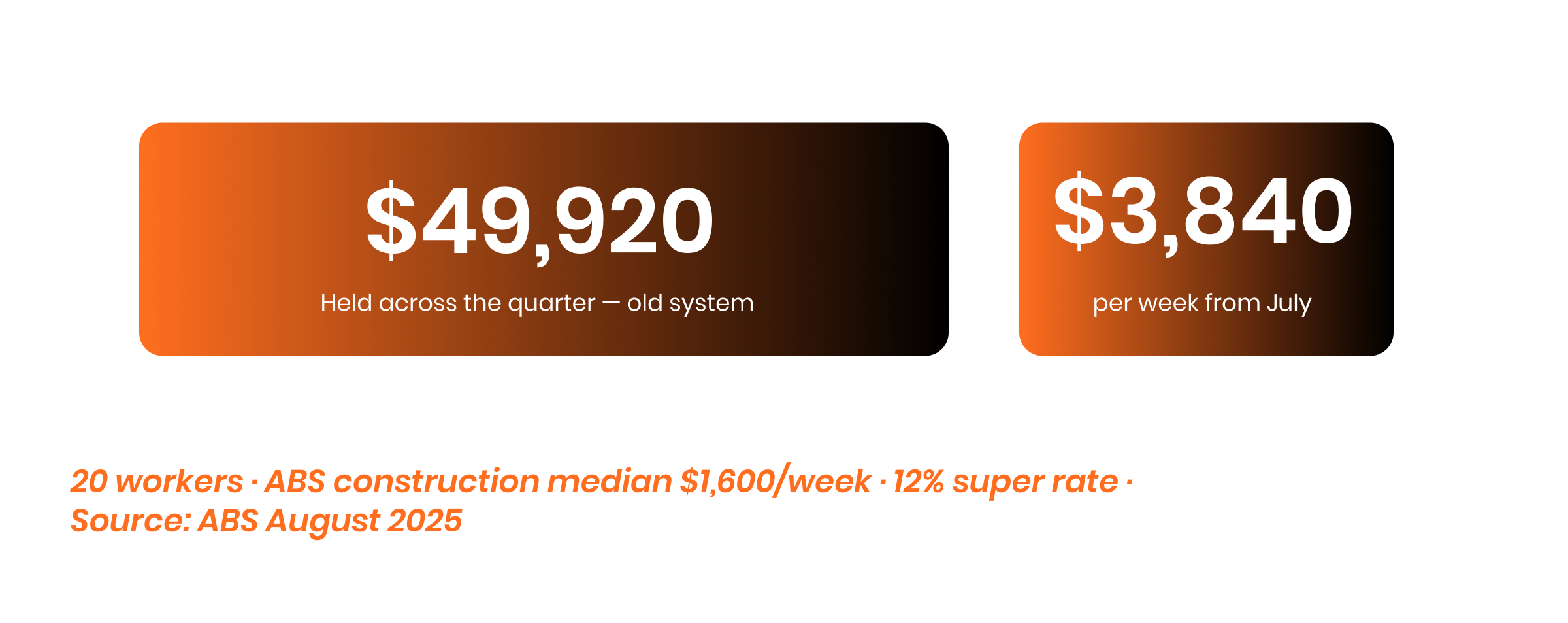
Consider a subcontractor with twenty workers on weekly pay at the industry median of $1,600 per week (ABS August 2025). Under the old system, the super owing across a quarter sat at around $49,920 before it was legally due. That money was spent and replaced, spent and replaced, as a rolling buffer. From 1 July 2026, that same business must remit $3,840 every week- on time, every payday cycle, with no grace between pay run and fund receipt. Nothing about the business has changed. What changes is that the buffer is gone, and the true cash position is exposed.
3. The reform exists for a reason
It is worth being clear about why government acted. The ATO estimates that around $6.25 billion in super went unpaid in a single recent year. The Super Members Council puts the figure at 3.3 million workers shortchanged $5.7 billion in 2022-23 alone, and more than $47 billion over the decade. For a 25-year-old on median wages, Treasury modellingsuggests earlier payment could mean around $6,000 more at retirement through compounding.
Unpaid super has long been one of the earliest signals that a business is under strain. Payday super turns that signal from an annual whisper into a real-time alarm.
4. The enforcement is sharper than the headline
The compliance change matters as much as the cash flow change. Miss the seven-day window and the Super Guarantee Charge applies, now assessed per payday rather than per quarter. It carries daily compounding interest and an administrative uplift of up to 60% of the shortfall and interest. For directors, the exposure is personal and, in many cases, unavoidable: a Director Penalty Notice for unpaid super is a lockdown notice, meaning that placing the company into administration after the fact does not extinguish the personal debt. The ATO issued more than 84,500 Director Penalty Notices in 2024-25, a 136% jump.
There is a first-year grace period under the ATO’s PCG 2026/1, which protects employers who genuinely try and fix errors quickly. It does not protect those who were using super as cash. From 1 July 2027, even that leniency ends.
5. What the strong firms already do
The businesses that will move through this without disruption share a pattern. It has nothing to do with luck.
They never treated super as working capital. They model total employment cost, not net wages, so the 12% was always real money in their forecasting. Their payroll systems are ready for the new reporting requirements, and they watch their ATO position as a live number rather than a year-end surprise. Roughly 40% of Australian employers already pay super more often than quarterly. For them, 1 July is a scheduling change, not a shock.
That is the real divide. Payday super does not separate good builders from bad ones. It separates businesses with genuine working capital from businesses that were structurally dependent on the quarterly gap to manage their obligations. That dependency is now visible in a way it never was before.
The most useful way to read this reform is not as a compliance deadline. It is as a diagnostic.
For the next twelve months, the question for any contractor, developer or procurement team is not whether a counterparty can do the work. It is whether that counterparty can pay super every cycle without strain. From July, that answer is visible in a way it never was before. A subcontractor who suddenly struggles to remit weekly super is showing you their cash position in real time. That is worth paying attention to before it becomes your delivery risk.
Payday super was designed to protect workers. Its quieter effect will be to show the market which businesses were already running on borrowed time. The firms that built real financial discipline will barely notice. The firms that did not are about to find out, and so is everyone who contracts with them.
What does this look like from where you are standing?
For the contractors, developers, subcontractors and procurement teams reading this: are you already paying super more frequently than quarterly, or is July 2026 a genuine adjustment?
The most useful conversations in this industry start before the deadline arrives. Leave a comment below.
This is the first of a closer look at financial discipline in Australian construction. Our next Deep Dive examines the cash architecture that the strongest builders actually run.
See you next week.
This article is general market commentary and does not constitute financial advice.
Keep reading
More from the bid team
14 October 2026 · Visionex Solutions
The Call You Should Not Make
Construction runs on relationships: a quick call to the client, a coffee with the project manager, a word on the site walk.
6 October 2026 · Visionex Solutions
How Defence Actually Evaluates
In Defence's final evaluation for the Army's new infantry fighting vehicles, then planned as a fleet of up to 450, Rheinmetall's tendered price was almost...
30 September 2026 · Visionex Solutions
The Bid You Should Not Submit
Defence's standard construction tender form asks you to declare that bidding was your own commercial decision. The question is whether you actually made one.
Have a tender on your desk?
Send it through. Within 24 hours you will have a go or no go call, a returnables check, and a clear view of where the marks are.