Home/Blog/Infrastructure Mega projects: Which States Will Overshoot Budgets and Why the Data Already Shows It
Deep Dives · 21 May 2026 · Hashan Senarathna
Infrastructure Mega projects: Which States Will Overshoot Budgets and Why the Data Already Shows It
The Intelligence Deep Dive 04 | Issue 008 | 2026 — a Hashan Senarathna deep dive.
1. The Pipeline Becomes A Different Problem
The most dangerous mistake in Australian infrastructure right now is treating the pipeline as a funding question.
That was the first question. It is no longer the only one.
Over the past three Deep Dives, the pressure has moved through three layers: scale, cost and conversion.
This fourth piece turns to the next constraint: delivery capacity.
Australia has the funding, the projects and the policy intent. What is less certain is whether the same labour market, contractor base and procurement system can absorb several megaproject cycles at once. Can Australia deliver the megaprojects inside the pipeline without consuming the rest of the construction system?
That distinction matters. A project can be funded and still be undeliverable on the original timetable. A government can allocate capital and still be unable to procure enough qualified contractors. A state can announce a rail line and still be short of tunnel crews, signalling specialists, civil electricians, interface managers, utility relocation teams and commissioning capability.
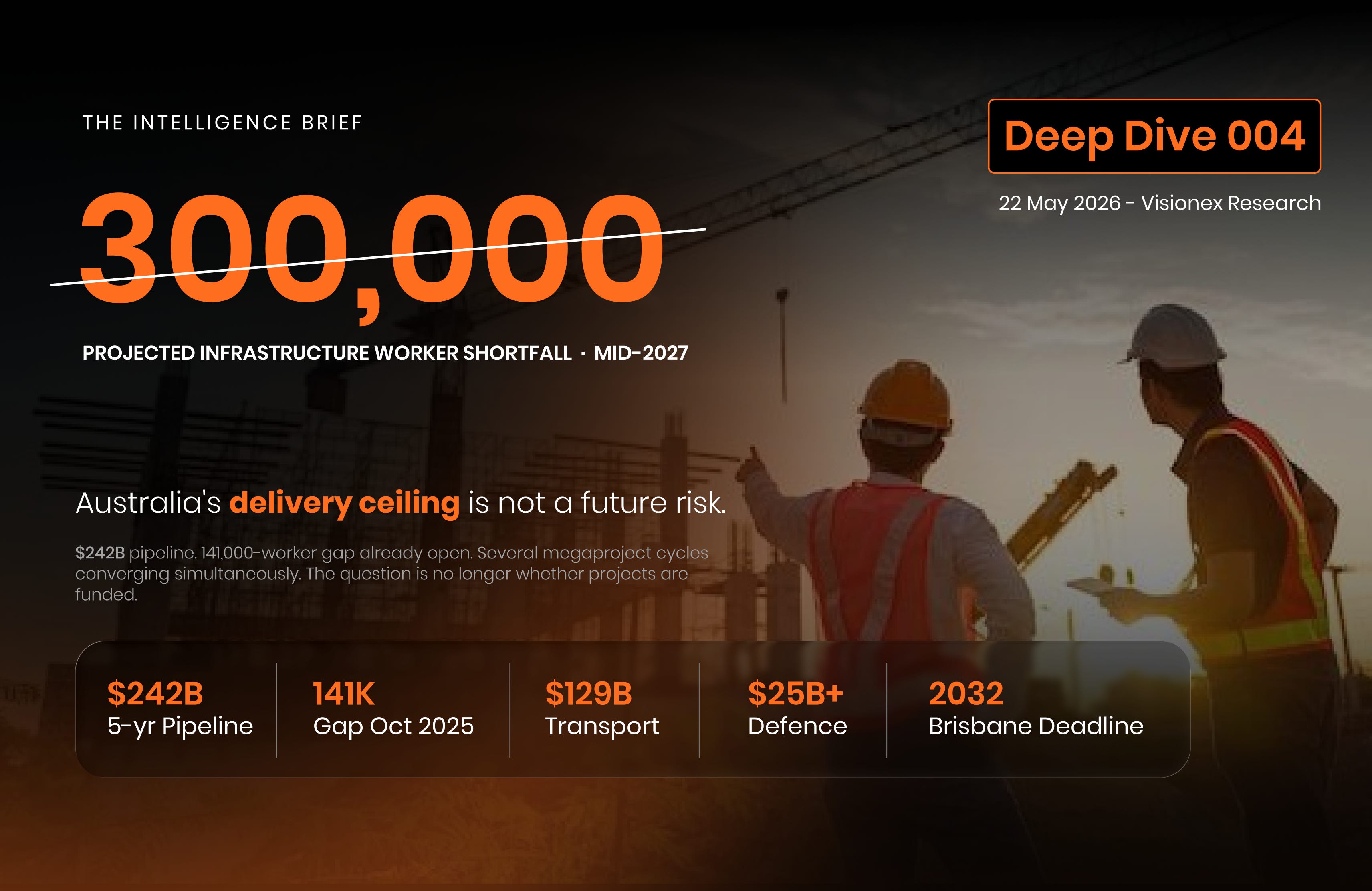
Infrastructure Australia’s 2025 Infrastructure Market Capacity Report places the five-year Major Public Infrastructure Pipeline at $242 billion, with transport still the largest component and utilities rising sharply as energy transition work accelerates. The same report identifies an infrastructure workforce shortfall of 141,000 workers in October 2025, projected to exceed 300,000 workers by mid-2027.
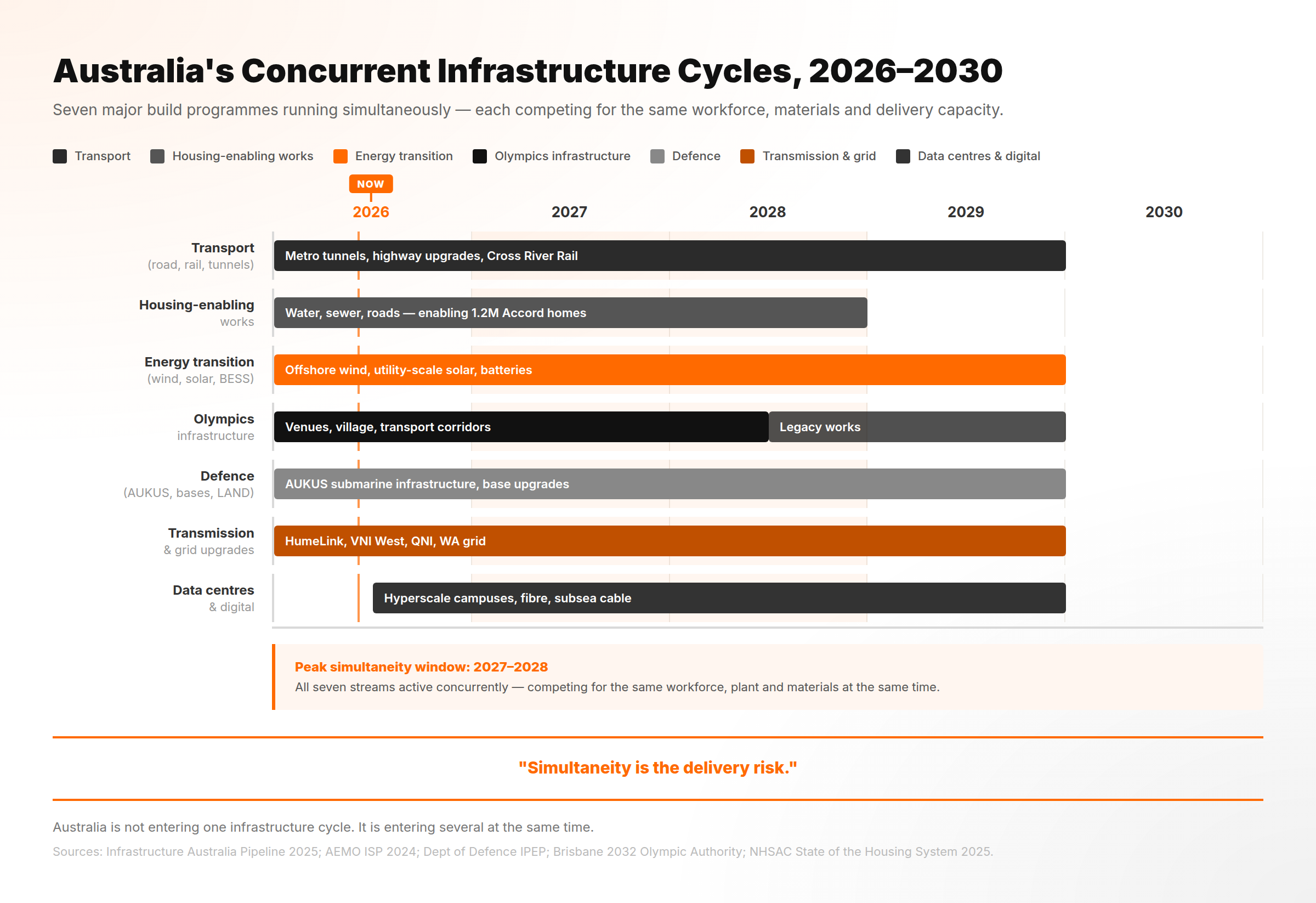
Deep Dive 01 asked whether the national construction pipeline could be delivered. Deep Dive 02 showed why the cost base will not reset quickly enough to save weak feasibilities. Deep Dive 03 showed that national housing recovery hides state-level conversion gaps. Deep Dive 04 applies the same logic to infrastructure: the risk is no longer whether projects are funded, but whether the delivery system can absorb them at the same time. The pipeline is not only large. It is simultaneous.
Transport megaprojects are still running. Housing-enabling infrastructure is being accelerated. Transmission and renewable energy projects are entering procurement. Brisbane 2032 has an immovable deadline. Defence infrastructure is shifting from strategic policy into physical works. Data centres are adding another demand stream for power, land, substations, switchgear and grid connection capacity.
The issue is no longer whether Australia wants to build. It clearly does. The issue is whether the delivery ecosystem can absorb the collision.
This Deep Dive ranks the state-level stress points, explains the engineering and procurement mechanisms behind budget overshoot, and identifies where the 2026 to 2030 pipeline is most likely to break first.
2. Mapping The Infrastructure Federation
Deep Dive 03 mapped Australia as a residential federation. Deep Dive 04 maps a different country.
The infrastructure federation does not follow the same pattern as the housing federation. A state can be closer to its residential target and still be near its infrastructure delivery ceiling. Another can be weaker on housing conversion but more mature in transport delivery. The national pipeline hides that variation.
The ranking in this piece is based on seven indicators: deadline pressure, programme concentration, underground and interface risk, labour market stress, contractor depth, design maturity and strategic non-discretionary status.
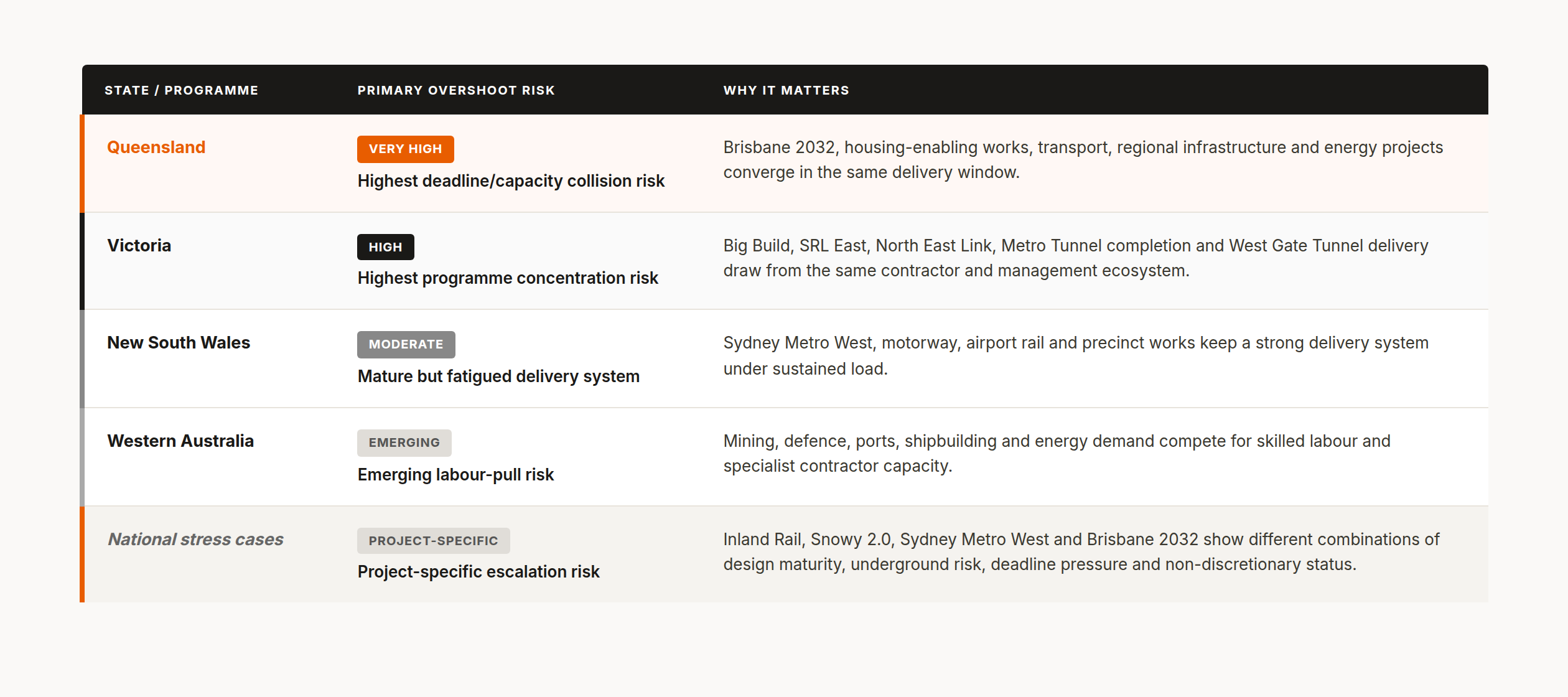
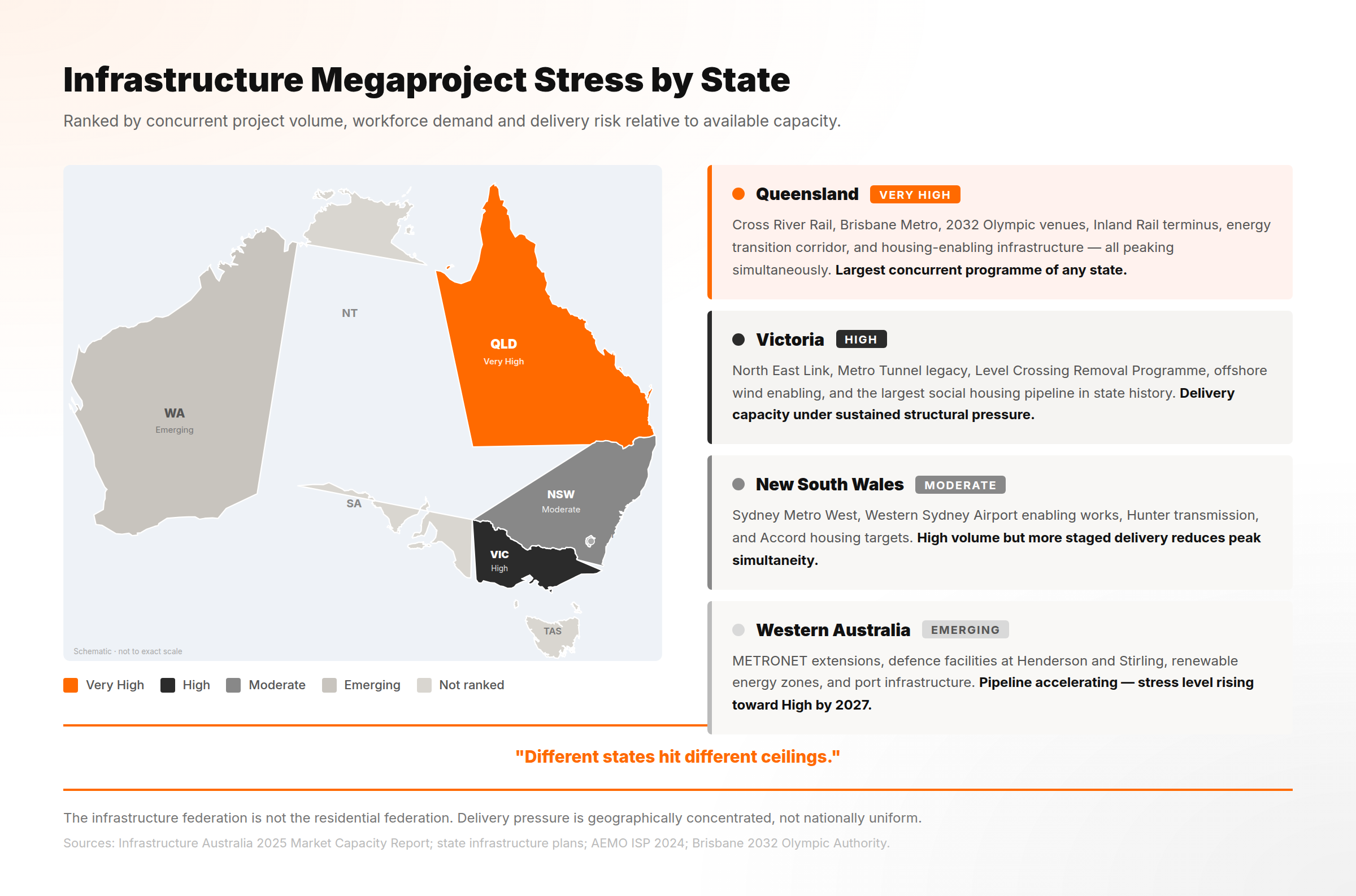
The early answer is clear. Queensland carries the highest deadline and capacity collision risk. Victoria carries the highest programme concentration risk. New South Wales is mature but fatigued after more than a decade of heavy programme load. Western Australia is emerging as a defence, mining, ports, energy and shipbuilding labour-pull market. Inland Rail, Snowy 2.0 and Sydney Metro West then sit as specific project-level stress cases inside the national picture.
Queensland reads as very high stress from an infrastructure angle. That is not because it has the largest absolute pipeline. It is because several delivery waves are converging in the same decade: Brisbane 2032 venues and villages, housing-enabling infrastructure, energy projects, transport upgrades, regional trunk infrastructure and private-sector population growth demand. The Queensland Government’s 2025-26 Budget committed $4.7 billion to implement the 2032 Delivery Plan, including funding for games venues and athlete villages.
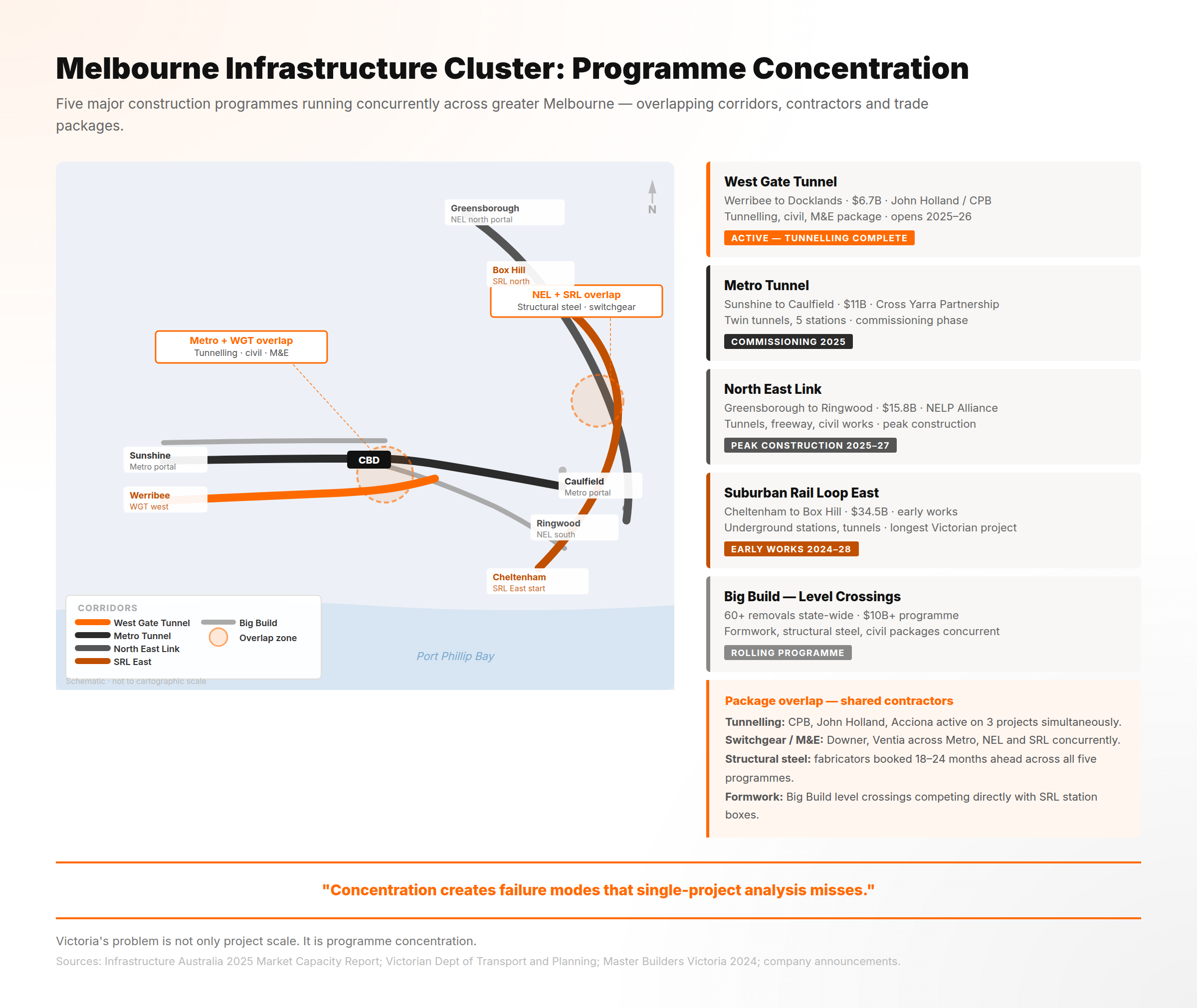
Victoria reads high. Its infrastructure problem is programme concentration. The state is carrying the Big Build, Suburban Rail Loop East, North East Link, Metro Tunnel completion and West Gate Tunnel delivery inside the same institutional ecosystem. Victoria’s Big Build describes major road and rail projects as being underway across the state, with several delivery milestones overlapping rather than sequencing neatly.
New South Wales reads moderate, but only because it is mature. Its risk is not that the infrastructure machine is untested. It is that the machine is now carrying Sydney Metro West, motorway extensions, airport rail and continuing metro delivery after a long period of heavy programme load. The Sydney Metro Independent Review was commissioned because the programme had reached a scale where value for money, governance and delivery models needed external scrutiny.
Western Australia reads emerging. Its public infrastructure pipeline is less dense than the eastern states, but the labour market is exposed to mining, defence, ports, energy and shipbuilding demand. The Commonwealth has committed $12 billion to the Henderson Defence Precinct, expected to support around 10,000 direct jobs over two decades.
The infrastructure federation is therefore not a ranking of ambition. It is a ranking of stress, and the stress is different in each state. Queensland is exposed through deadline pressure, Victoria through concentration, New South Wales through committed-load fatigue and Western Australia through emerging specialised labour pull.
3. The Iron Law Of Megaprojects: What Global Data Predicts For Australia
Megaprojects have a habit of making intelligent people overconfident.
That is not an Australian observation. It is global.
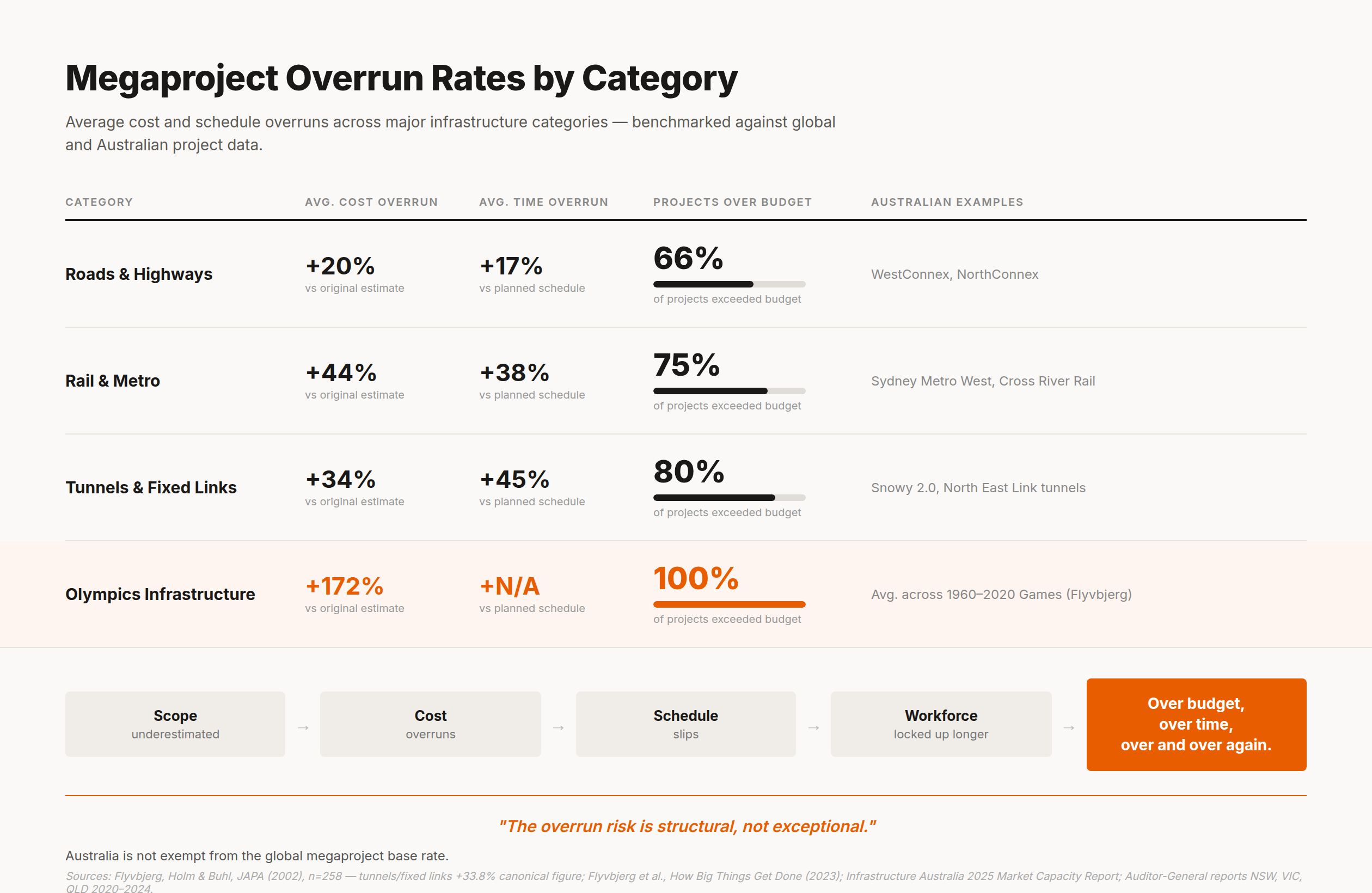
Bent Flyvbjerg’s work on megaprojects is useful because it removes the comforting idea that overruns are rare accidents. Flyvbjerg, Holm and Buhl’s global transport infrastructure research, published in the Journal of the American Planning Association found average real cost overruns of around 20% for roads, around 45% for rail, and around the mid-30% range for fixed links, including bridges and tunnels. Their sample covered 258 transport infrastructure projects across project types, regions and historical periods, so the figures should be read as a global base rate, not an Australian-specific estimate.
The Olympics evidence belongs in a separate lane. The Oxford Olympics research shows that the Games carry unusually high cost-overrun risk, and its 2024 update specifically places Brisbane 2032 inside the question of whether future Games can meet the International Olympic Committee’s affordability ambitions.
The shorthand attached to this evidence is the Iron Law of Megaprojects: over budget, over time, over and over again.
Australia should treat this as a base-rate warning, not as a slogan.
The behavioural reason this matters is the planning fallacy. Daniel Kahneman and Dan Lovallo argued that decision-makers often take the inside view, building forecasts around the specific plan in front of them, rather than the outside view, which starts with outcomes from comparable past projects. For Australian megaprojects, the practical question is not only whether the current business case is internally coherent. It is whether the project has been benchmarked against what comparable projects actually did once procurement, geology, interfaces and labour pressure arrived.
The local evidence points in the same direction. Grattan Institute’s Australian transport infrastructure analysis, still the most recent comprehensive published Australian transport cost-overrun analysis, found that governments spent $34 billion more on transport infrastructure projects than first announced over the previous two decades, and that final costs exceeded promised costs by 21% across projects valued at $20 million or more. Flyvbjerg gives the global base rate. Grattan shows that Australia has its own version of the same problem.
The usual Australian discussion asks whether a project has a good business case, whether the route is right, whether the benefit-cost ratio is defensible, or whether the procurement model is appropriate. Those questions matter. But the global evidence says even projects with strong strategic rationale can still overrun because cost estimates are made before uncertainty is fully revealed, before underground conditions are fully encountered, before utility interfaces are fully known, and before labour markets move against the programme.
The Australian risk is larger because the projects are not arriving one by one.
A tunnel project in a quiet market can still overrun. A tunnel project competing with another tunnel project, a metro package, a transmission build, a defence precinct, Olympics works and housing infrastructure is exposed to a different order of risk. The overrun is no longer only inside the project. It is created by the market surrounding the project.
That is the Deep Dive 04 lens. These figures are not predictions for any one Australian project. They are base rates that become more dangerous when multiple project categories compete for the same delivery market. The question is not whether Australia’s megaprojects will experience overruns. The historical evidence says some will. The question is how much the simultaneity of the 2026 to 2030 pipeline amplifies the normal mega-project pattern.
4. The Specific Competition: Project-by-Project Crowding With Residential
The labour competition claim is now too broad to be useful.
It is not enough to say infrastructure competes with housing. That was established in Deep Dive 03. The commercial question is where the competition actually appears.
It appears in packages.
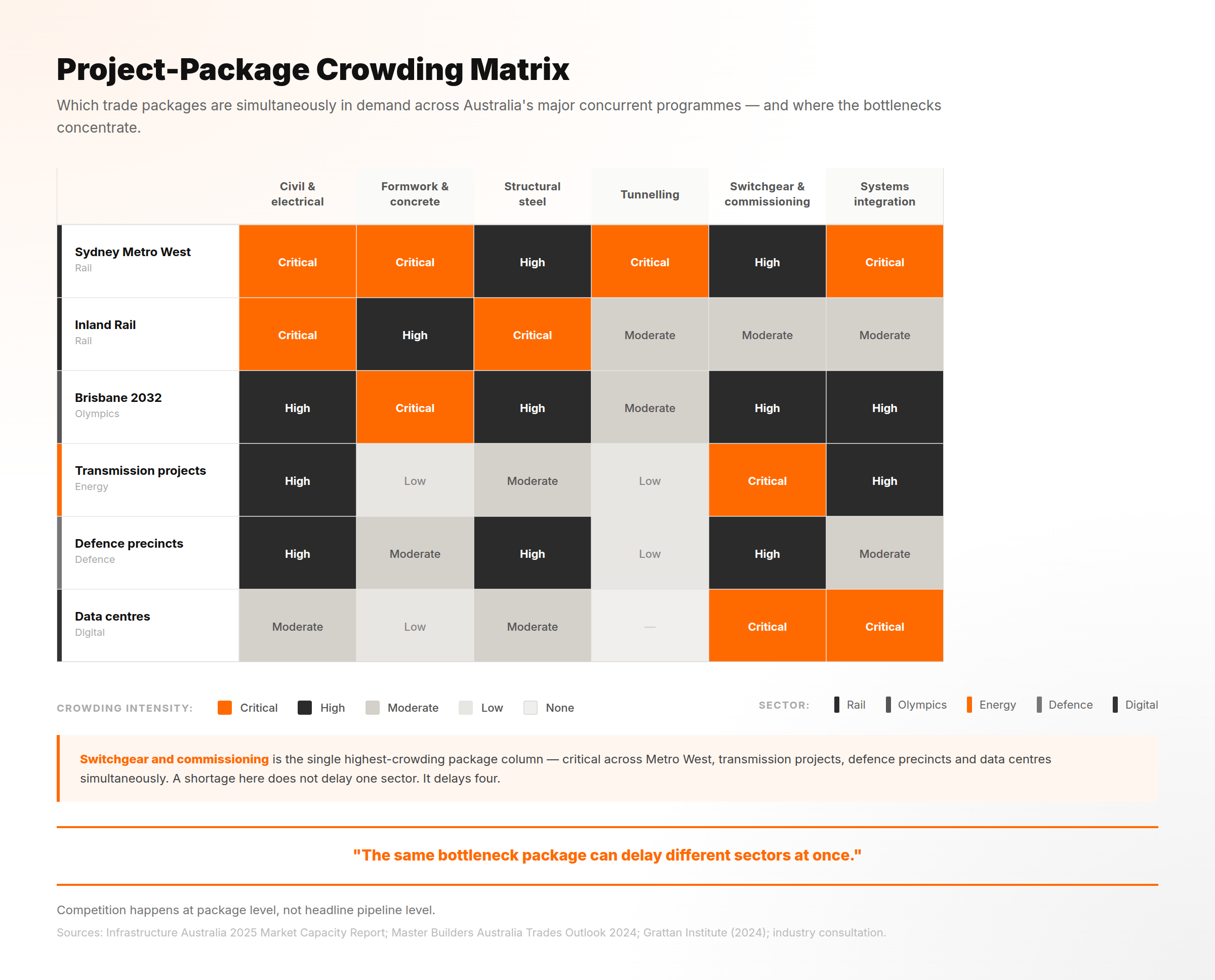
The overlap is not always one-to-one, but the pressure is real. Civil electrical, formwork, structural concrete, steel fabrication, switchgear and commissioning packages draw from finite national and regional subcontractor pools. A civil electrician on a metro station package, a high-voltage specialist on a substation, a signalling team in a commissioning programme and a structural crew on a bridge or station box may not be interchangeable, but they sit inside overlapping markets. When several mega-project categories procure those packages at once, the available market depth narrows.
This is why Infrastructure Australia’s report matters beyond the headline workforce shortage. Its 2025 report includes specific discussion of non-labour supply pressures, including domestic steel fabrication capacity, and identifies workforce and skills shortages as a central market constraint across infrastructure delivery. Infrastructure Australia is effectively saying the bottlenecks are both people and packages.
The package-level crowding is easiest to see in four clusters.
Civil electrical: metro rail, transmission, substations, data centres, airports and hospitals all need electrical trades and commissioning capability.
Concrete and formwork: tunnels, stations, bridges, high-rise apartments, hospitals, schools and defence works all draw from overlapping structural crews.
Structural steel and fabrication: transmission towers, station canopies, bridges, industrial buildings, defence precincts and renewable energy infrastructure all compete for fabrication windows.
Switchgear and grid connection: transmission projects, renewable generation, data centres, hospitals, metro systems and large residential precincts all need long-lead electrical equipment.
The data centre wave makes this sharper. Planning work by the Australian Energy Market Operator (AEMO) now treats data centres as a material load-growth driver, and recent reporting on the draft 2026 Integrated System Plan (ISP) indicates data centre demand is becoming large enough to affect grid planning. AEMO’s ISP programme is no longer just an energy-market document. It is a construction capacity signal.
5. Underground Uncertainty: The Hidden Engineering Risk Behind Tunnel Overruns
Tunnels look clean on a map. They are rarely clean in delivery.
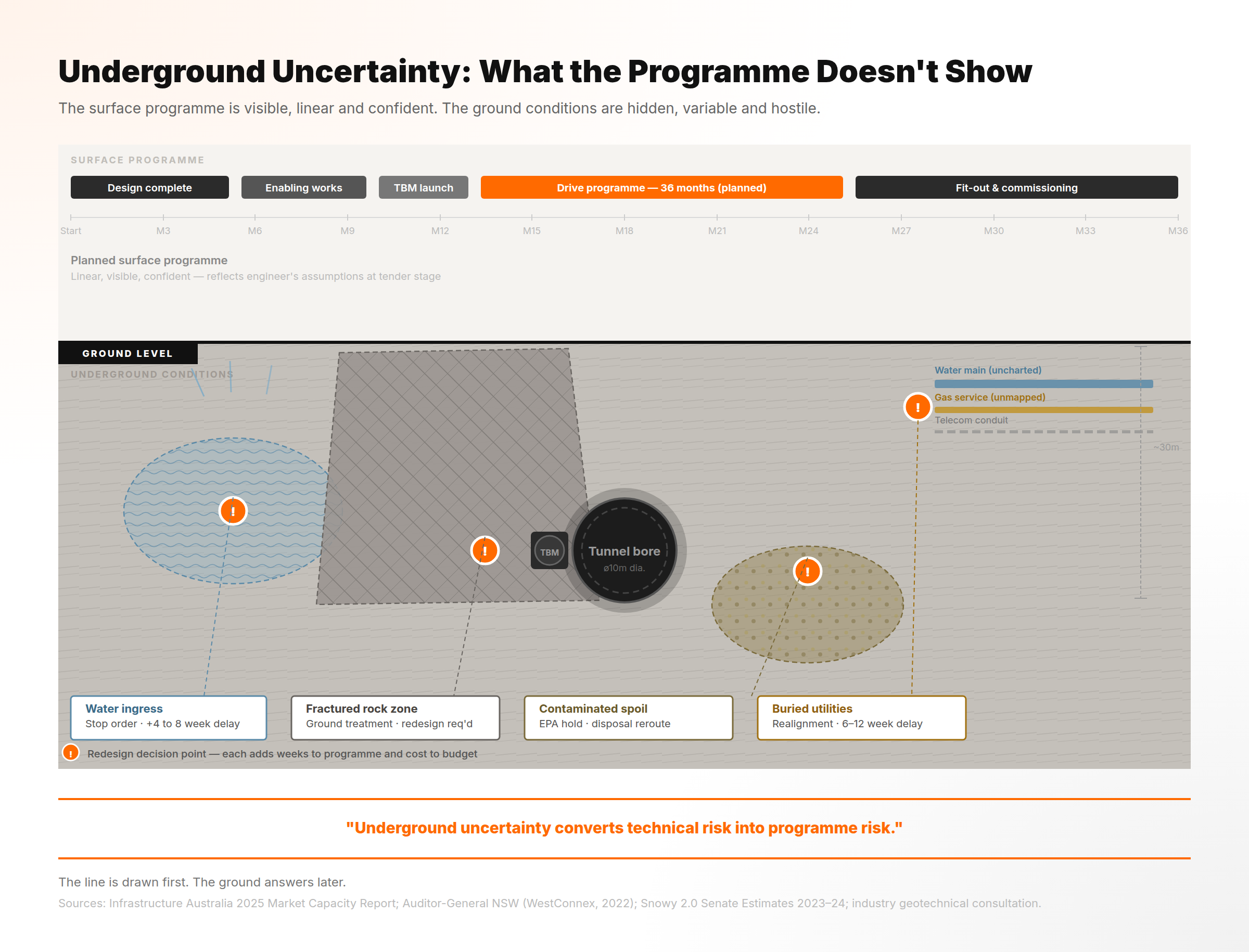
The line is drawn first. The ground answers later.
Geotechnical investigation reduces uncertainty. It does not eliminate it. A borehole tells the project team what exists at that point. It does not reveal every water pathway, contamination pocket, fractured rock zone, buried structure, interface risk or settlement behaviour across an entire tunnel alignment. The cost surprise is not that engineers fail to investigate. The surprise is that underground conditions cannot be fully known until the project is already committed.
This is why tunnelling risk is different from normal surface construction risk. Surface infrastructure can be re-sequenced more easily. Underground infrastructure compresses options. Water ingress, contaminated spoil, tunnel-boring machine stoppages, unexpected ground movement or changed support requirements can cascade through the entire programme because downstream station fit-out, track installation, signalling and commissioning are waiting behind the tunnel drive.
Australia has recent evidence. The West Gate Tunnel opened to traffic on 14 December 2025 after years of delay, with contaminated soil disposal a central delivery issue in the project’s history. The Melbourne Metro Tunnel required complex tunnelling through a dense urban environment, under operating transport and utility networks. Sydney Metro’s multiple stages have shown both the capability Australia has built and the exposure that comes with repeating tunnel-heavy packages across the same labour and engineering market.
Snowy 2.0 is a different asset class, but the tunnelling lesson is even sharper. Snowy Hydro’s own project reset put the revised total cost at $12 billion, with first power targeted for the second half of 2027 and full commercial operation targeted for December 2028. The 2023-24 annual report summary confirms the reset followed a significant period of change on the project.
The lesson is not that tunnels should be avoided. Australia needs them. The lesson is that every additional tunnel in the 2026 to 2030 window adds another draw on scarce underground engineering, tunnelling, spoil, groundwater and interface capability.
The hidden ground risk becomes a visible market risk when too many projects carry it at once.
For estimators and commercial teams, tunnel risk should not be treated as a contingency line only. It affects programme float, spoil strategy, subcontractor sequencing, commissioning dates and the price of every downstream package waiting behind the tunnel drive.
6. Procurement Stress At Megaproject Scale
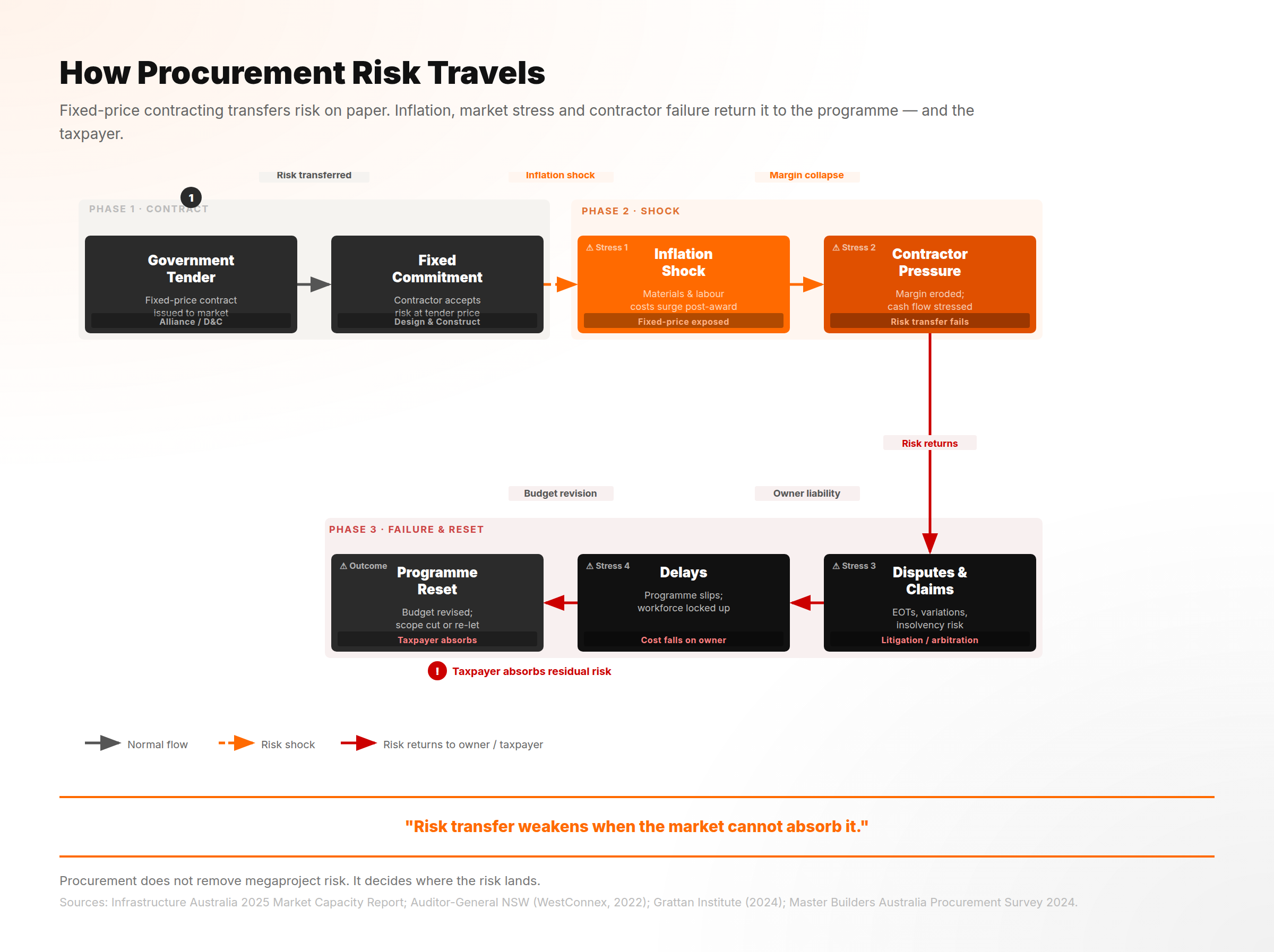
Procurement models do not fail only because they are poorly designed. They fail when the risk they are asked to carry becomes larger than the model.
Design and construct, alliance contracting and integrated project delivery were all developed to improve on blunt fixed-price risk transfer. Each can work. None is immune to megaproject stress.
The problem at megaproject scale is that the unknowns are too large and the market depth is too thin. A design-and-construct (D&C) contract can allocate design and delivery risk to the contractor, but it cannot create more qualified bidders. An alliance can share risk more intelligently, but it cannot make inflation, tunnelling delay or productivity loss disappear. An integrated model can improve collaboration, but it cannot remove the pressure created when the same specialist subcontractors are being chased by multiple principals.
Snowy 2.0 shows the alliance and cost-pass-through dilemma at national scale. The project reset to $12 billion acknowledged the reality that the previous delivery settings no longer matched the conditions facing the project. Snowy Hydro framed the reset as securing a critical energy transformation project. That language matters. When the asset is strategic enough, the principal cannot simply walk away from overruns.
Inland Rail shows the early-design and scope maturity problem. The Schott Review of Inland Rail found a major escalation in the project’s expected cost, and the Commonwealth’s summary of the review states the estimate rose from $16.4 billion in 2020 to at least $31.4 billion in 2022, with very little certainty on the actual cost, primarily due to delays and immature preliminary designs. The same statement says the full project could not be delivered until at least 2036, as set out in the Departmental media release.
Sydney Metro West and WestConnex show the interface problem. Urban megaprojects do not only procure civil works. They procure works around property, utilities, roads, operating rail systems, communities, precinct planning and future development interfaces. The Sydney Metro Independent Review examined governance, delivery models and value for money for a reason.
The issue is not whether one procurement model is right. The issue is whether the model is being used inside a market that can still price risk competitively. When bidder depth thins, risk transfer becomes more expensive and less real.
For procurement teams, the issue is not only which contract model is selected. It is whether the market has enough bidder depth to price risk competitively, absorb shocks without withdrawal, and avoid turning uncertainty into risk premiums, claims, acceleration costs and programme resets.
7. The Big Build Lens: Victoria’s Megaproject Cluster
Victoria is the clearest Australian example of programme concentration risk.
The issue is not one project. It is the cluster.
The Big Build’s Level Crossing Removal Programme, Suburban Rail Loop East, North East Link, Metro Tunnel completion and West Gate Tunnel delivery have placed multiple large projects inside the same delivery ecosystem. Each project can be defended on its own strategic terms. The risk appears when they are read together.
Programme concentration changes the mechanics of delivery. The same tier-1 contractors appear across adjacent tenders. The same specialist consultants are asked to staff business cases, claims, schedule reviews, assurance processes and technical packages. The same project directors, commercial managers, planners and interface managers become scarce. The same subcontractor market prices against several live opportunities at once.
That is different from a state simply having a large capital programme. A large programme spread across time can be manageable. A concentrated programme compresses decisions, labour, commercial capability and dispute bandwidth into overlapping years.
The Suburban Rail Loop shows why this matters. Infrastructure Australia’s 2025 evaluation of Suburban Rail Loop (SRL) East raised assurance questions around cost confidence, funding and delivery certainty. Since then, the Commonwealth has committed a further $3.8 billion, bringing its total contribution to $6 billion. That does not remove the delivery-capacity question. It makes sequencing, cost confidence and bidder depth more important because the project is now even more firmly inside Victoria’s committed megaproject load.
North East Link and West Gate Tunnel add the road-side dimension. The West Gate Tunnel opened to traffic on 14 December 2025, after a delivery history that demonstrated how disputes and technical issues can alter the programme path of a major urban road. North East Link remains one of the largest road projects in the state’s history.
Victoria’s risk is therefore not only cost. Deep Dive 02 owns that argument. It is delivery concentration. Too many major commitments in the same labour and contractor market turn normal project risk into system risk.
8. The Brisbane 2032 Question: Delivery Under An Immovable Deadline
Brisbane 2032 is not a normal infrastructure programme because the deadline is not negotiable.
A rail project can open late. A motorway can be staged. A hospital can shift commissioning if the political and operational cost is absorbed. An Olympic and Paralympic Games cannot casually move to the following year.
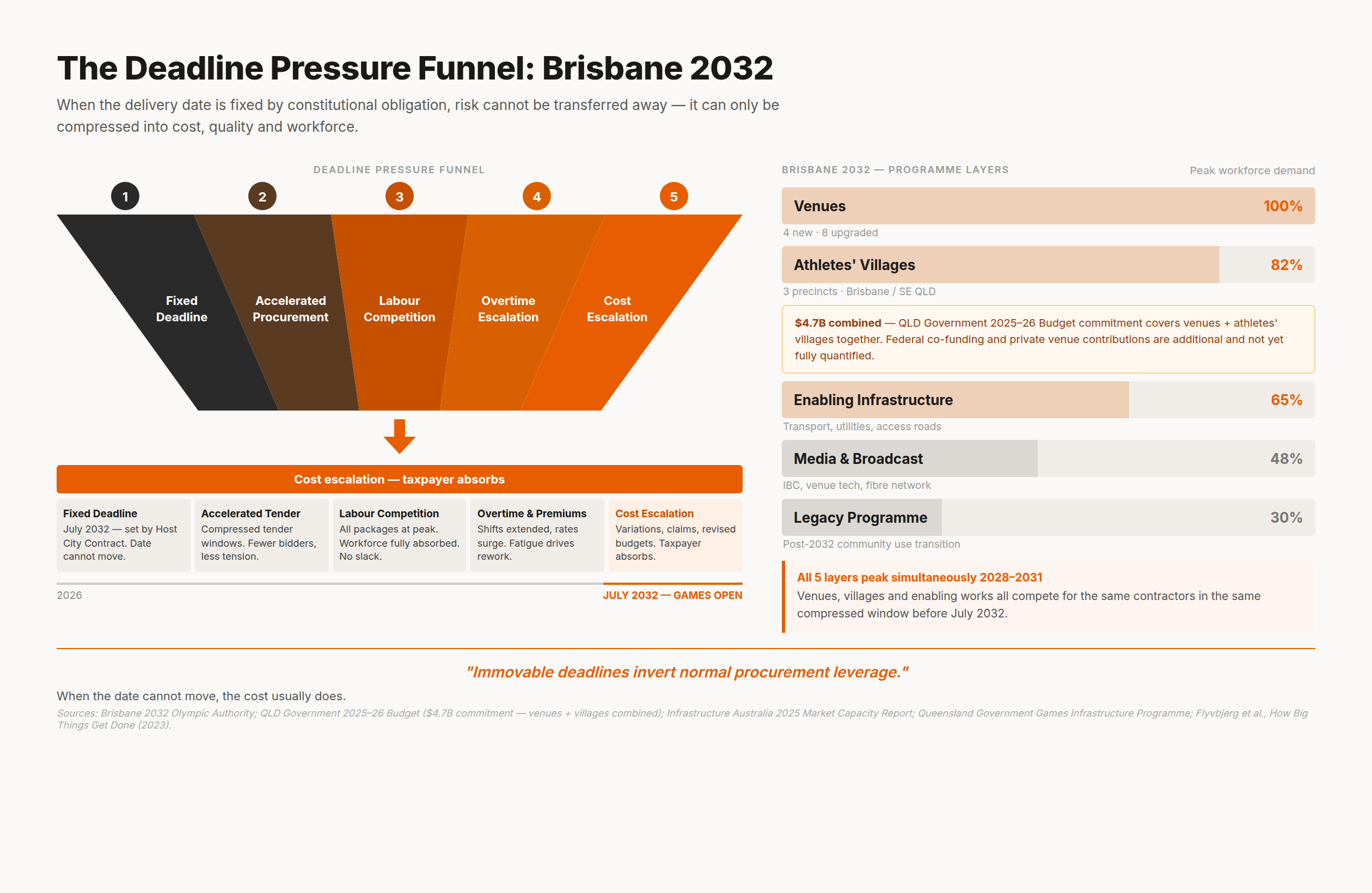
That immovable date changes procurement logic. Under ordinary conditions, a principal can choose between cost, scope and time. Under Games conditions, time dominates. Cost overruns become preferable to programme failure. Labour pricing accelerates because contractors know stoppage is not a realistic option. Risk transfer becomes more difficult because the state cannot credibly allow critical venues, villages or transport works to fail.
The Queensland Government’s 2025-26 Budget committed $4.7 billion for the 2032 Delivery Plan, including venues and athlete villages. The public funding number is not the whole story. The delivery story is the interaction between Games works, housing-enabling infrastructure, Brisbane population growth, regional trunk infrastructure, energy projects and ordinary commercial construction demand.
Brisbane’s cost pressure was already visible in Deep Dive 03. The difference here is what the Olympics do to the market. They do not simply make construction more expensive. They make time non-negotiable, and that changes who holds leverage.
A contractor asked to price a time-critical venue package in 2027 is not pricing a normal building. It is pricing penalty exposure, overtime, acceleration, interface risk, reputational risk and the knowledge that the principal has limited ability to defer. A subcontractor with finite labour can choose between ordinary private work and a high-visibility Games package. In a tight labour market, the Games package sets the tone.
The more subtle risk sits in the adjacent works. Games venues attract public attention. Enabling works, utilities, road access, public realm, temporary works, precinct connections, security overlays, transport interfaces, village legacy conversion and local trunk infrastructure carry much less attention but still consume capacity.
Brisbane 2032 therefore matters beyond sport. It is a test of whether Australia can deliver an immovable-deadline megaproject inside a labour market already stretched by housing, energy, transport and regional infrastructure. The operating assumption is that the deadline will be met. The open question is how much the rest of the market pays for meeting it.
9. The Defence Megaproject Wave
Defence infrastructure has been sitting in the construction conversation as a labour-pull footnote. That understates it.
The Australia–United Kingdom–United States (AUKUS) security partnership, Henderson, Osborne and the broader Defence estate are not just workforce demand stories. They are megaproject delivery stories in their own right.
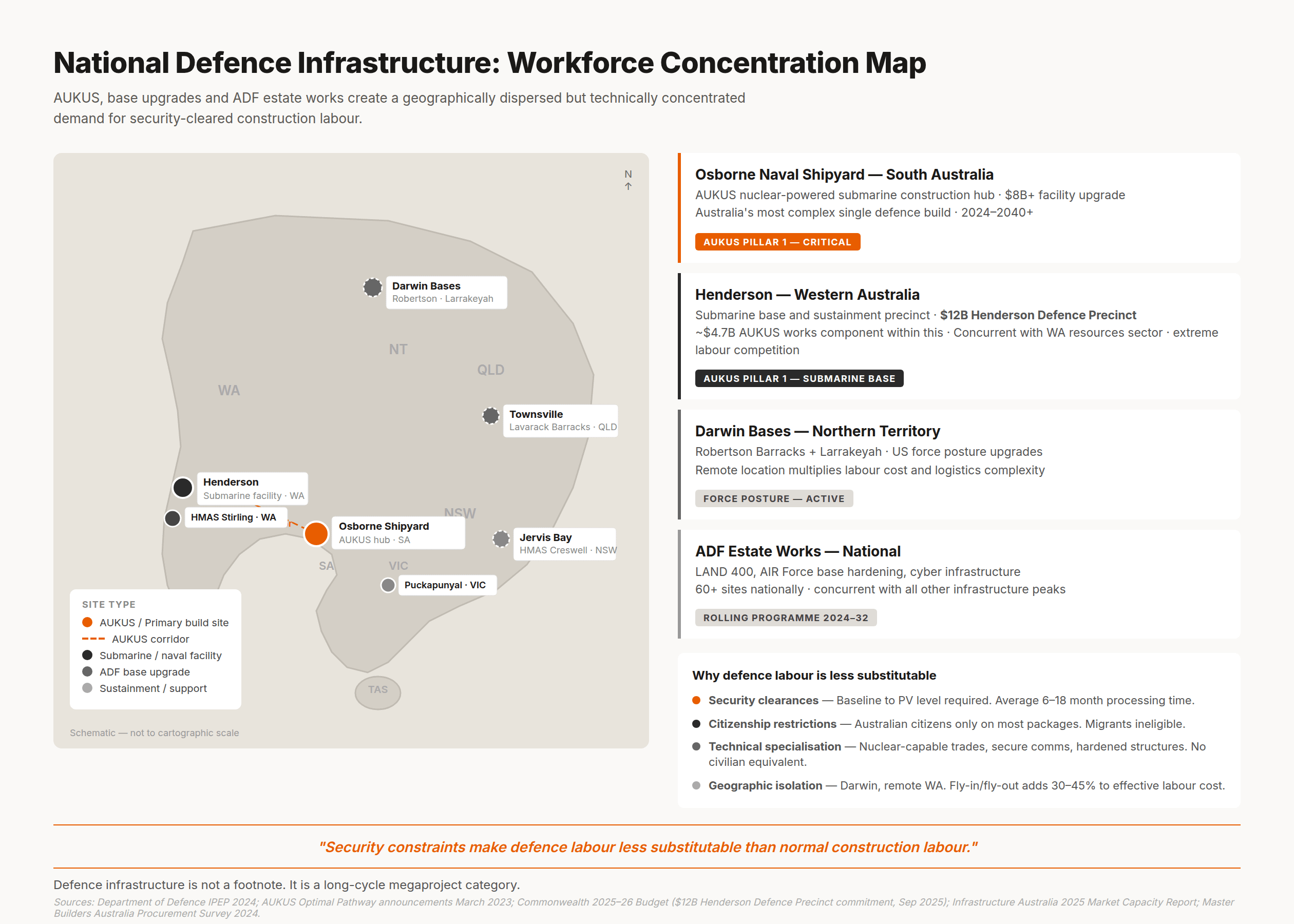
The Commonwealth commitment to Henderson is the clearest signal. The Government has announced $12 billion toward the Henderson Defence Precinct, supporting continuous naval shipbuilding and AUKUS in Western Australia, with around 10,000 direct jobs expected over two decades. Related Defence planning points to a wider investment programme over the decade. That is a long-duration construction and industrial infrastructure programme, not a short capital works package.
Osborne carries a different but related pressure. Australia’s nuclear-powered submarine pathway requires specialist shipyard, security, training and sustainment capability. The construction point is not only the size of the spend. It is the specialist institutional and labour capability required around the physical build.
Defence infrastructure is harder to deliver than ordinary industrial infrastructure because the labour pool is less substitutable. Workforce access is constrained by clearance, citizenship, security and technical requirements; marine, secure facility, shipyard and systems-integration contractor pools are thinner; and procurement timelines are measured in decades rather than isolated construction packages.
The construction implication is direct. Defence adds a long-cycle, high-security, high-specialisation demand stream to the same national market already being pulled by transport, housing, energy and data infrastructure. It also anchors skilled labour in particular regions for long periods, especially South Australia and Western Australia.
That makes defence one of the least discussed but most important mega-project categories in the 2026 to 2030 delivery ceiling.
10. The New South Wales (NSW) Megaproject Programme: Largest, Most Mature, Most Constrained
New South Wales is not short of infrastructure delivery experience. That is precisely why its current risk is easy to misread.
The state has built a mature megaproject machine over more than a decade: Sydney Metro, WestConnex, major motorway works, airport rail, precinct infrastructure and hospital programmes. That maturity matters. It gives NSW institutional capability other states are still building.
But maturity is not spare capacity.
NSW is therefore not the highest-risk state because its delivery system is immature. It is exposed because its mature delivery system has been under sustained load for more than a decade.
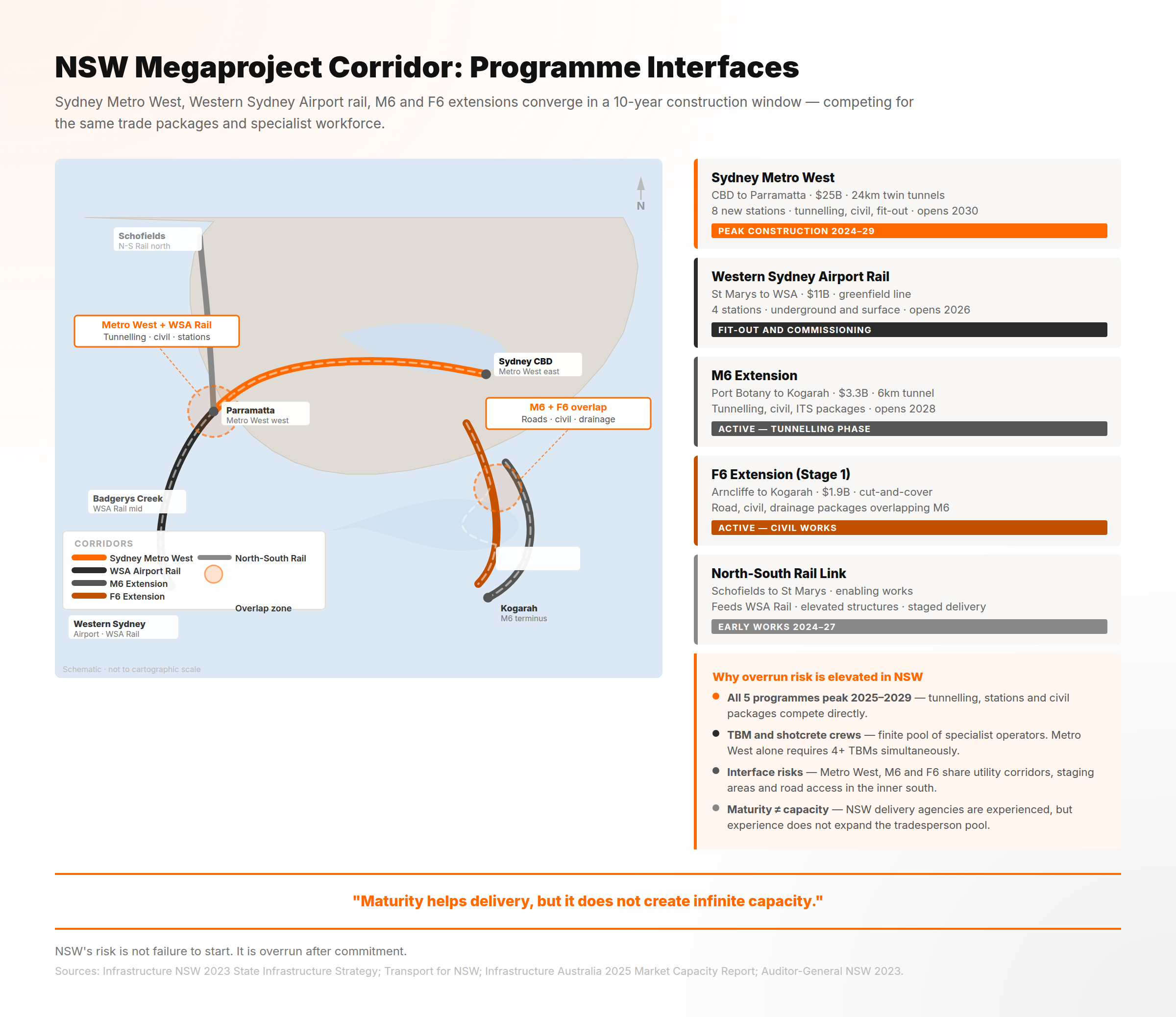
Sydney Metro West alone is large enough to test any delivery system. The NSW Government stated in 2023 that Sydney Metro West was estimated to cost $25.32 billion, with opening in 2030 at the earliest, compared with earlier expectations in the mid to late 2020s. The subsequent Sydney Metro Independent Review examined value for money, governance, delivery models and integration with the wider transport network.
That is the NSW infrastructure problem in one project: not failure to start, but exposure after commitment.
The same logic applies across the broader programme. M6 and F6 motorway packages, Western Sydney Airport rail connections, ongoing metro works and precinct-enabling infrastructure all draw from overlapping civil, tunnelling, rail systems, utility and interface capability. The state has the most mature delivery system in the country, but also the deepest accumulation of committed works.
This distinction matters commercially. NSW is less exposed to the first-order problem of not knowing how to deliver megaprojects. It is more exposed to second-order fatigue: repeated use of the same market, repeated pressure on the same executive capability, repeated reliance on the same utility coordination and repeated negotiation with the same contractor base.
NSW’s infrastructure risk is not failure to start. It is delivery under load.
Deep Dive 03 dealt with housing projects that fail to convert. This is different. Sydney’s major infrastructure projects are already moving, which means delay does not sit neatly inside one project. It flows into cost, sequencing, contractor claims and public timetable pressure.
For contractors, NSW remains attractive because the pipeline is real. For government, that same reality creates a cost exposure that cannot be managed by announcements. The issue is no longer whether the programme exists. It is whether the state can keep the committed programme inside a market that has already absorbed a decade of major works.
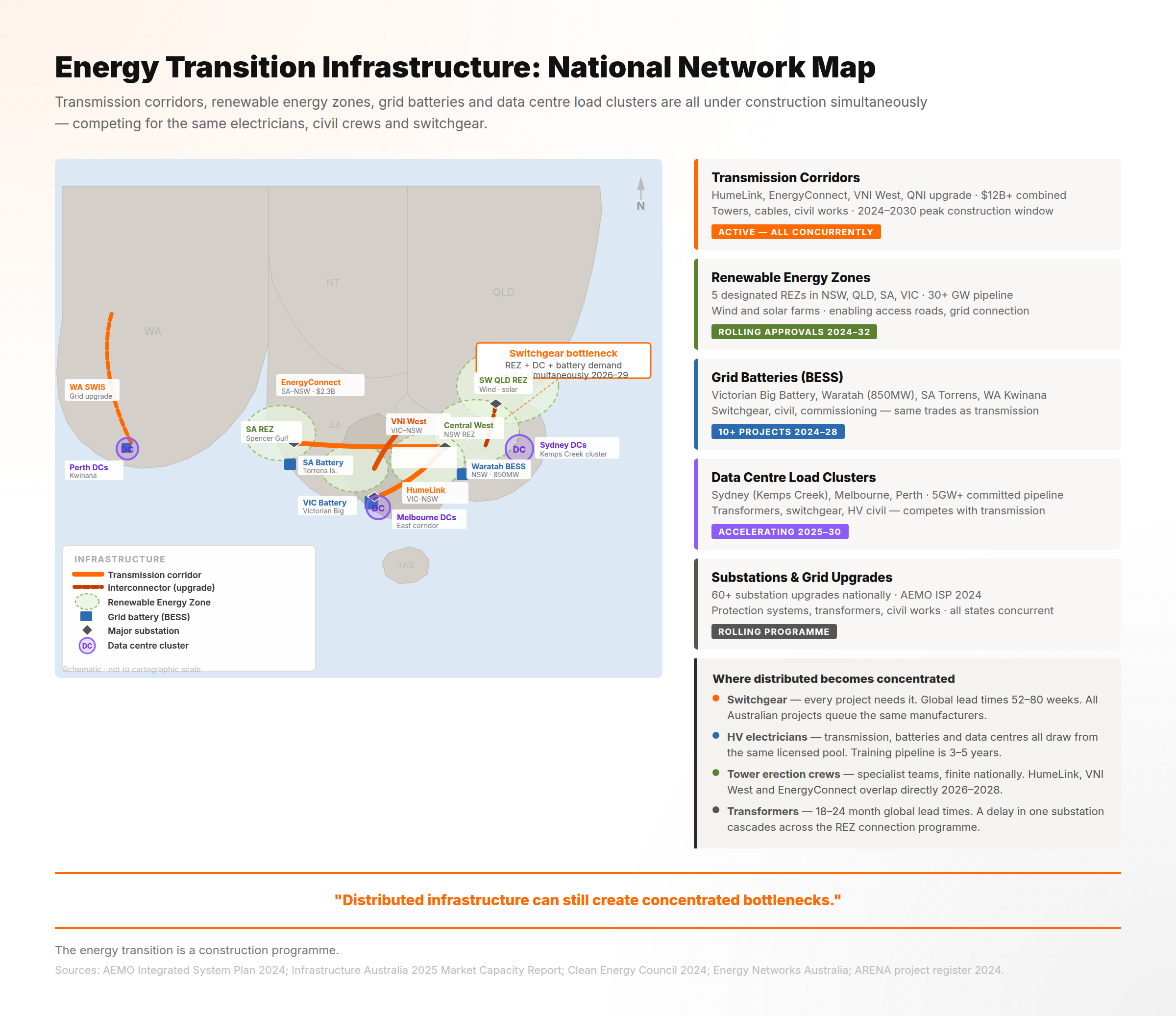
11. The Quiet Megaproject Boom: Energy Transition Infrastructure
The energy transition is not one project. It is a national construction programme disguised as an electricity-market transition.
That distinction matters for builders, estimators, developers and governments. Transmission lines, substations, renewable energy zones, batteries, pumped hydro, gas firming, data centre connections and distribution upgrades all require physical construction: land access, planning approvals, steel, concrete, roads, civil electrical, switchgear, cranes, commissioning teams and specialist project management.
AEMO’s 2024 Integrated System Plan describes the least-cost pathway for the National Electricity Market’s transition. The delivery implication is direct: the electricity system needs new transmission, generation and storage built while coal exits and demand changes. Transmission is therefore not only an energy-planning issue. It is a construction-capacity issue.
This is why the energy transition belongs in a megaproject article, not only an energy article.
Transmission competes with transport for civil labour. Substations compete with data centres for switchgear and high-voltage specialists. Renewable energy zones compete with regional housing and roads for earthworks, access tracks, foundations and cranes. Battery projects compete with industrial facilities for grid connection, electrical engineering and commissioning teams.
The project geography also matters. Energy infrastructure often sits outside the metropolitan markets where the contractor base is deepest. Regional transmission, renewable and storage projects need labour accommodation, transport logistics, concrete supply, access roads, local council interfaces and community engagement. Infrastructure Australia’s warning that regional workforce shortages are expected to intensify is therefore central to the energy build, not a side issue.
There is a second-order risk. Energy projects are enabling infrastructure for other sectors. Delays in transmission can delay renewable generation. Delays in substations can delay data centres. Delays in grid capacity can delay industrial expansion. One project category becomes the dependency behind another.
The quiet megaproject boom is quiet only because it is distributed. It does not look like one tunnel or one stadium. It looks like a network. Networks can fail slowly, then suddenly.
12. Tier-1 Contractor Consolidation: Who Can Actually Build This?
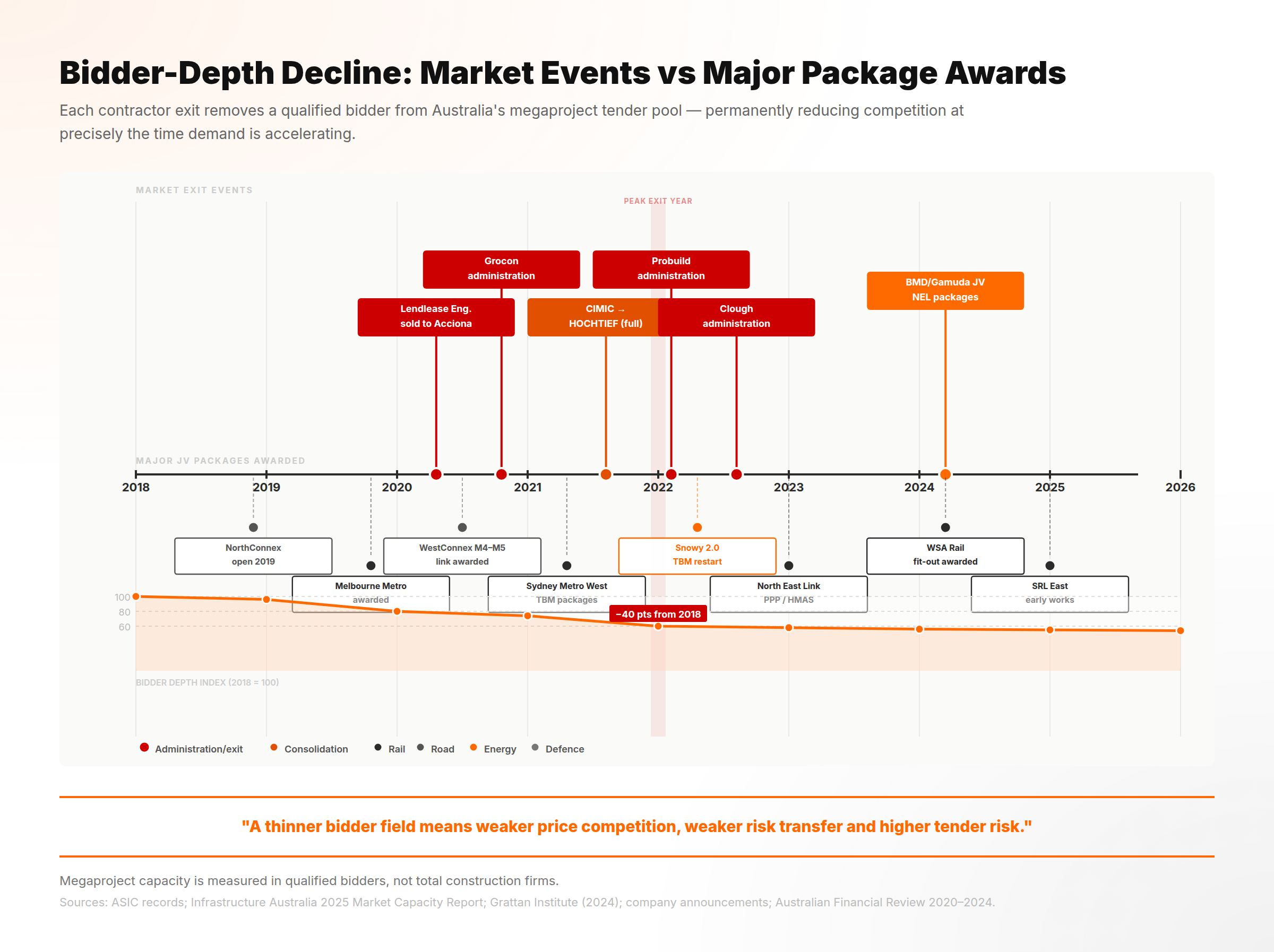
The megaproject market is not short of construction companies. It is short of balance sheets that can carry risk. That is the difference between industry size and bidder depth.
Australia has thousands of builders, subcontractors and specialist firms. It has far fewer organisations with the bonding capacity, safety systems, engineering strength, commercial discipline and delivery history required to take on a major tunnel, rail, hospital, defence, energy or motorway package. This is where the delivery ceiling becomes visible before construction begins.
A government client does not need a large theoretical construction industry. It needs enough qualified bidders willing to price the work, carry the risk, hold the programme, manage the interfaces and survive if the job moves against them. That is a much narrower market than the headline construction sector suggests.
Infrastructure Australia’s 2025 Market Capacity Report sizes the Major Public Infrastructure Pipeline at around $242 billion over five years and identifies labour availability as a critical delivery constraint. But labour is only one part of capacity. Contractor depth is another. A record pipeline does not automatically create more tier-one balance sheets. It can expose how few of them are available.
The contractor base has changed materially through the past cycle. Lendlease completed the sale of its Australian Engineering business to Acciona in 2020. Grocon, a long-established Australian private builder, entered voluntary administration in November 2020. Probuild entered voluntary administration in 2022. CIMIC moved from ASX-listed company to wholly owned HOCHTIEF subsidiary in 2022. Clough Group also entered voluntary administration in 2022. The point here is not to pre-empt the insolvency analysis in Deep Dive 05. It is narrower: the national market has fewer balance sheets with the depth, appetite and systems to carry repeated megaproject risk.
None of this means Australia lacks capable contractors. It does not. The country still has serious delivery capability across transport, buildings, energy, defence and civil infrastructure. The point is narrower and more commercially important. The number of credible bidders for any one major package is structurally limited. That matters because bidder depth shapes price before a shovel touches the ground.
When the bidder field is thin, price competition weakens. Contractors do not need to chase work aggressively when the pipeline is deep, risk is high and alternatives are available. Risk transfer weakens as well. A principal can write risk into a contract, but risk only transfers if the market is willing to accept it at a price the principal can live with. If too few contractors can credibly bid, those contractors can qualify the risk, price the risk heavily, or decline the tender outright.
Programme sequencing also becomes harder. The same contractor groups and joint venture partners appear across transport, energy, defence and social infrastructure packages. Governments may tender projects separately, but the market receiving those tenders is not separate. It is the same limited pool of people, systems, balance sheets and executive attention being asked to absorb repeated risk.
This is why contractor depth belongs in a megaproject article, even though insolvency and financial health are the subject of Deep Dive 05. Insolvency measures financial stress after failure. Bidder depth measures delivery risk before award.
The commercial consequence is simple. Between 2026 and 2030, the projects most exposed to budget overshoot will not always be the ones with the weakest policy case. They may be the ones with the thinnest bidder field, the most aggressive risk transfer, and the least room to re-sequence once the preferred contractor market has already been absorbed elsewhere.
13. The Coordination Problem Nobody Talks About
Most mega-project analysis treats projects as independent. Delivery does not.
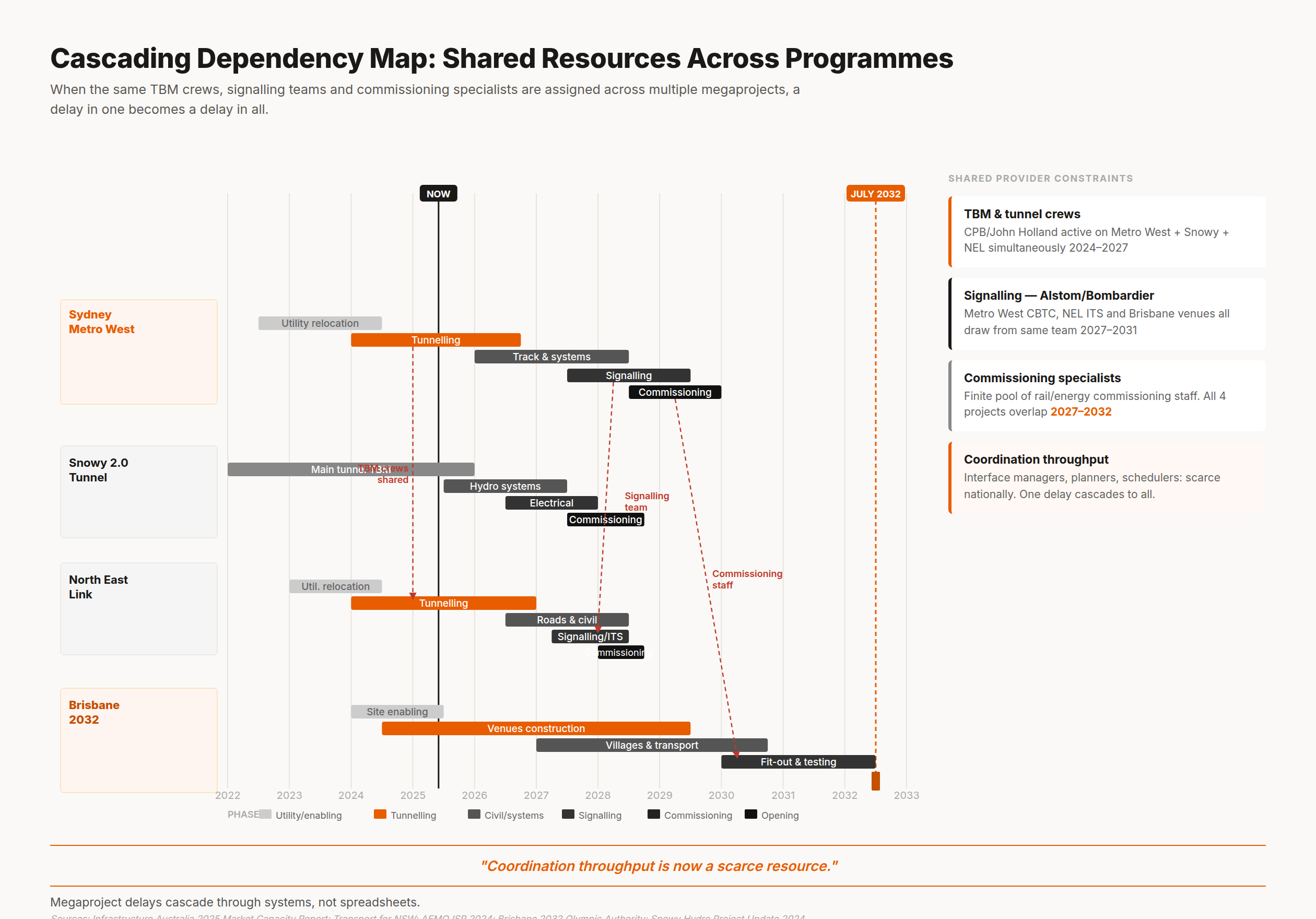
A rail tunnel is not just a tunnel. It is utility relocation, property acquisition, tunnelling, station excavation, structural works, mechanical and electrical systems, track installation, signalling, communications, testing, commissioning, operational readiness and integration with the existing network. Each stage depends on another. A delay upstream does not stay upstream.
That is true inside a project. It becomes more important across a pipeline.
When multiple megaprojects share the same utility provider, the same signalling contractor, the same high-voltage specialists, the same rail possessions, the same assurance resources or the same commissioning teams, dependencies begin to compound across projects rather than within one project.
This is the coordination problem Australia does not discuss enough.
A utility relocation delay on one transport corridor can absorb the crews and review bandwidth needed somewhere else. A tunnelling issue can move the start date for station fit-out, which moves the window for mechanical and electrical works, which moves testing, which moves operational readiness. If another project planned around the same specialist team, the delay does not remain local. It becomes a resource conflict.
The Sydney Metro Independent Review’s focus on governance, delivery models and integration points to this broader systems problem. Transport for NSW did not review metro delivery only as a construction task. It reviewed the operating model around a complex programme.
Energy projects show the same pattern in another form. A delayed transmission corridor can hold back renewable generation. A delayed substation can hold back a data centre. A delayed grid connection can alter the timing of industrial projects and housing precincts. The dependency is not always visible in the headline project list, but it is real in delivery.
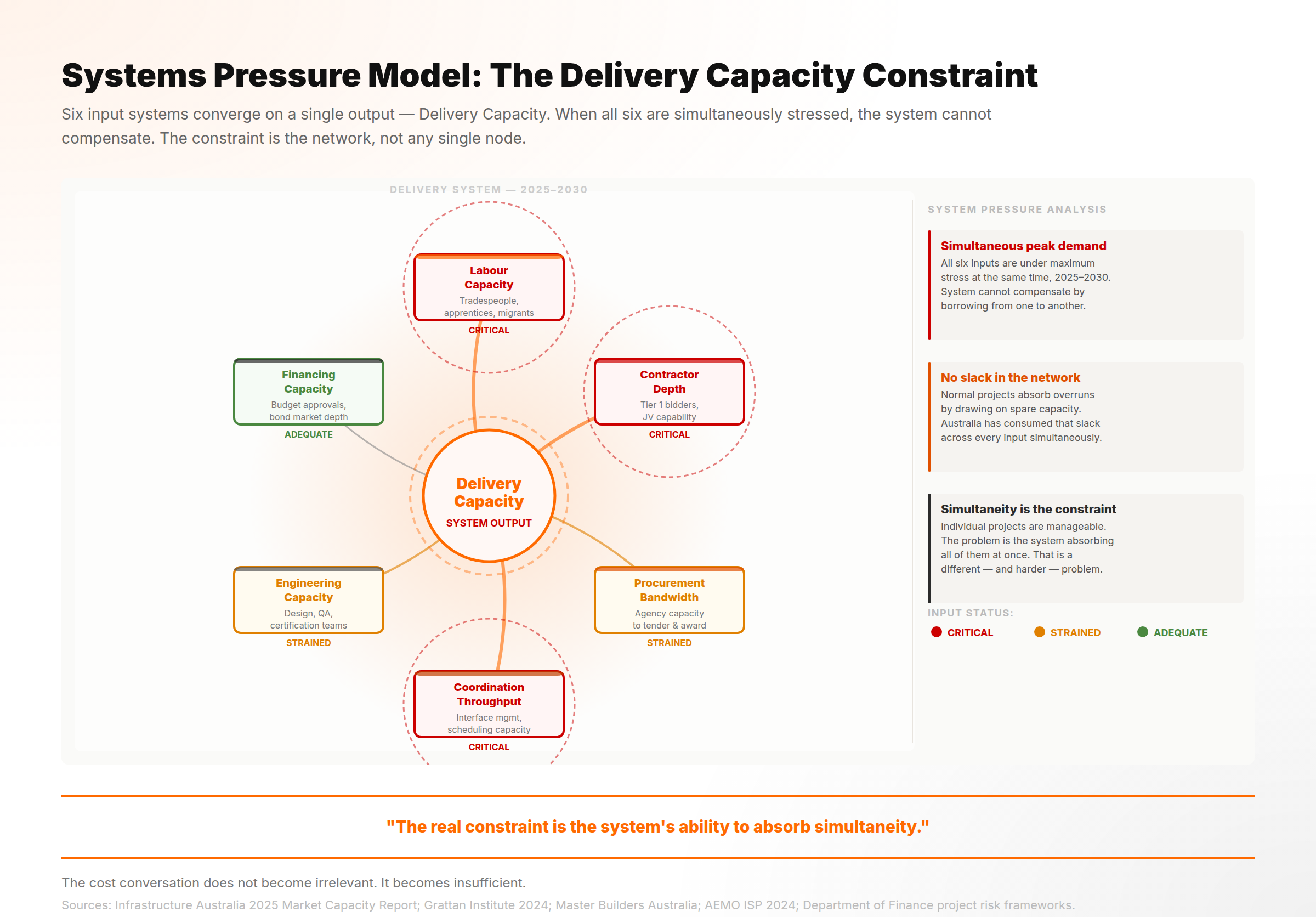
Coordination throughput is therefore a capacity category. Labour matters. Contractors matter. Procurement matters. But the system also needs enough institutional capacity to coordinate interfaces across many live programmes at once.
That is where the delivery ceiling becomes hardest to see. The project can be funded, staffed and contracted, then still be delayed because the system cannot process the dependencies fast enough.
For clients and contractors, coordination failure is a commercial risk before it becomes a construction delay. Every unresolved interface can move labour, claims, testing windows and handover dates across multiple packages
14. Where The Pipeline Breaks First: Named Projects, Named States
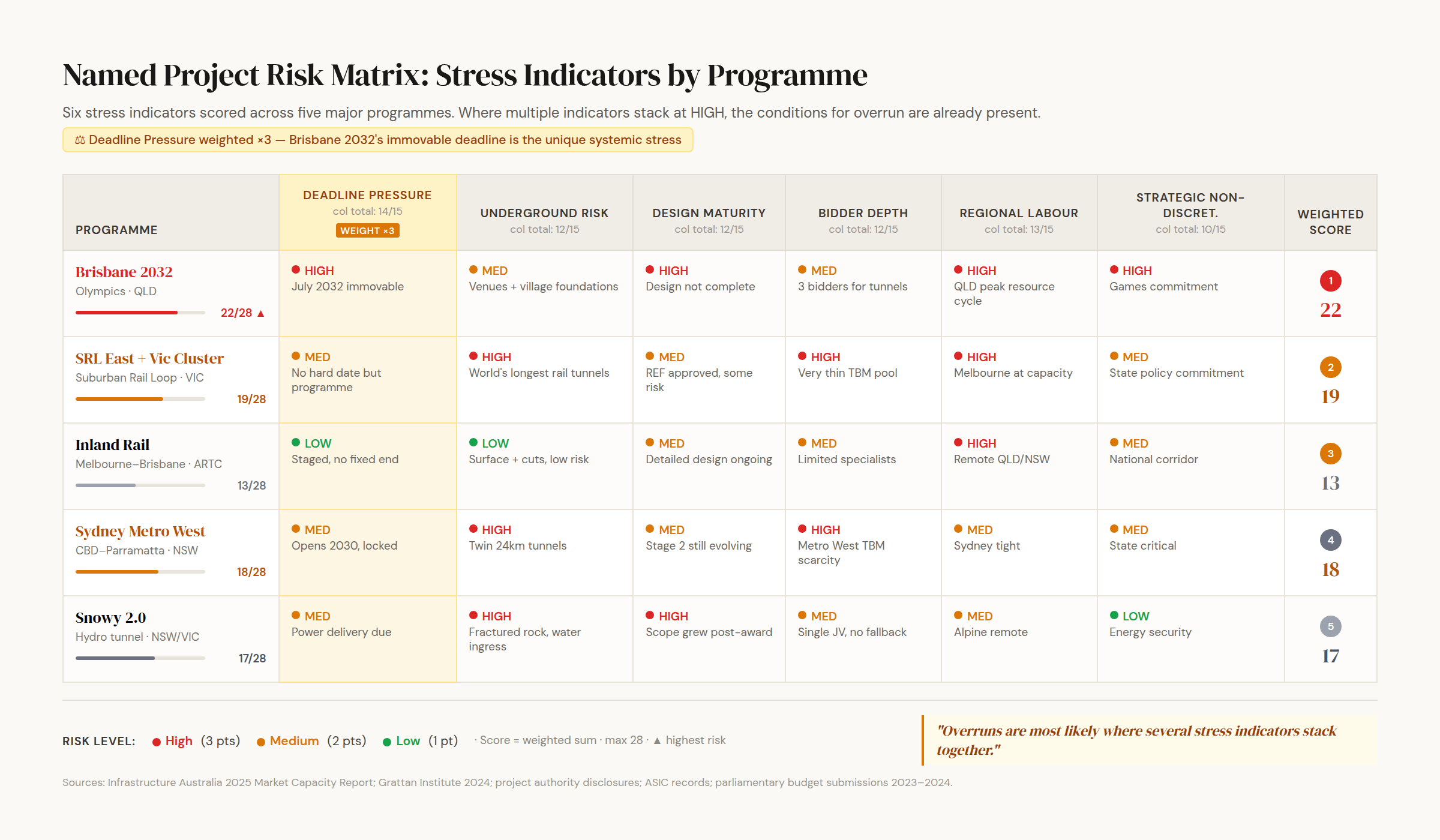
The evidence now points past the general warning. The next question is where the pressure breaks first, and which state programmes are most exposed when labour, contractor depth, procurement risk and fixed deadlines collide.
The responsible answer is not a single dramatic prediction. It is the tiered risk view introduced earlier in the infrastructure federation: immature design, low cost certainty, underground exposure, immovable deadlines, thin bidder depth, regional labour stress and known programme concentration.
On that basis, the highest-risk programme cluster is Queensland’s 2032 delivery environment. The risk is not only venues. It is the collision between Games works, transport, housing-enabling infrastructure, regional trunk infrastructure, energy projects and private-sector growth. The Queensland Government’s $4.7 billion 2032 Delivery Plan commitment gives the programme a funding frame, but the immovable deadline gives contractors leverage. The most likely failure mode is cost escalation before programme failure.
The second high-risk cluster is Victoria’s megaproject concentration. Suburban Rail Loop East carries assurance questions around cost confidence, funding and delivery certainty, even after the Commonwealth’s additional $3.8 billion commitment brought its total contribution to $6 billion. North East Link and the broader Big Build continue to draw from the same contractor and management pool. The likely failure mode is not abandonment. It is escalation across concurrent packages and reduced flexibility to re-sequence.
The third high-risk project is Inland Rail beyond the already prioritised southern section. The Schott Review found the estimated cost rose from $16.4 billion in 2020 to at least $31.4 billion in 2022, with little certainty on final cost, and recent Commonwealth statements indicate the full original project cannot be delivered until at least 2036, as set out in the Minister for Infrastructure media release. The leading indicator is immature scope and route complexity.
The fourth is Sydney Metro West. NSW has the most mature delivery system, but Sydney Metro West is already a committed, high-cost, tunnel-heavy programme with a reset cost and timing frame. The risk is not starting. It is maintaining cost discipline through the remaining delivery cycle.
The fifth is Snowy 2.0. The project has already reset to $12 billion, with first power targeted for late 2027 and commercial operation targeted for December 2028. The leading indicators are tunnelling complexity, productivity, contractor reset and strategic non-discretionary status.
These are not claims that projects should not proceed. They are claims that the market should stop treating overruns as surprises.
15. The Delivery Ceiling: Why The Cost Conversation Has To Change
Cost is still part of the story. It is no longer the whole story.
Australia’s next infrastructure constraint is capacity: the labour, contractor depth, procurement bandwidth and coordination machinery required to carry several major programmes at once. Infrastructure Australia’s 2025 Market Capacity Report puts the five-year Major Public Infrastructure Pipeline at $242 billion and projects the infrastructure workforce gap will rise from 141,000 workers to around 300,000 by mid-2027.
The cost conversation does not become irrelevant. It becomes too narrow.
Australia’s infrastructure constraint is not cost in isolation. It is not productivity in isolation. It is the absolute capacity of the system to absorb simultaneity. Labour, contractor depth, procurement bandwidth, coordination throughput, engineering capacity and financing capacity are all being tested together.
That is why Infrastructure Australia’s 2025 Market Capacity Report is the anchor source for this piece. A 300,000-worker shortfall by mid-2027 is not merely a labour statistic. It is a warning about the size of the gap between commitment and delivery capacity. Regional shortages intensify the problem because many of the next infrastructure waves, transmission, renewable energy, defence, ports, regional roads and Games-enabling works, are not all in inner metropolitan labour markets.
The market still tends to ask whether projects are funded. That question now sits too early in the chain.
The sharper questions are different. How many qualified bidders are available? Which packages are competing for the same subcontractors? Which projects require the same civil electricians, tunnel crews, signalling specialists, steel fabricators or commissioning teams? Which delivery deadlines are immovable? Which projects carry underground risk that cannot be fully known before award? Which programmes share the same utility, grid or systems interfaces? Which principals can tolerate delay, and which will pay almost anything to avoid it?
That is the delivery ceiling.
It does not mean Australia stops building. It means the country has entered a period where sequencing, procurement realism and capacity allocation matter as much as project selection. The most commercially intelligent clients will not simply ask what they want built. They will ask what the market can absorb at the same time.
The pipeline is still real. The ambition is still real. The constraint is also real.
For governments, the lesson is to sequence the pipeline, not just announce it. For contractors, it is to price capacity, not just scope. For developers, it is to understand infrastructure crowd-out before assuming enabling works will arrive on time. For procurement teams, it is to test bidder depth before assuming market appetite. The next phase of Australian construction will be decided less by the size of the announcement and more by the discipline of the sequence.
Coming in Deep Dive 05: Insolvency Season, mapping the financial health of Australia’s construction sector in 2026.
See you next week.
Note: This article is general market commentary and does not constitute financial advice.
Keep reading
More from the bid team
14 October 2026 · Visionex Solutions
The Call You Should Not Make
Construction runs on relationships: a quick call to the client, a coffee with the project manager, a word on the site walk.
6 October 2026 · Visionex Solutions
How Defence Actually Evaluates
In Defence's final evaluation for the Army's new infantry fighting vehicles, then planned as a fleet of up to 450, Rheinmetall's tendered price was almost...
30 September 2026 · Visionex Solutions
The Bid You Should Not Submit
Defence's standard construction tender form asks you to declare that bidding was your own commercial decision. The question is whether you actually made one.
Have a tender on your desk?
Send it through. Within 24 hours you will have a go or no go call, a returnables check, and a clear view of where the marks are.