Home/Blog/Government Buyers Are Getting A Searchable Supplier Directory, Contractors Have Weeks To Get On It
Industry News · 29 May 2026 · Hashan Senarathna
Government Buyers Are Getting A Searchable Supplier Directory, Contractors Have Weeks To Get On It
This Week’s Read 04 | Issue 009 | 2026 — a Hashan Senarathna deep dive.

The contractors most exposed to procurement reform are not the ones who don’t read the rules. They’re the ones who wait for the tender to drop before they start working on the win. That habit is becoming expensive.
The Commonwealth Procurement Rules 2025 commenced on 17 November 2025. The next pressure point is 1 July 2026, when the Supplier Portal opens to all suppliers, Indigenous Procurement Policy eligibility tightens, and the Australian Capital Territory (ACT) Government’s procurement reforms commence. For construction, the headline number is $7.5 million. Below that threshold, CPR 5.4 now requires non-corporate Commonwealth entities to invite only Australian businesses.
This is not a legal timing issue. It is a visibility issue. Contractors need to be easier to find, verify, invite and award work to before the buyer looks.
1. The Rules Are Already Here. July Is The Visibility Cliff
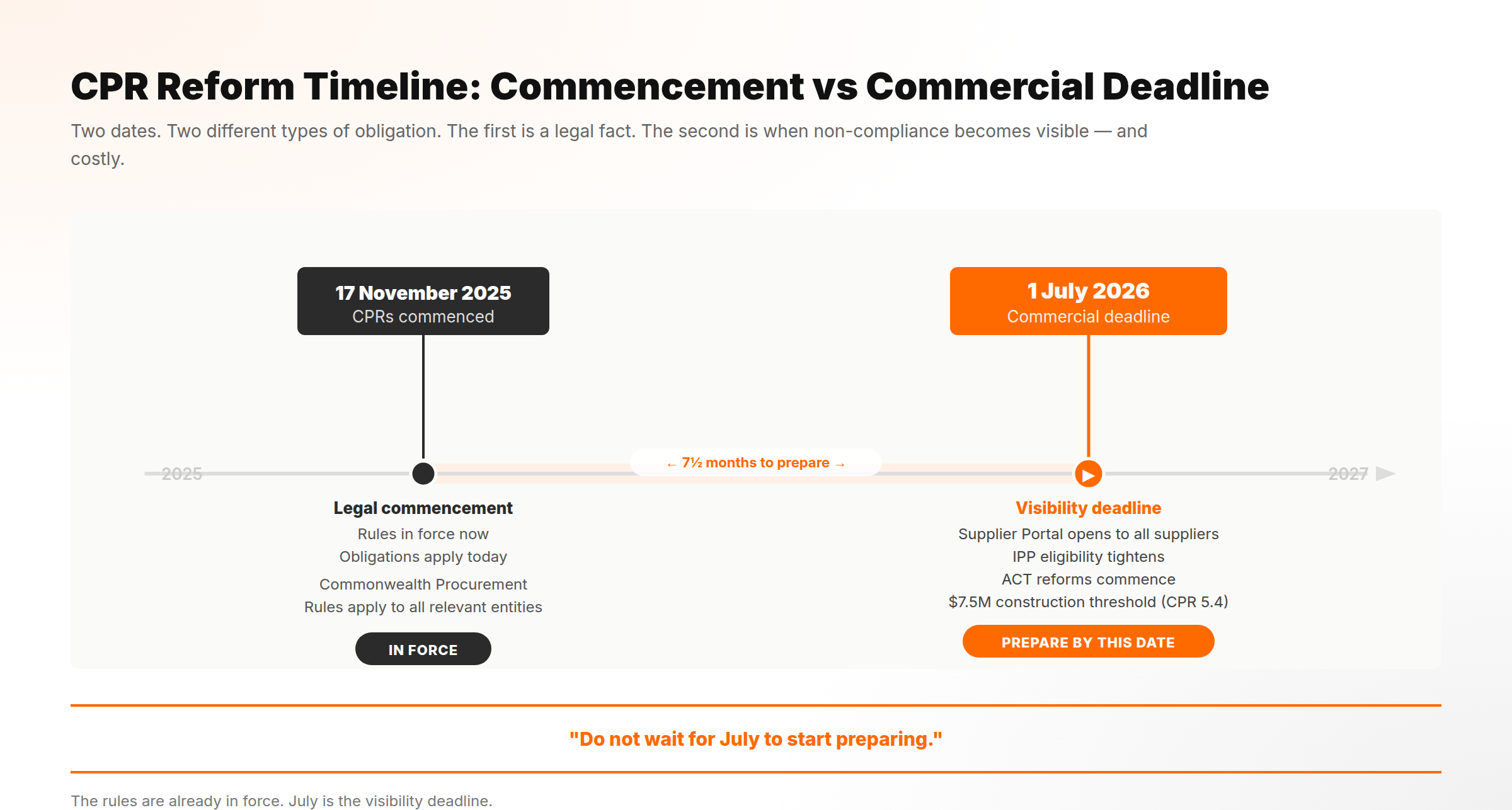
The procurement rules are not waiting until July. They are already here.
The Commonwealth Procurement Rules 2025 commenced on 17 November 2025. The compliance environment has already shifted. July matters because it is the next commercial deadline, when supplier visibility, Indigenous Procurement Policy eligibility and ACT procurement reform all move into sharper focus.
For construction, the headline number is the $7.5 million construction threshold. That threshold has not been raised. What has changed is the Australian-business invitation rule below it. CPR 5.4 means non-corporate Commonwealth entities must invite only Australian businesses for construction services below that threshold.
That does not guarantee work. Value for money still governs the decision. Procurement teams still test price, capability, risk and delivery confidence. But the invitation gate matters. Contractors that cannot meet the Australian-business definition face a narrower path below that threshold. Australian-owned contractors face an opening, but only if they are visible and verifiable.
The reform is not just changing how tenders are assessed. It is changing who gets invited.
2. Supplier Visibility Is Becoming A Business Development Asset
Before a contractor can win government work, a buyer needs to know they exist.
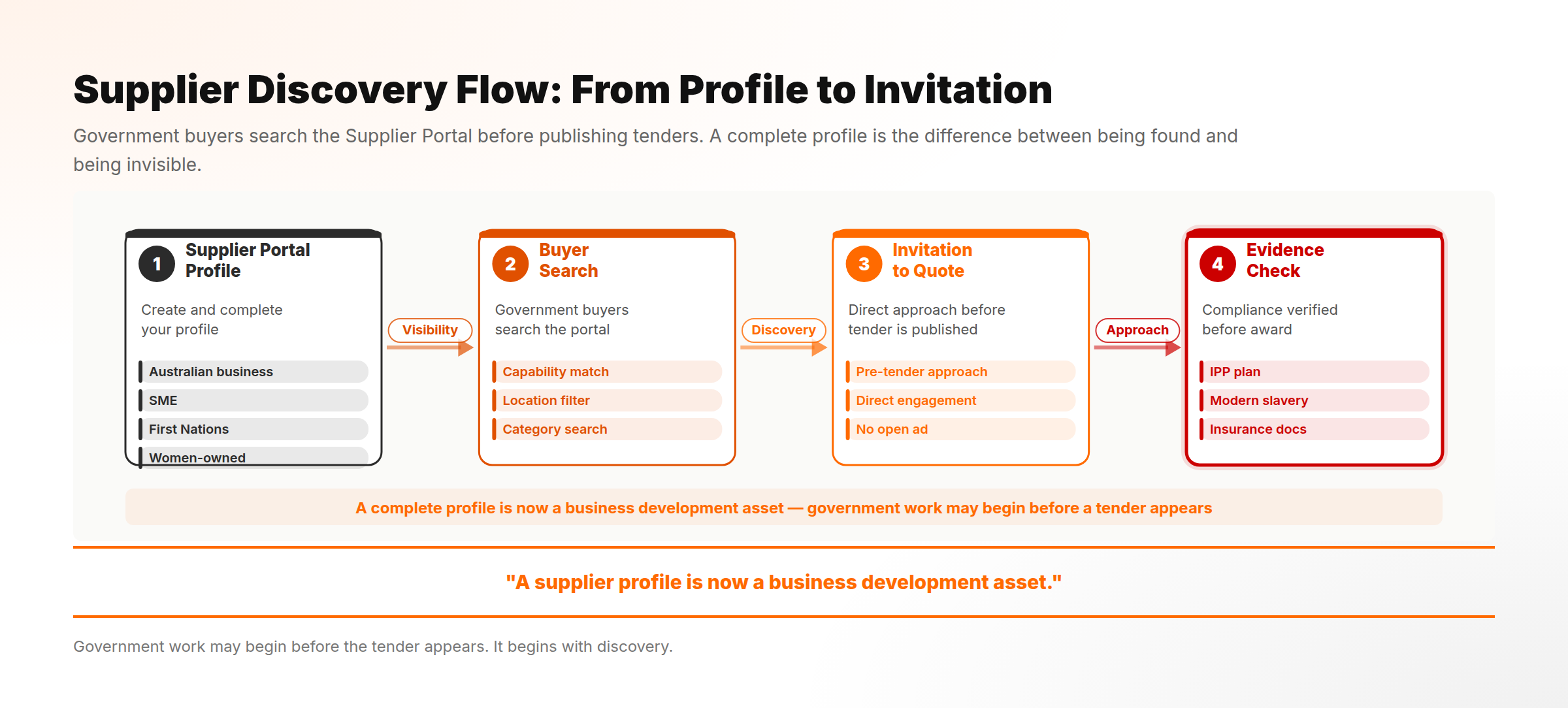
The Supplier Portal is where that begins. It sits inside AusTender but is not a replacement for it, and is not the lodgement platform. It is a discovery surface. Suppliers self-manage profiles, including key characteristics such as Australian business, Small and Medium Enterprise (SME), First Nations business and women-owned status.
The Portal is already live for 645 Management Advisory Services and People Panel suppliers. From 1 July 2026, it opens to all suppliers. The data will not be complete on day one. It is opt-in and supplier-managed, so directory quality depends on supplier uptake.
International research on SME participation in public procurement consistently identifies limited information access and weak supplier visibility as primary barriers to winning public contracts. A recent systematic review of 119 academic studies in the Journal of Purchasing and Supply Management organises these findings under “systemic barriers” as one of five major research themes. That is why contractors should treat the Portal as business development, not administration. Buyer-initiated discovery works from information available at the moment of search. A thin or outdated profile may not appear. A current, capability-aligned profile becomes a practical route into an invitation.
The tender still matters. The bid still matters. But the first commercial contest may now be whether a buyer can find the right supplier at all.
3. Australian Business, SME And Local Status Now Need Evidence
Eligibility is only useful if buyers can verify it.
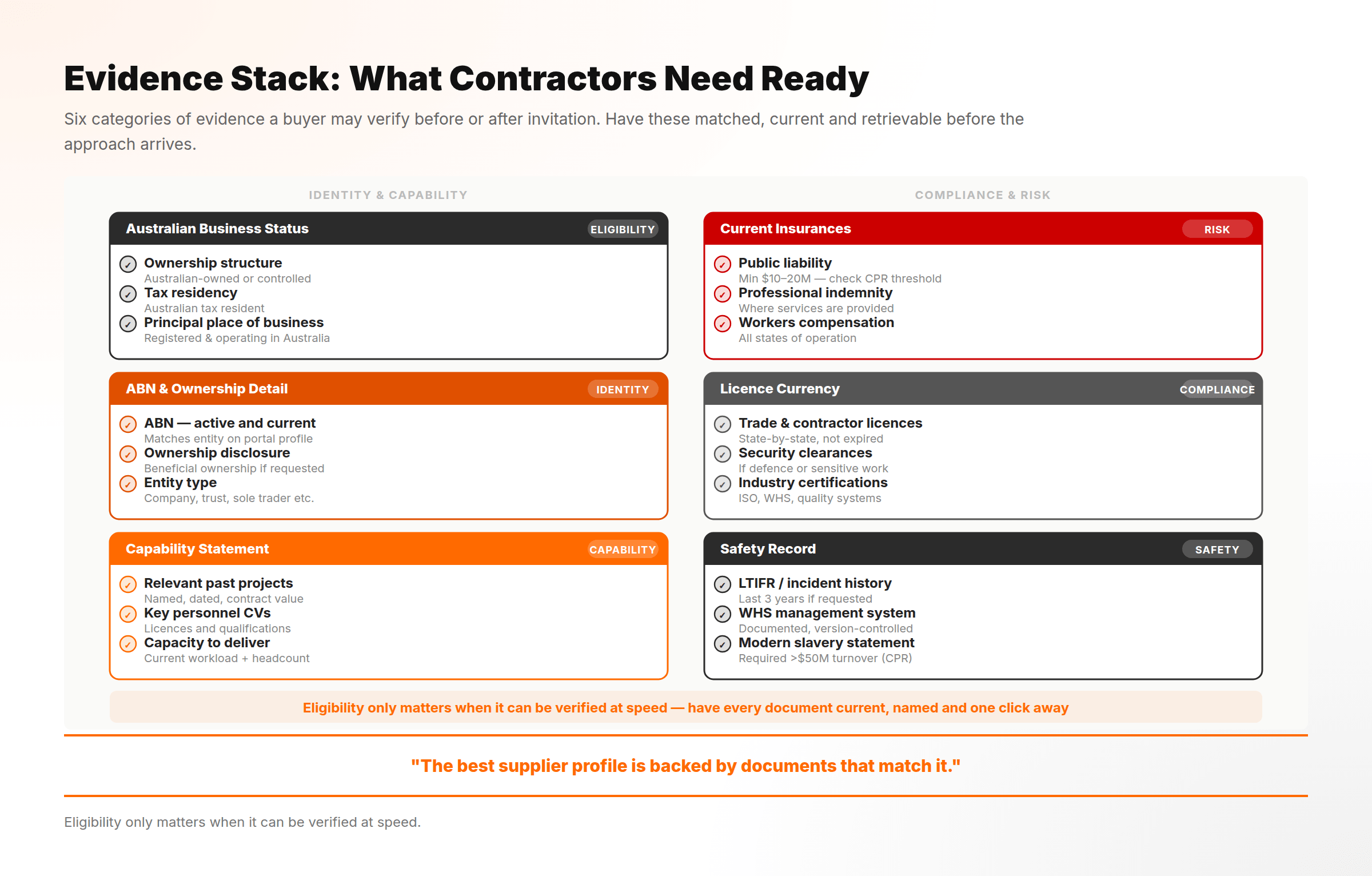
For Australian-business priority, the Department of Finance definition is practical. The business, and any parent business, must meet specific criteria: 50% or more Australian ownership, Australian tax residency, and principal place of business in Australia. For construction services below $7.5 million, that status can affect whether a contractor is invited under CPR 5.4.
The commercial problem is not the definition. It is the evidence trail.
The Australian National Audit Office’s 2023 Procurement Complaints Handling audit, whose recommendations directly informed several of the 2025 CPR amendments, identified deficiencies in how Commonwealth entities receive, document and resolve supplier complaints. A procurement team comparing suppliers needs confidence that business status can be declared, substantiated and reconciled with supplier profile, ABN information and tender documents. If a claim cannot be checked quickly, it loses value.
For contractors, routine documents become commercial assets. A current capability statement, ABN and ownership detail, current insurances, licence currency and safety record are not compliance files in a folder. They are the proof that lets a buyer move from interest to invitation.
This matters most for smaller contractors and subcontractors. The reform may reduce some access barriers, but it does not remove the need to prove capability. Being eligible gets attention. Being organised converts attention into opportunity.
4. Indigenous Participation Tightens. ACT Opens A Local Pathway
The new Commonwealth and ACT procurement settings reward genuine participation, not last-minute name dropping.
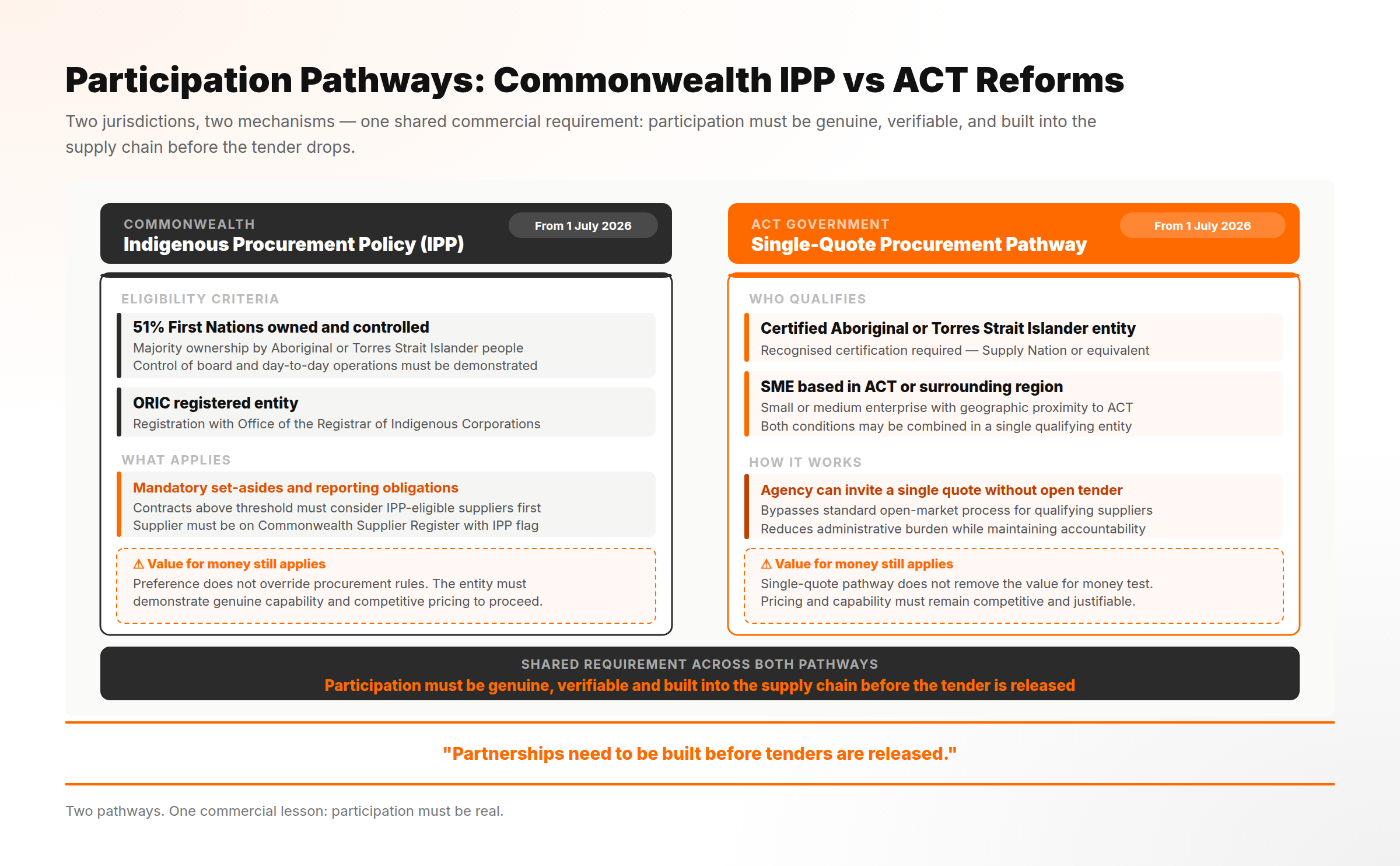
From 1 July 2026, First Nations businesses must be 51% or more First Nations owned and controlled, or registered with ORIC, to access the Indigenous Procurement Policy (IPP). The intent is to ensure IPP benefits flow genuinely to First Nations people.
That shifts the focus from nominal to verified participation. Eva’s 2025 analysis in the Australian Journal of Public Administrationfound IPP contracts had concentrated in a small number of suppliers, echoing earlier University of New South Wales (UNSW) research by Denny-Smith and Loosemore (2017), which raised concerns that procurement participation can appear stronger on paper than in ownership, control or delivery substance. The policy debate around “black cladding”, examined in the NIAA’s 2024 reform discussion paper, exists because participation claims can become performative if ownership, control and commercial substance are not tested. The 51% rule and Office of the Registrar of Indigenous Corporations (ORIC) pathway make that test explicit.
The ACT reform moves in the same direction through a different mechanism. From 1 July 2026, under the Government Procurement Amendment Act 2026, a Territory entity using limited tender may seek one written quotation from a certified Aboriginal or Torres Strait Islander entity or an SME in the ACT or surrounding region. That is a single-quote pathway, not a direct award. Value for money still applies.
The commercial lesson is the same in both jurisdictions: participation must be built before tenders are released. Genuine partnerships, verified status and delivery confidence matter more than names on the cover.
5. A Late Tender Is No Tender. Bid Discipline Is Now Strategy
A strong tender submitted late is still a failed tender.
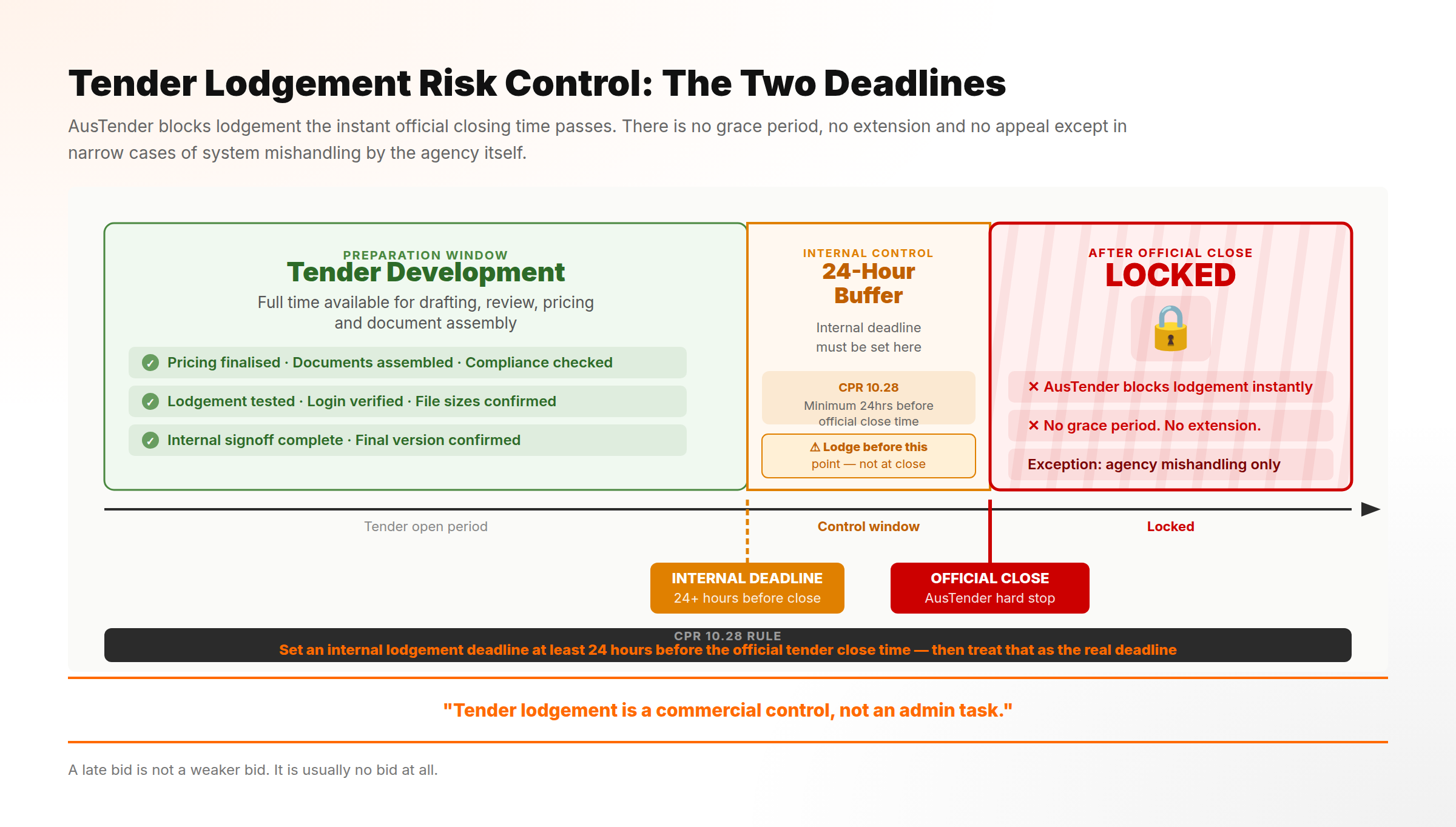
CPR 10.28 is clear: late submissions must not be accepted unless lateness was caused by mishandling by the relevant entity. Courier or postal mishandling arranged by the supplier does not qualify. AusTender blocks lodgement after closing time.
For contractors, tender lodgement is a commercial risk control. The final upload is where months of estimating, commercial review, subcontractor pricing and executive sign-off either become a valid bid or disappear from the competition.
CPR 4.5(c) now makes ethical conduct an express value-for-money consideration. For contractors carrying unresolved corporate conduct issues, including safety, payment or director-conduct matters, procurement risk no longer sits outside the assessment. The ANAO’s 2024 audit of procurement reform implementation at the Digital Transformation Agency confirms that procurement risk and controls are now subject to standing audit-committee oversight.
By July, contractors should have six things under control:
1. Update the Supplier Portal / AusTender profile with current capabilities, characteristics and service categories.
2. Verify Australian-business status: ownership, tax residency, principal place of business.
3. Refresh capability statement, insurances, licences and safety documentation.
4. Review ACT presence and certification if relevant; assess single-quote eligibility.
5. Identify and confirm First Nations and local SME partnerships before tenders are released.
6. Set internal submission deadlines at least 24 hours before official close.
The procurement reform story is easy to misread as compliance. That is too small.
The real shift is earlier in the commercial chain. Government buyers are getting a more structured way to discover suppliers, test eligibility and justify invitations. Contractors waiting for the tender release may still compete, but they may be arriving after the first screen has already happened.
The advantage now belongs to the businesses that are visible, verifiable and ready before the buyer starts looking. In government work, that may become the difference between being invited to price and never seeing the opportunity at all.
What does this look like from where you’re standing?
For the contractors, developers, subcontractors, consultants and procurement teams reading this: where is the visibility shift showing up first? Supplier profile setup, evidence packaging, First Nations or local partnerships, ACT positioning, or internal bid-lodgement controls? The most useful conversations in this industry start before the deadline arrives. Leave a comment below.
See you next week.
Note: This article is general market commentary and does not constitute financial, legal or procurement advice.
Keep reading
More from the bid team
14 October 2026 · Visionex Solutions
The Call You Should Not Make
Construction runs on relationships: a quick call to the client, a coffee with the project manager, a word on the site walk.
6 October 2026 · Visionex Solutions
How Defence Actually Evaluates
In Defence's final evaluation for the Army's new infantry fighting vehicles, then planned as a fleet of up to 450, Rheinmetall's tendered price was almost...
30 September 2026 · Visionex Solutions
The Bid You Should Not Submit
Defence's standard construction tender form asks you to declare that bidding was your own commercial decision. The question is whether you actually made one.
Have a tender on your desk?
Send it through. Within 24 hours you will have a go or no go call, a returnables check, and a clear view of where the marks are.