Home/Blog/Daily Margin, Not Monthly: The Cash Architecture Surviving Builders Run
Deep Dives · 18 June 2026 · Hashan Senarathna
Daily Margin, Not Monthly: The Cash Architecture Surviving Builders Run
The Intelligence Deep Dive 06 | Issue 012 | 2026 — a Hashan Senarathna deep dive.
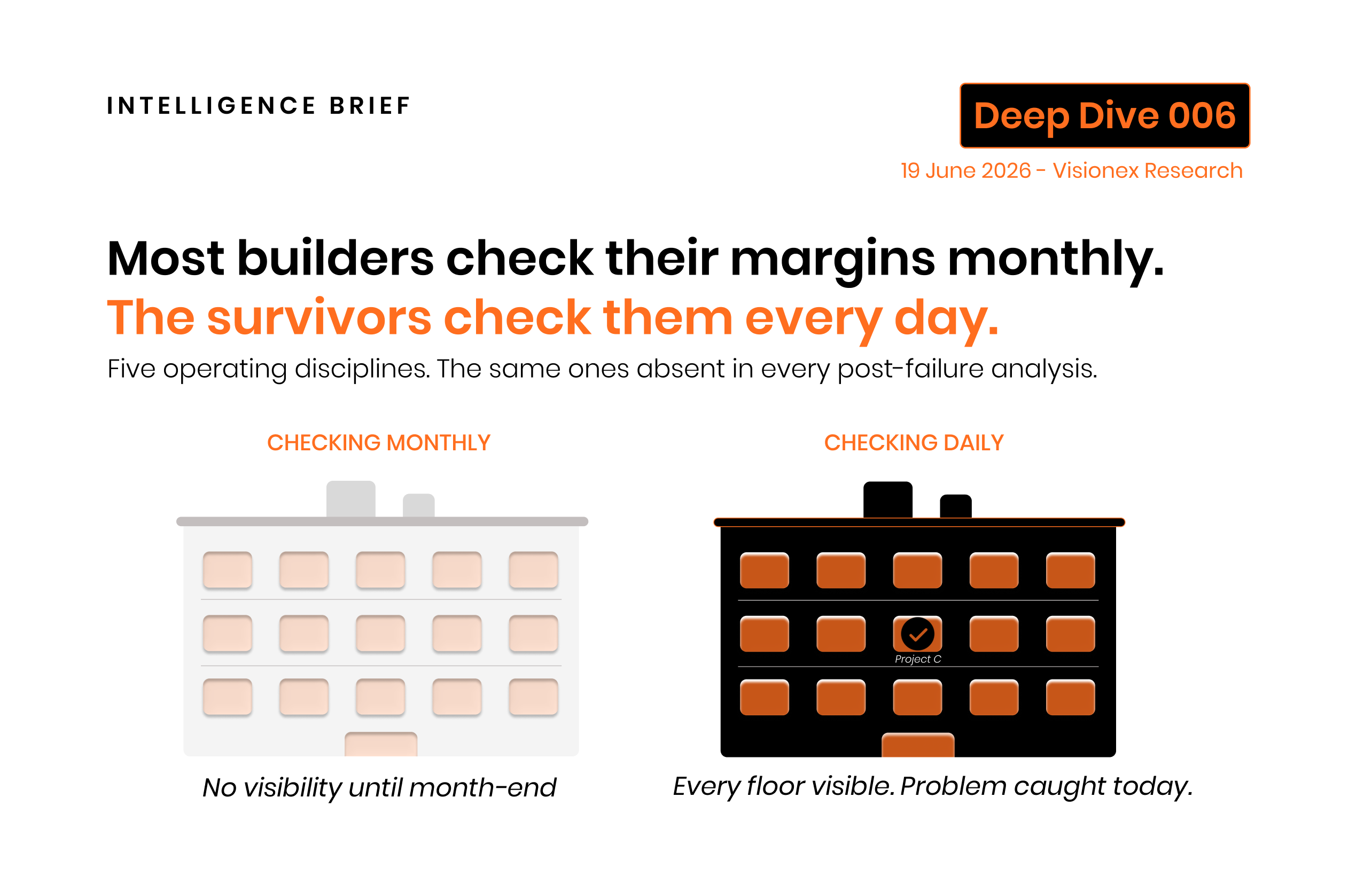
Two builders. Same city. Same type of work. One will come out of 2027 materially stronger. The other will not see the problem coming until it is already inside the business. The difference is not their contract portfolio, their client relationships, or their crews. It is what they look at, and how often they look at it.
Deep Dive 05 showed where the insolvency cascade starts and what legal protections exist for the subcontractors swept up in it. This chapter is the operating layer above that. It profiles five specific disciplines that separate the firms running the current market from the ones being consumed by it. None require expensive software. All require the decision to start
1. Why construction fails on cash, not on contracts
The problem is structural before it is personal.
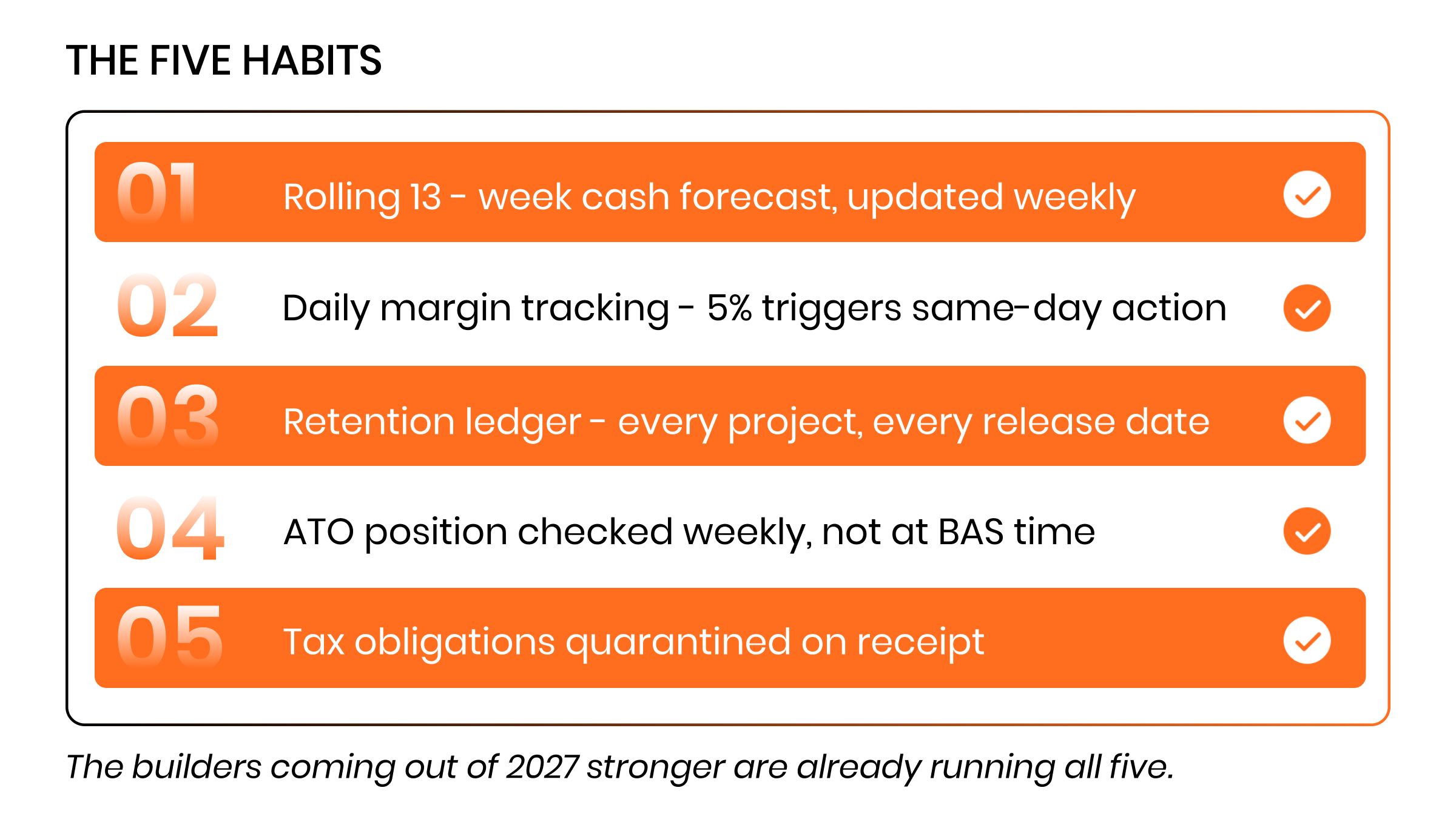
The construction industry is structurally prone to insolvency: it is highly leveraged, with projects typically facing high up-front costs, supply chain risks, and cash flows dependent on hierarchical contracting chains. As a result, Australian Securities and Investments Commission (ASIC) data consistently shows the industry records higher insolvency ratesthan any other sector in the country. Costs go out daily. Payment arrives weeks later. For the 98.5 per cent of Australian construction businesses with fewer than 20 employees, confirmed by the Australian Bureau of Statistics (ABS), there is rarely a credit facility substantial enough to bridge that gap. There is the next invoice, and the hope that it clears before payroll.
The Reserve Bank of Australia (RBA) traces the failure pathway directly: insolvency typically follows an extended period of cashflow difficulty, leading to an inability to repay debts. The RBA identifies inadequate cash flow as the most cited cause of business failure in its analysis of ASIC data, ahead of trading losses and poor strategic management.
ASIC Series 3 data for the year to 30 June 2023 - the most recent year for which ASIC has published a cause-of-failure breakdown - confirm the same pattern for construction specifically. Construction received 28 per cent of all external administrator reports lodged in Australia, more than any other industry, and inadequate cash flow or high cash use was cited in 52 per cent of those reports. More recently, in the 12 months to June 2025 (the latest full financial year), ASIC recorded 3,596 construction companies entering external administration for the first time, the highest figure in over a decade.
Research published two decades ago reached the same conclusion. A United States (US) study by Arditi, Koksal and Kale found that inadequate financial management was the primary driver of construction failure, and that it was preventable. The ASIC data suggests the industry has not broadly absorbed it.
2. The rolling 13-week forecast
Most builders have a budget. It was set in January, reviewed at mid-year, and filed at year-end. A budget is a historical document dressed as a plan. When a subcontractor falls behind in May, when a variation is rejected in July, or when a key client delays a progress payment, the annual budget does not update. The builder discovers all of it at once, usually at month-end, when the gap between what was expected and what happened has already compounded into something much harder to fix.
A rolling 13-week cash flow forecast is a fundamentally different instrument. It is a live, weekly-updated map of every confirmed dollar coming in and every committed dollar going out across the next quarter. Moore Australia’s analysis “The 2026 Construction Landscape: Risks, Pressures and Where Builders Can Win,” published in March 2026, identifies rolling 13-week forecasts, aligned payment terms, and the right mix of facilities as the cash flow foundation for construction businesses that are surviving the current environment. Harris and McCaffer’s Modern Construction Management, the standard industry text, makes the case directly: cash flow forecasting provides an excellent early warning system, and anything outside a firm’s financial demands could result in the company’s potential liquidation.
The 13-week window is deliberate. Long enough to see a cash gap forming before it arrives. Short enough to stay anchored in operational reality rather than speculative forecasting. A meaningful forecast contains confirmed inflows: progress claims by project with expected receipt dates, retention releases with scheduled dates, deposit invoices. And confirmed outflows: weekly payroll, superannuation under Payday Super from 1 July 2026, subcontractor claims by project, materials orders, plant finance, Business Activity Statement (BAS) and Pay As You Go (PAYG) instalment dates.
Critically, it also tracks the work in progress (WIP) position on each active job: whether the business is overbilled or underbilled relative to cost incurred. A job can look profitable on the profit and loss statement (P&L) while tying up cash in retention and WIP simultaneously. For businesses that want to extend this further, a three-way model connects profit and loss, cash flow and balance sheet into one view. Only the three-way view reveals when all three are pulling in different directions at the same time, which in construction they frequently do.
Moore Australia’s 2026 analysis names the operating standard precisely: daily capture of labour, materials, plant and subcontractors, with the loop closed between site and finance so insights drive action rather than post-month-end surprises. The distinction between a forecast that works and one that sits in a folder is one question: did last week’s update change any decision? If not, it is decorative.
3. Daily margin tracking
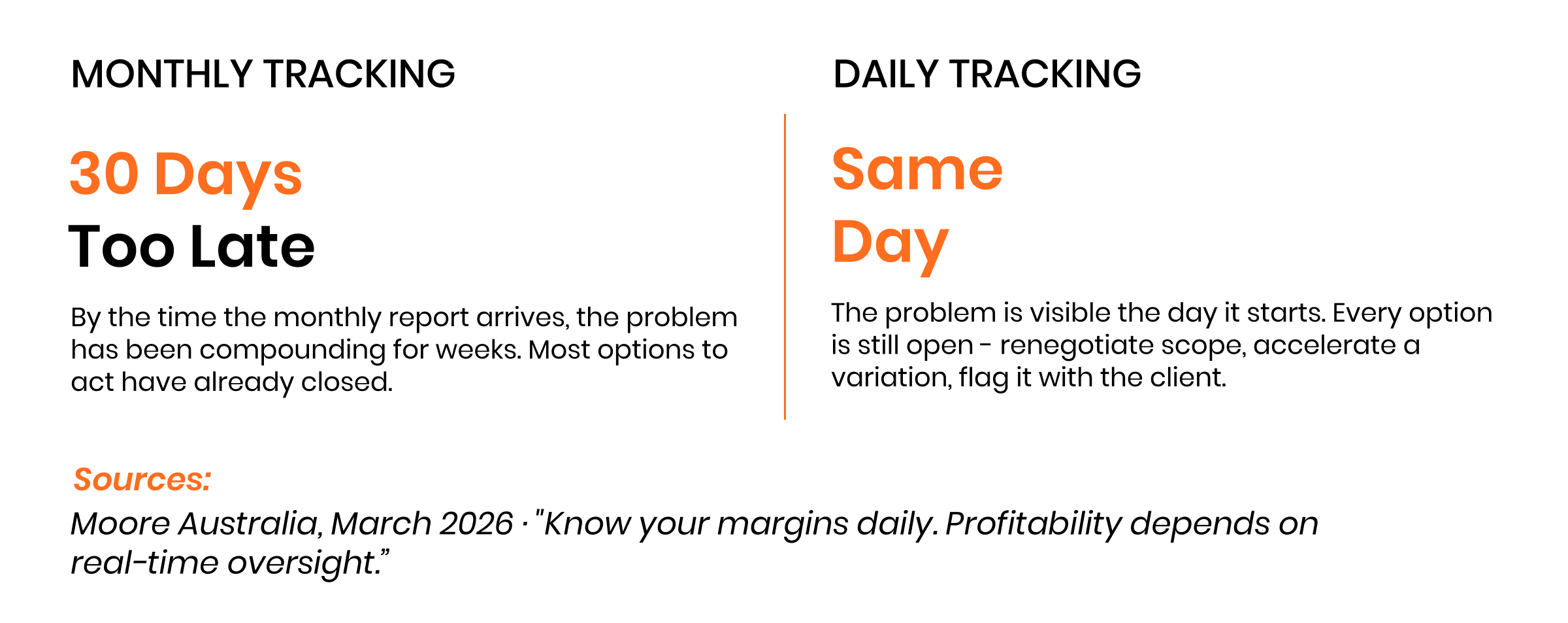
A business owner who checks project margins monthly is making decisions on data that is 30 days old. In a market where labour rates, subcontractor claims and variation approvals move constantly, a monthly read is a historical document by the time it arrives. The damage has often been done. The response window has closed.
Daily margin tracking does not require sophisticated software. It requires five questions asked of every active project every working day: where are actual labour hours against programme, materials receipted against ordered, subcontractor claims submitted against approved, the variation register status (approved, pending, rejected), and the WIP position. These five data points, captured daily, tell a business owner within minutes whether a job is performing or quietly eroding.
The trigger matters as much as the tracking. The surviving firms have set a threshold, typically five per cent of project budget, at which a cost overrun triggers a conversation that day. Not at month-end. In July, when that conversation happens, options still exist: renegotiating a subcontractor scope, accelerating a variation approval, adjusting the programme, or flagging an issue with the client before it becomes a dispute. The business that waits for the monthly report has the same conversation in October, when most of those options have already closed and the problem has compounded into a margin crisis.
In practice this looks like a project manager who starts Monday morning by comparing actual spend against the weekly programme for each active job, flagging any line item running more than five per cent over budget before the first meeting of the day. On a healthy job it takes minutes. The value is not in the time it takes when everything is running well. The value is in the speed at which it catches a problem when it is not.
Moore Australia’s 2026 analysis names this discipline directly: “Know your margins daily. Profitability depends on real-time oversight.”
4. Retention as live cash
There is approximately $18 billion in earned but unavailable money sitting inside Australian construction at any given time. Most businesses are not actively managing it.
Carbon Group puts the scale in context. Based on ABS Australian Industry data, published December 2024, the Australian construction industry is worth more than $568 billion annually. Approximately 450,000 subcontractors account for roughly 40 per cent of industry income, around $227 billion. With contract retention typically running at five per cent of progress claims, approximately $18 billion is outstanding across the sector at any given time. For a business turning over between $600,000 and $1 million annually, the average outstanding retention sits at approximately $40,000. That is not a rounding error. For most small construction businesses, it is the difference between a comfortable BAS quarter and a crisis.
Deep Dive 05 covered retention from the subcontractor’s legal angle: the risk of losing it on insolvency, the state-by-state protection frameworks. This chapter is the operating angle for the builder and head contractor. Most businesses treat retention as a passive line item: money owed, expected eventually. The surviving firms treat it as a scheduled receivable with a live management obligation. They know, for every active project, exactly how much retention is held, when practical completion is scheduled, when the half-release falls due, when the defects liability period ends, and when the full release is expected. Overdue retention is chased actively, not waited for.
There is a second cash problem embedded in retention that is less visible. Some accounting methods recognise retention as income too early, meaning Goods and Services Tax (GST) and income tax are paid on money that has not yet been received. Carbon Group identifies this directly. A business paying tax on unrecovered retention is funding the Australian Taxation Office (ATO) from its own working capital without knowing it.
A retention ledger does not need to be complicated. One row per project. Columns for retention held, practical completion date, half-release date and amount, defects liability period end date, full-release date and amount, and current status: on track, overdue, or in dispute. Businesses that implement one consistently find that amounts they had quietly accepted as “eventually” represent a material and recoverable cash position. A business running six active projects simultaneously is typically carrying $150,000 to $250,000 in outstanding retention, an amount that sits invisible when untracked in the business while its day-to-day obligations are being met from the operating account. A retention amount that is overdue by 90 days often needs a formal payment claim under the relevant Security of Payment Act before the client will move. That clock does not start until someone looks at the ledger.
Retention, the ATO position, and the tax timing gap covered in the following two sections are three versions of the same underlying problem: money that has been earned but not yet recovered, or obligations that are accumulating inside the business without anyone watching the number.
5. ATO position: the weekly early warning signal
The data on ATO debt and construction business failure is specific enough to function as an operating threshold.
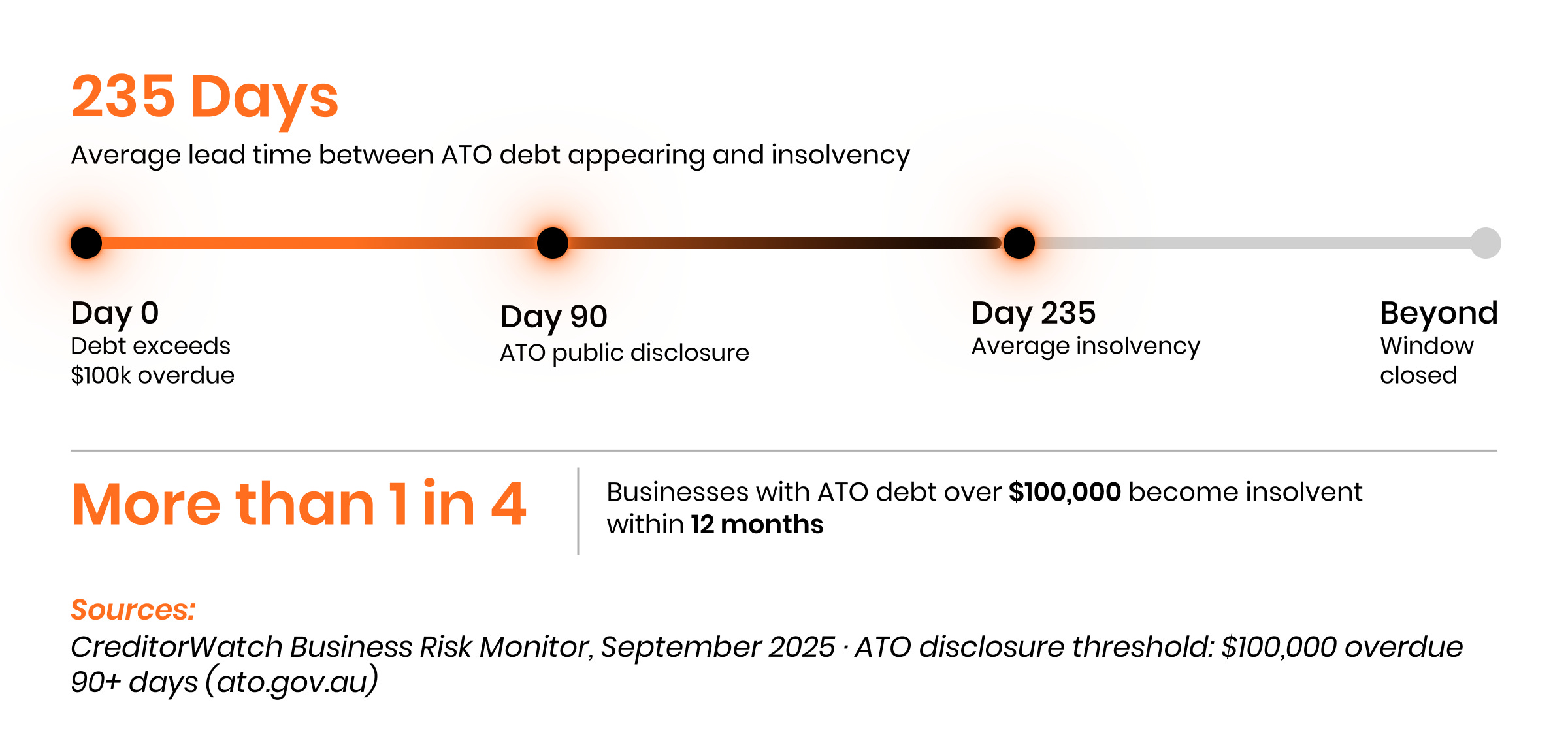
The CreditorWatch Business Risk Monitor, launched in September 2025, found that more than one in four businesses carrying ATO tax debts over $100,000 became insolvent within 12 months of that debt being recorded. The average lead time between the appearance of the debt and the insolvency event was 235 days. That figure is the most commercially important number in this section. The warning signal is visible and actionable nearly eight months before failure becomes irreversible, but only if someone is watching it.
Most construction businesses check their ATO position at BAS time, once per quarter. Some discover it for the first time when the debt has already crossed the threshold at which the ATO begins public disclosure of business tax debts. The disclosure threshold is at least $100,000 overdue for more than 90 days, where the business is not actively engaging with the ATO to manage the debt. By the time disclosure begins, the 235-day warning window has already been running for months.
The CreditorWatch April 2026 Business Risk Index confirms the current environment is making this worse, not better. Late payments are at a six-year high. Three of the four highest new ATO tax default inflows since post-COVID enforcement resumed have been recorded in the past four months. Construction’s rolling annual insolvency rate sits at 1.18 per cent. The 7.15 per cent of construction invoices currently running more than 60 days overdue is the fourth-highest rate of any industry in Australia.
Three numbers to track weekly: the BAS position for the current quarter (GST and PAYG withholding accumulated but not yet remitted), the PAYG instalment position against the current schedule, and the super guarantee position against the payroll cycle. If combined ATO obligations at any point exceed four weeks of gross revenue, that is the trigger for immediate action, not the next quarterly BAS.
From 1 July 2025, the cost of ignoring this signal increased materially. Under the Treasury Laws Amendment (Tax Incentives and Integrity) Act 2025, the General Interest Charge (GIC) on unpaid tax is no longer tax deductible. The rate currently runs at 10.96 per cent per annum for the April to June 2026 quarter, compounding daily. Carbon Group confirmed the practical consequence: businesses now have a strong incentive to obtain bank finance rather than allow ATO debt to accumulate, because bank interest remains deductible and GIC does not. The ATO has become, in effective cost terms, the most expensive creditor a construction business can carry.
6. Capital against tax
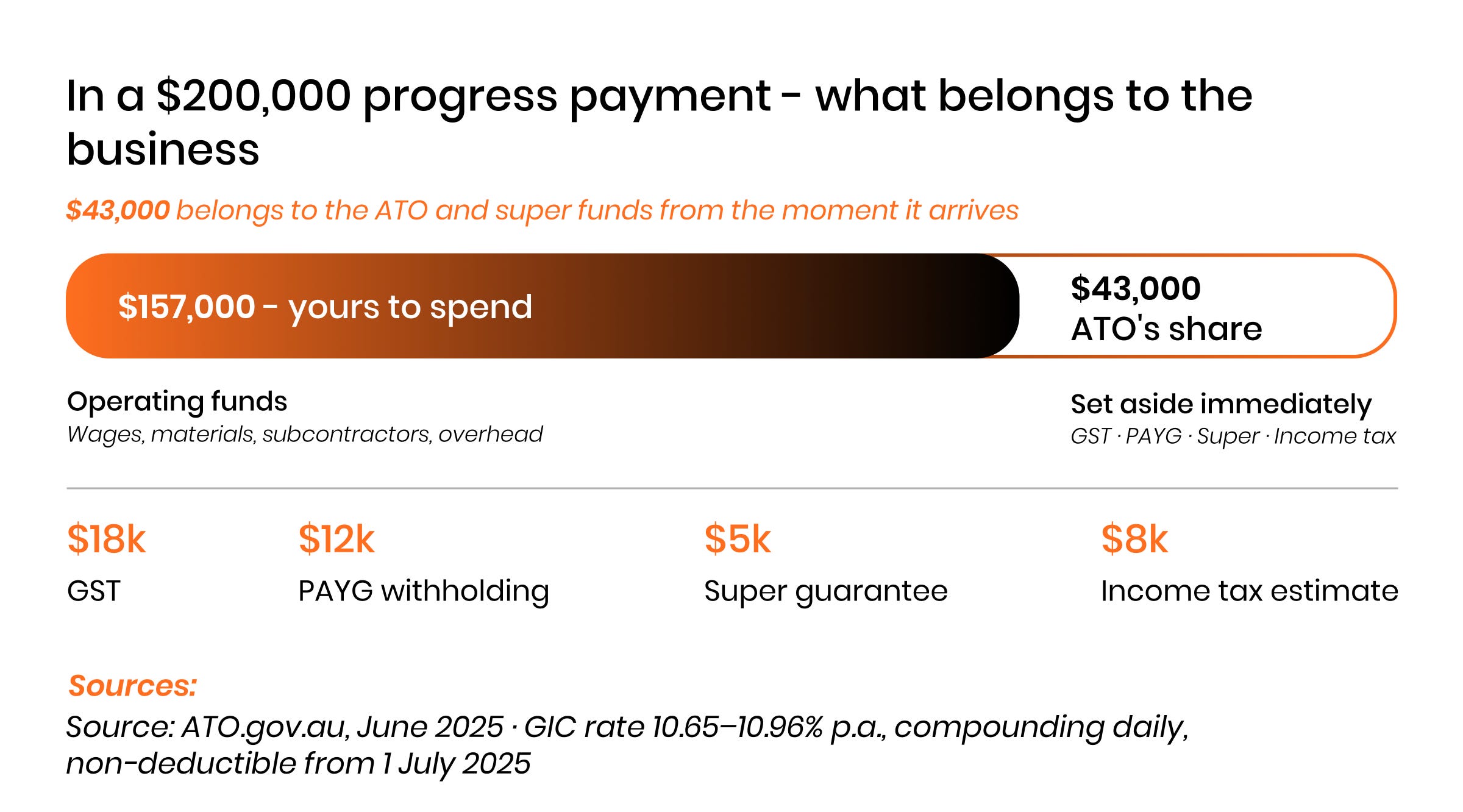
Every progress payment received by a construction business contains money that does not belong to the business. The GST, the PAYG withholding on wages, the super guarantee and the income tax on the profit margin are real obligations from the moment the payment arrives. The due date is weeks or months away. In that gap, the money can be spent, and in many construction businesses, it is.
When the BAS falls due, the account balance is lower than it should be. That is not always a cash flow crisis in the conventional sense. It is frequently the consequence of ordinary operating decisions made by a business that did not distinguish, day to day, between money that was operationally theirs and money that was being held on behalf of the ATO. The directors believed the business was profitable. It was. But the cash available was not all theirs to spend.
The ATO states the answer directly: “Set aside GST, PAYG withholding and super from your cash flow, so you have the funds available when it’s time to pay.”
The quarantine system is not sophisticated. A separate bank account. A fixed transfer rule applied to every progress payment received. Consider a builder receiving a $200,000 progress payment. The GST component is approximately $18,000. The PAYG withholding on wages for the associated fortnight might be $12,000. The super guarantee on those wages sits at approximately $5,000. The income tax estimate on the margin is another $8,000. In total, approximately $43,000 of that payment belongs to the ATO and the super funds: money that was never operationally the builder’s to spend. A business without a quarantine system spends the $43,000 operationally and scrambles when quarterly obligations arrive simultaneously. A business with the rule transfers the amount the day the payment arrives, settles each obligation from the reserved account when it falls due, and never has the conversation about where the money went.
Since 1 July 2025, the cost of not running this discipline has increased sharply. GIC at 10.96 per cent per annum for the current quarter, compounding daily and fully non-deductible, is now the cost of treating the ATO as a funding source. A business carrying $100,000 in unpaid BAS is paying more than $10,000 per year in non-deductible interest. Every day the balance sits unresolved, the cost grows. The businesses that quarantine tax obligations do not pay GIC. The businesses that do not are paying the most expensive cost of capital in their business, without having made a deliberate decision to borrow from anyone.
7. Capital View
ASIC confirms that the share of companies entering insolvency remains elevated in construction, particularly for smaller firms where the operating environment has been challenging. The CreditorWatch April 2026 Business Risk Index recordsthe construction sector at a 7.15 per cent rate of invoices more than 60 days overdue and a 1.18 per cent rolling annual insolvency rate, against a backdrop where late payments have reached their highest level in six years and ATO tax default inflows remain very elevated. The Australian Financial Security Authority (AFSA) State of the Personal Insolvency System 2024-25 confirms the personal stakes: construction and related services made up more than one-third of all business-related personal insolvencies in 2024-25, and the ATO is the largest single creditor in the personal insolvency system. The environment described across Deep Dives 01 through 05 is not easing. It is intensifying.
For developers and project lenders, the five disciplines in this chapter are counterparty risk signals, not just internal operating practices. The independent Construction Industry Rating Tool (iCIRT) framework, Equifax’s rating tool now used by lenders and institutional clients to assess construction counterparties, directly measures whether a firm has operational systems to track liquidity and cash flow in real time. A business running these disciplines is not ticking a box. The habits themselves are what the rating is measuring.
A head contractor who can tell you today what their 13-week cash position looks like, what retention is outstanding and when it is due, and what their current ATO balance is: that business is a materially lower delivery risk. Their project will not stop because payroll failed on a Thursday morning. Their subcontractors will be paid because retention is tracked and claimed before it goes overdue. Their ATO position will not quietly accumulate into a six-figure liability that forces an administration mid-programme. These are not aspirational outcomes. They are the direct consequences of running or not running five operating disciplines.
The iCIRT framework makes this measurable. Equifax’s six-pillar framework for construction counterparty assessment scores firms directly on their Capacity (project pipeline, liquidity, cash flow) and Capital (funding, borrowing capacity, covenants, debt serviceability) positions. Lenders and institutional procurement teams are already using iCIRT ratings to distinguish between head contractors before awarding finance and contracts. A firm running the five disciplines in this chapter is not just a more resilient business partner. They are specifically scoring higher on the criteria that institutional clients are beginning to require as a condition of engagement.
A contractor who cannot answer the three questions above is carrying risk they have not priced. In a market where 3,596 construction businesses entered administration in the 12 months to June 2025, the highest figure in over a decade, that is not a theoretical concern. It is the operating baseline.
The five habits
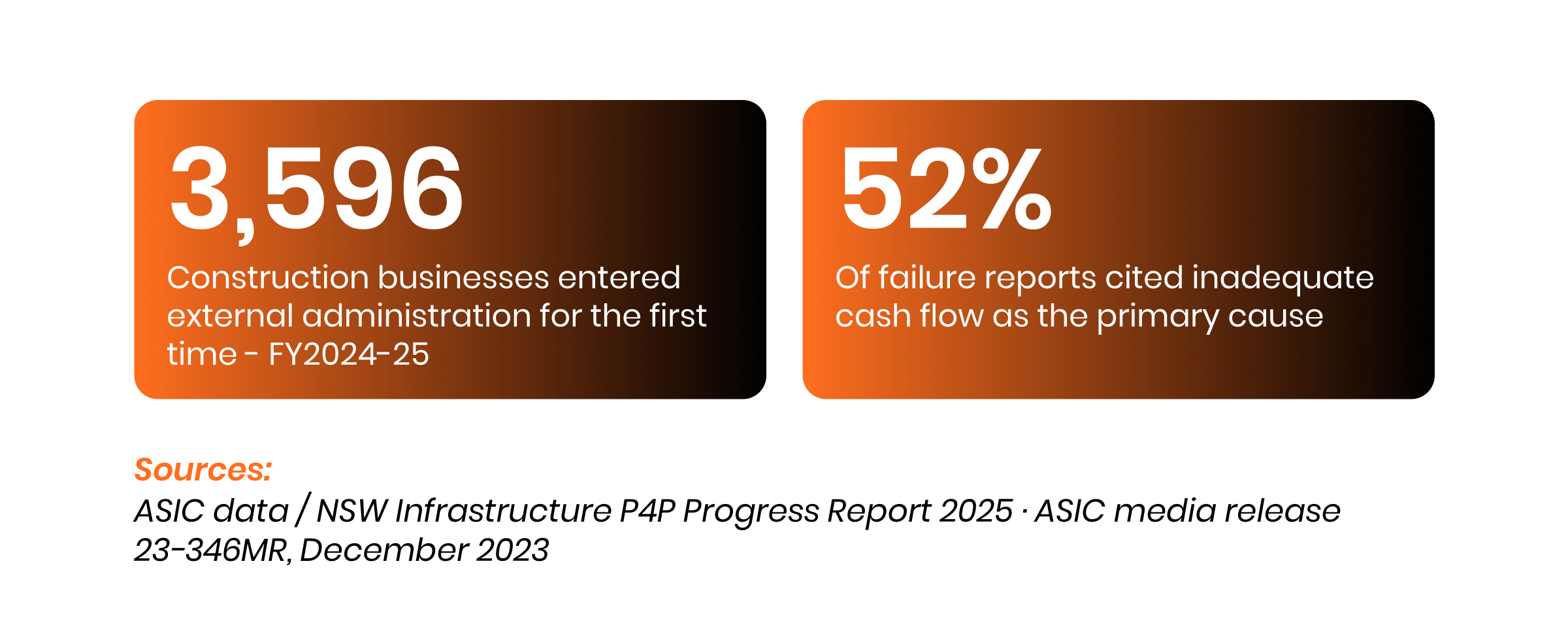
A rolling 13-week cash forecast, updated every week. Daily margin tracking with a five per cent threshold that triggers same-day action. A retention ledger for every active project, actively managed. An ATO position checked weekly, with obligations quarantined from the moment revenue is received. And the discipline of treating the ATO’s share as the ATO’s, not as operational cash.
The cause of construction failure has been documented for decades. The CreditorWatch data puts the average warning window at 235 days. The ASIC data shows inadequate cash flow was cited in 52 per cent of external administrator reports in the most recent year for which ASIC has published cause-of-failure data. The RBA is watching the sector directly. The iCIRT framework is making financial operating discipline visible to the institutional market for the first time.
The builders coming out of 2027 stronger are already watching themselves.
Of these five disciplines, how many does your business currently run?
The next chapter in the Financial Discipline thread publishes 28 August 2026 as Deep Dive 11: Reading Failure Six Months Early: PPSR, ASIC and the iCIRT Signal Set. It covers the prediction layer: how to identify counterparty failure before it happens, using public data that most procurement teams are not yet reading.
See you next week.
Note: This article is general market commentary and does not constitute financial, legal or investment advice. All monetary figures are in Australian dollars (AUD).
Keep reading
More from the bid team
14 October 2026 · Visionex Solutions
The Call You Should Not Make
Construction runs on relationships: a quick call to the client, a coffee with the project manager, a word on the site walk.
6 October 2026 · Visionex Solutions
How Defence Actually Evaluates
In Defence's final evaluation for the Army's new infantry fighting vehicles, then planned as a fleet of up to 450, Rheinmetall's tendered price was almost...
30 September 2026 · Visionex Solutions
The Bid You Should Not Submit
Defence's standard construction tender form asks you to declare that bidding was your own commercial decision. The question is whether you actually made one.
Have a tender on your desk?
Send it through. Within 24 hours you will have a go or no go call, a returnables check, and a clear view of where the marks are.