Home/Blog/Australia's Battery Storage Pipeline Is the Biggest in the Nation's History. The Construction Industry Has to Actually Build It.
Industry News · 26 June 2026 · Hashan Senarathna
Australia's Battery Storage Pipeline Is the Biggest in the Nation's History. The Construction Industry Has to Actually Build It.
This Week's Read 06 | Issue 013 | 2026 — a Hashan Senarathna deep dive.
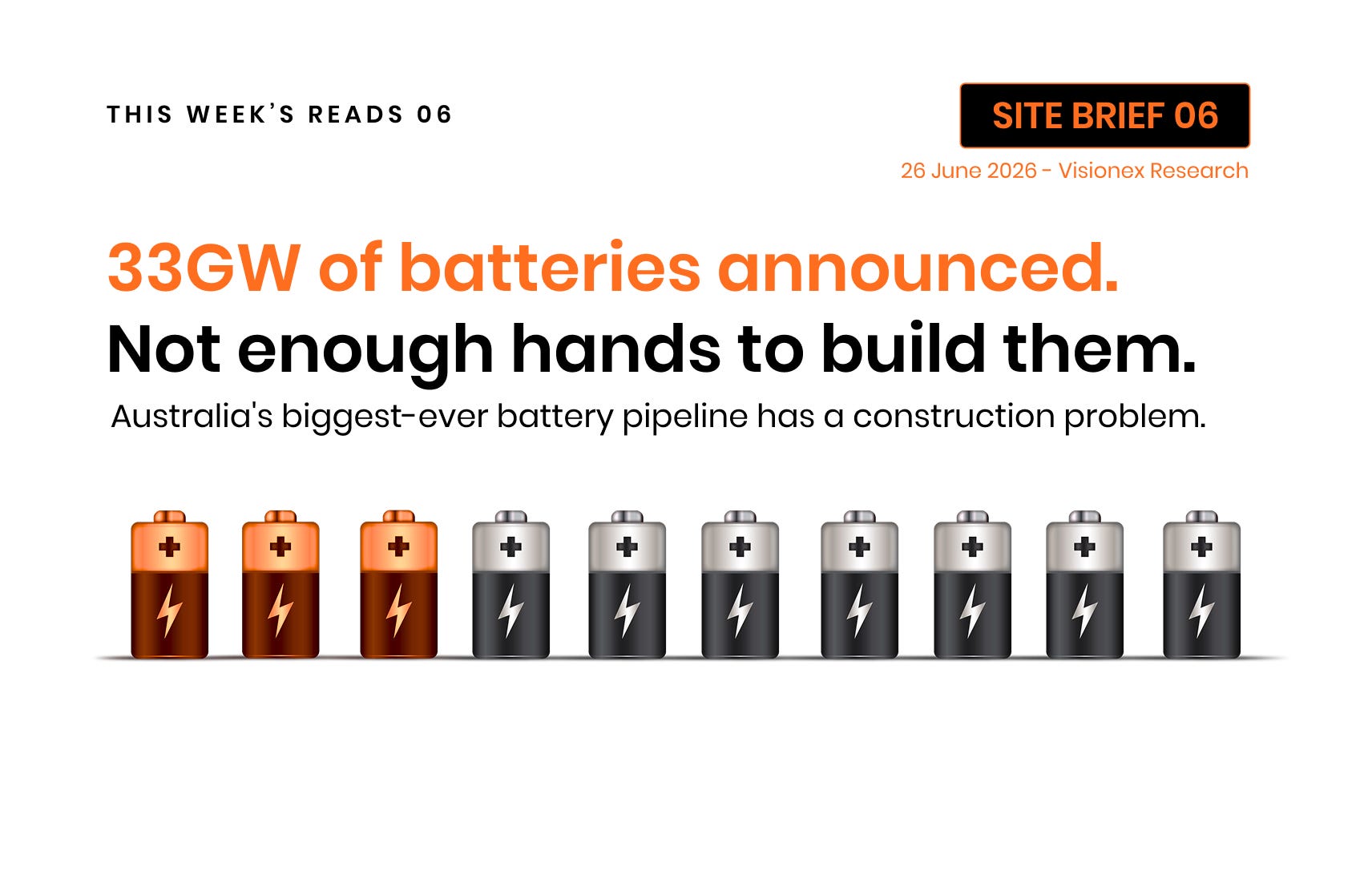
Australia has announced more battery storage than any country in its history. It has contracted enough capacity to power cities, replace coal plants and hit renewable energy targets that would have seemed ambitious a decade ago. There is only one problem: almost none of it is built.
The gap between what governments have approved and what the construction industry can physically deliver is now the most consequential constraint in Australian energy infrastructure. It is not a policy problem. It is a trades problem, a supply chain problem, a timing problem - and for construction firms, it is a business opportunity if they understand what they are looking at.
1. The pipeline is real. The construction is not.
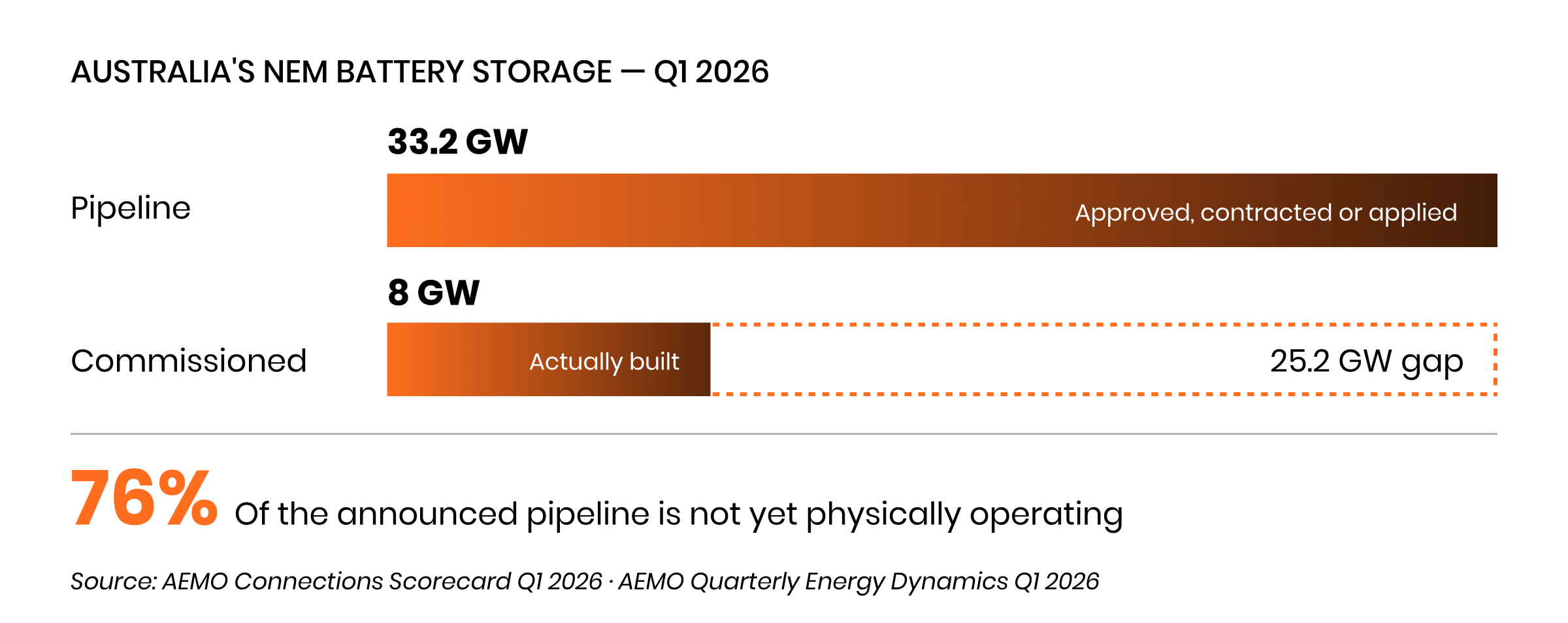
In the first quarter of 2026, the Australian Energy Market Operator’s (AEMO) Connections Scorecard confirmed that 33.2GW of standalone battery storage is now progressing through the National Electricity Market (NEM) connection process- a 62 per cent increase on the same period in 2025. Battery projects now represent 49 per cent of the entire 67.3GW NEM pipeline. The numbers are extraordinary.
What they do not tell you is how much of that pipeline is physically under construction. AEMO itself flags the answer: projects are taking longer to move from approvals to delivery due to funding uncertainty, supply chain constraints and resource limitations. The pipeline is an expression of intent. Construction is a different conversation entirely.
2. New South Wales is running out of time.
The sharpest illustration of the delivery gap sits in New South Wales (NSW). At the Energy Storage Summit Australia 2026 in March, NSW Energy Security Corporation (ESC) Chief Executive Officer (CEO) Paul Peters told the audience that the state’s storage requirement for 2030 had grown from 40GWh to 56GWh - driven entirely by solar penetration accelerating faster than anyone planned. Of that 56GWh, only 12.5GWh had reached financial investment decision.

That 75 per cent figure is not an abstraction. Eraring, Australia’s largest coal-fired power station, is confirmed to close in April 2029. Battery storage is the primary replacement technology. If construction does not accelerate materially in the next 12 to 18 months, NSW faces a structural gap between coal exiting and storage arriving.
The NSW Energy Security Corporation made its first investment in June 2026 - committing $100 million to the 650MW PLUS Grid Storage platform across four projects, with construction on the Newcastle site scheduled to begin in July 2026. It is a significant move. It is also, relative to what needs to be built, a starting point.
3. What a battery project actually requires.
A utility-scale Battery Energy Storage System (BESS) is not a product you order and plug in. A typical project involves roughly 200 battery containers, 52 inverters and transformers, high-voltage switchyard infrastructure, civil hardstands and access roads, and grid connection works - followed by a commissioning period that can run for months. Construction alone takes 18 to 24 months from site mobilisation.
The physical components are overwhelmingly imported. Over 80 per cent of battery cells and modules used in Australian projects come from China, South Korea or Japan. CATL and BYD dominate the utility-scale segment. No commercial-scale lithium-ion cell manufacturing exists in Australia, and domestic production is not expected before 2028 at the earliest. Supply chain lead times compound the construction timeline significantly.
None of this can be rushed. Each project represents an 18-to-24-month civil and electrical construction programme - and Australia has more of them coming than it has contractors to build.
On the contracting side, legal analysis of the Australian market confirms that a limited number of contractors are willing to take on a traditional lump-sum Engineering, Procurement and Construction (EPC) role for BESS projects. The market has shifted toward split contracting - separating battery supply from balance of plant civil and electrical work. That opens the market to more firms but also fragments delivery risk across multiple packages and interfaces.
4. The labour market cannot absorb this volume.
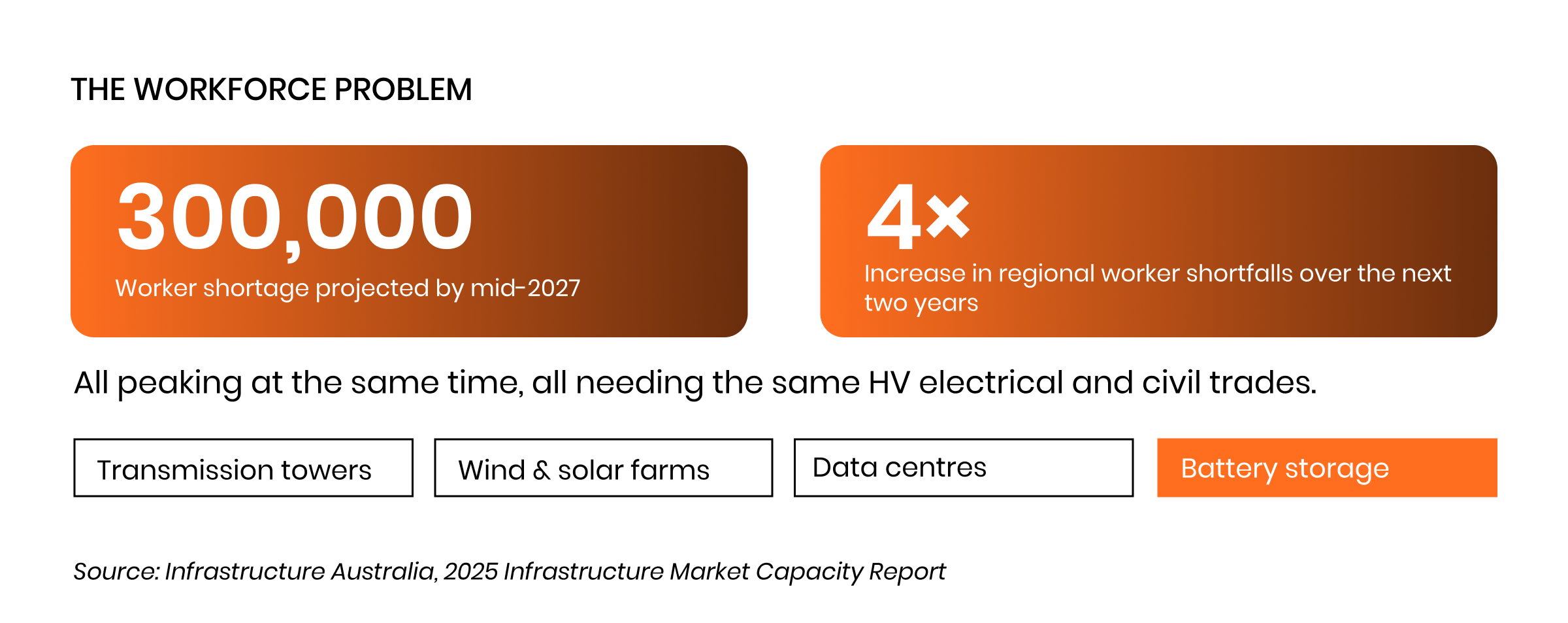
The construction workforce problem is well documented but still not fully priced into project schedules. Infrastructure Australia’s 2025 Market Capacity Report projects a national construction worker shortage of 300,000 by mid-2027. Transmission projects alone - which compete directly with BESS for the same High Voltage (HV) electrical and civil trades - have jumped from $4 billion to $15 billion in the five-year public infrastructure pipeline.
The pressure will be felt most acutely outside the capital cities. Infrastructure Australia forecasts a four-fold increase in regional worker shortfalls over the next two years, driven by the simple geography of energy projects. BESS projects are built near substations and renewable energy zones, not near large workforces.
The specialist trades required for battery construction - HV electricians, switchyard civil crews, grid commissioning engineers - are the same trades being absorbed simultaneously by data centre construction, transmission tower programmes and wind and solar farm builds. The South Australian (SA) Firm Energy Reliability Mechanism (FERM) Tender alone contracted six battery projects with delivery horizons clustered around 2028 and 2029, compressing demand for the same specialist pool into the same window.
Infrastructure Australia’s own industry survey makes the scale of the problem plain: 63 per cent of firms cite labour cost as a substantial threat to delivery, and 59 per cent cite skills shortages as the primary risk factor. Firms are not investing ahead of the pipeline. Most are taking a wait-and-see approach, counting on redeploying workers from adjacent sectors once demand materialises rather than building specialised capacity in advance.
5. Who is positioning for this work.
The contractor pool active in BESS delivery is still small. GenusPlus Group has emerged as the clearest example of a firm moving early. In April 2026, GenusPlus was awarded a $110 million EPC contract for the 200MW/800MWh Koolunga BESS in South Australia, while concurrently delivering the Reeves Plains BESS for Alinta Energy. Its revenue grew 61 per cent to $535 million in the first half of Financial Year 2026 (FY2026).
Those numbers tell you what early positioning in a thin contractor market looks like. For civil contractors, HV electrical firms and balance of plant specialists that have not yet engaged with BESS procurement, the question is no longer whether this market exists - it is whether they understand the prequalification requirements, the procurement structures and the developers approaching financial close.
What this means for the industry.
The tension running through Australia’s battery storage programme is not about ambition or investment. On both fronts, the momentum is real. The constraint is physical delivery capacity - and it is converging with a labour market already stretched to breaking point across transport, housing, data centres and transmission.
For construction firms, this is not a story to read and file. The SA FERM Round 2 and NSW long-duration storage tenders are already in preparation. The federal Capacity Investment Scheme tender rounds will follow. Each round produces contracts that need to be built - and the contractor pool capable of building them is still forming.
The firms that move now on prequalification, on procurement intelligence and on trade resourcing strategies will be structurally better placed than those waiting for Requests for Proposals (RFPs) to arrive. In a market where labour is the binding constraint, pipeline visibility is not just useful. It is competitive.
Australia does not have a battery storage shortage. It has a battery storage construction shortage. The two problems require very different solutions.
More reads next week.
This article is general market commentary and does not constitute financial or legal advice.
Keep reading
More from the bid team
14 October 2026 · Visionex Solutions
The Call You Should Not Make
Construction runs on relationships: a quick call to the client, a coffee with the project manager, a word on the site walk.
6 October 2026 · Visionex Solutions
How Defence Actually Evaluates
In Defence's final evaluation for the Army's new infantry fighting vehicles, then planned as a fleet of up to 450, Rheinmetall's tendered price was almost...
30 September 2026 · Visionex Solutions
The Bid You Should Not Submit
Defence's standard construction tender form asks you to declare that bidding was your own commercial decision. The question is whether you actually made one.
Have a tender on your desk?
Send it through. Within 24 hours you will have a go or no go call, a returnables check, and a clear view of where the marks are.